If you came to this page from an outside link, you may want to see the Picture of the Month and visit my main page.
| Where Should I Go from Here? Visit the Map |
- Denver Companies
- Colorado Miscellany
Denver Tramway Company

|
| (Source: "Denver and Its Street Railways." Street Railway Journal. March, 1893.) No thumbnail. |
line: 15th Street
opened: 22-December-1888. 15th Street and Colfax Avenue on 15th to Mary Street (now Umatilla Street). Mary Street to Fay Street (now 30th Street). Fay Street to Gallup Street (now Zuni Street). Gallup Street to Ashland Avenue (now 29th Street). Ashland Avenue to 15th Street.
powerhouse: 15th Street and Colfax Avenue.
grip: Henry M Lane single-jaw side grip.
gauge: 3'6"
cars: Dummy and trailer trains.
turntables: terminal loop at outer end
crossings:
| Intersection | Company | Status |
|---|---|---|
| 15th/Curtis | DCCRy | superior |
| 15th/Larimer | DCCRy | superior |
line: Broadway
opened: 22-December-1888. From turntable at 15th Street and Larimer Street on 15th to Broadway. Broadway to turntable at Alameda Avenue.
extended: ??-???-1890. Broadway to Alaska Avenue. Alaska Avenue to Bannock Street(?). Bannock Street(?) to Dakota Avenue. Dakota Avenue to Broadway.
powerhouse: 15th Street and Colfax Avenue.
grip: Henry M Lane single-jaw side grip.
gauge: 3'6"
cars: Dummy and trailer trains.
turntables: terminal loop at outer end
crossings:
| Intersection | Company | Status |
|---|---|---|
| 15th/Curtis | DCCRy | superior |
line: Colfax Avenue
opened: 22-December-1888. From Colfax Avenue on Colfax Avenue to Cleveland Place (now Fillmore Street). Cleveland Place to Park Boulevard (now 17th Avenue(?)). Park Boulevard to Detroit Street. Detroit Street to Colfax Avenue.
powerhouse: 15th Street and Colfax Avenue.
grip: Henry M Lane single-jaw side grip.
gauge: 3'6"
cars: Dummy and trailer trains.
turntables: terminal loop at outer end
crossings:
line: 18th Avenue
opened: 03-November-1889. From 15th Street and Tremont Place on Tremont Place to 18th Avenue. 18th Avenue to Humboldt Street. Humboldt Street to 26th Avenue. 26th Avenue to Lafayette Street. Lafayette Street to 18th Avenue
alternate loop: ??-???-1889. Washington Street from 18th Avenue to 22nd Avenue. 22nd Avenue Marion Street. Marion Street to 24th Avenue. 24th Avenue to Washington Street. Washington Street to 18th Avenue.
powerhouse: 15th Street and Colfax Avenue.
grip: Henry M Lane single-jaw side grip.
gauge: 3'6"
cars: Dummy and trailer trains.
turntables: terminal loops at outer end
crossings:
notes: In 1887, the Denver Electric and Cable Company gave up on Professor Sidney Howe Short's (ironic name) conduit electric system. The company had changed its name to the Denver Tramway Company in 1886. The Denver Tramway Company built four lines that opened between late 1888 and late 1889. The lines faced no major grades, and the company started to convert them to electric in 1893.

|
Professor Sidney Howe Short's Series System was not a success. No thumbnail. |

|
Henry M Lane. From the May, 1895 Street Railway Journal. |
Henry M Lane of Cincinnati designed the lines using his non-trust grip.
The 18th Avenue line turned out to be a disaster. With a blind conduit to connect the powerhouse to the tracks and two outer loops, the cable was subjected to too much curvature and wore out quickly. The loop via Washington Street was abandoned on 11-December-1889, a little over a month after the line opened. The whole line was abandoned on 28-November-1891, as part of a deal with the Denver City Cable Railway, which allowed them to avoid crossing the line on Tremont Street when it built its 17th Avenue line.

|
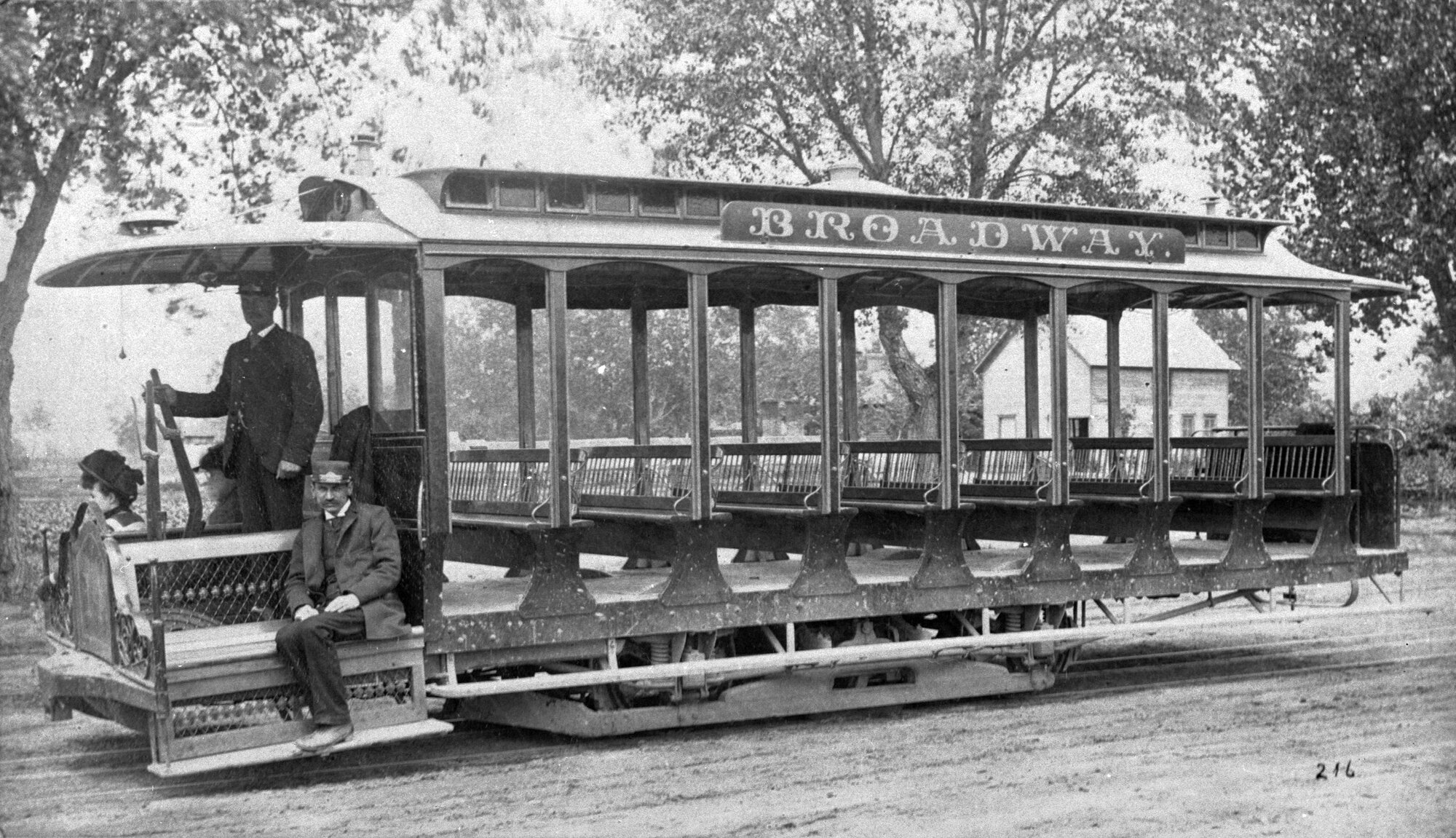
Denver Tramway car 31 at 15th and Lawrence. Note the outward-facing seats flanking the gripman's position. Photo by William Henry Jackson. Denver Public Library photo. Image File: ZZR700310481. All rights reserved. |
|
A Denver Tramway Broadway car 31 at 15th and Lawrence. Note the gripman's unusual enclosure. Denver Public Library photo. Image File: X-27907. All rights reserved. |
On 01-May-1893, the Broadway line was converted to electric traction. The Colfax and 15th Street lines were converted on 06-July-1893.

|
Denver Tramway car 40, preserved at the Forney Transportation Museum. Photo courtesy of the Forney Transportation Museum. All rights reserved. March, 2006 Picture of the Month. |
Remarkably, one of the Denver Tramway's cable cars survives. Pamela Bestall, director of the Forney Transportation Museum, explains that the car was built in 1886 by the Laclede Car Company of Saint Louis, as horse car 271. It was converted to cable car 40 in 1888 or later. It was later renumbered 901. When the Denver Tramway converted from cable to electric operation, most of the cable cars were burned. This car survived and was used as a tool shed by the Denver Regional Transportation District. When a Mister Horn, a former RTD employee, heard that the car (tool shed) was going to be destroyed, he arranged to purchase it and moved it to his ranch near Conifer. After the museum purchased it, Bill Wright of Fort Collins, Colorado coordinated its extensive restoration.
Go to top of page.
Denver City Cable Railway

|
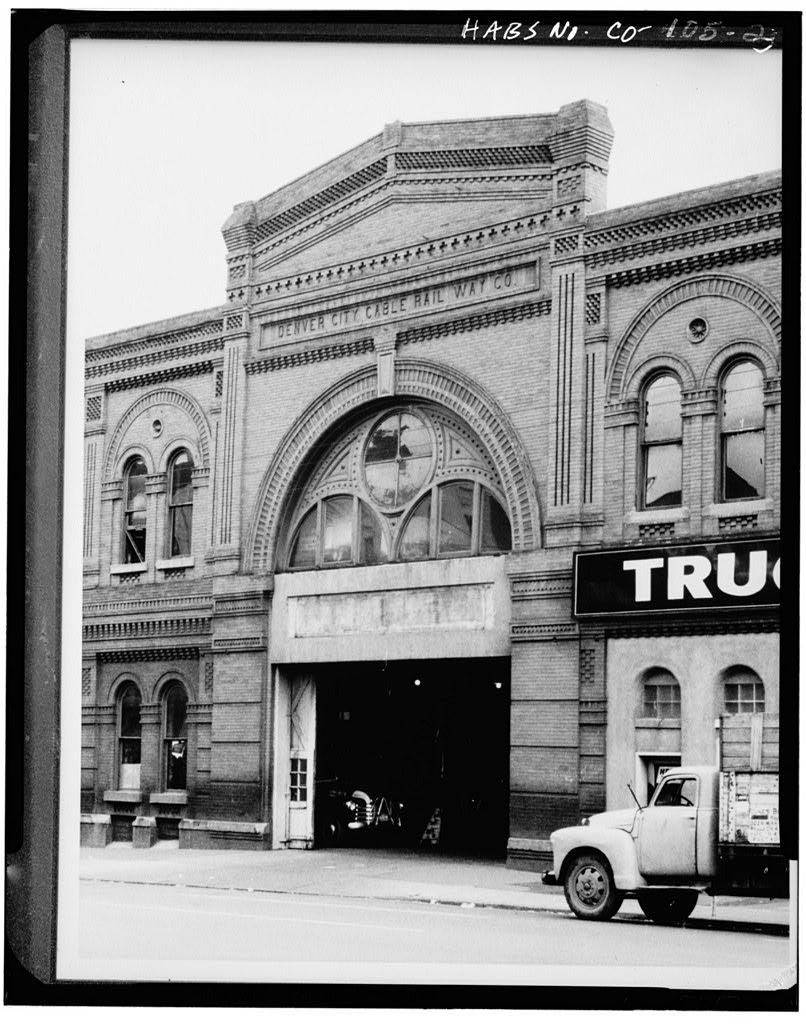
The Denver City Cable Railway Company name still appears above the doorway of the building. Google Maps Streetview Image updated May 2014. Copyright 2016 Google. July, 2016 Picture of the Month. |
line: Larimer Street
opened: 16-October-1889. Greenwood Street (now Tennyson Street) and Colfax Avenue on Colfax to Larimer Street. Larimer to Downing Street. Downing to Market Street (now Walnut Street?) to 40th Avenue.
powerhouse: 18th Street and Lawrence Street.
grip: Gillham double-jaw side grip.
gauge: 3'6"
cars: Dummy and trailer trains.
turntables: ?
crossings:
| Intersection | Company | Status |
|---|---|---|
| Larimer/15th | DT | inferior |
| Larimer/16th | DCCRy | inferior |
| Larimer/17th | DCCRy | inferior |
line: 17th Avenue
opened: 01-November-1889. Goss Street (now Tejon Street) and Humphrey Street (now 41st Avenue) on Goss to 16th Street. 16th to Court Place. Court Place to 17th Avenue. 17th Avenue to York Street.
powerhouse: 18th Street and Lawrence Street.
grip: Gillham double-jaw side grip.
gauge: 3'6"
cars: Dummy and trailer trains.
turntables: ?
crossings:
| Intersection | Company | Status |
|---|---|---|
| Larimer/15th | DT | inferior |
| Larimer/16th | DCCRy | inferior |
| Larimer/17th | DCCRy | inferior |
line: Welton Street
opened: 01-November-1889. Welton Street and 16th Street on Welton to 30th Street. 30th Street to 28th Avenue. 28th Avenue to Gaylord Street. Gaylord to 38th Avenue.
powerhouse: 18th Street and Lawrence Street.
grip: Gillham double-jaw side grip.
gauge: 3'6"
cars: Dummy and trailer trains.
turntables: ?
crossings:
| Intersection | Company | Status |
|---|---|---|
| Welton/17th | DCCRy | superior |
line: 17th Street
opened: 22-December-1891. 17th Street and Wyncoop Street at Union Station on 17th to Court Street.
powerhouse: 18th Street and Lawrence Street.
grip: Gillham double-jaw side grip.
gauge: 3'6"
cars: Dummy and trailer trains.
turntables: ?
crossings:
| Intersection | Company | Status |
|---|---|---|
| 17th/Larimer | DCCRy | superior |
| 17th/Welton | DCCRy | inferior |
line: West Denver (11th Street)
opened: 06-June-1892. Curtis Street and 17th Street on Curtis to 11th Street. 11th Street became Kalamath Street (now 11th Street). Kalamath to 4th Avenue.
powerhouse: 18th Street and Lawrence Street.
grip: Gillham double-jaw side grip.
gauge: 3'6"
cars: Dummy and trailer trains.
turntables: ?
crossings:
| Intersection | Company | Status |
|---|---|---|
| Curtis/16th | DCCRy | inferior |

|
from the New York Daily Tribune, 19-July-1889. No thumbnail. |

|
from the New York Sun, 19-January-1890. No thumbnail. |
notes: The Denver City Cable Railway secured the rights to used the patent trust's technologies. Robert Gillham designed an installation similar to his Kansas City Cable Railway. The powerhouse at 18th Street and Lawrence Street was set up to drive 13 cables in an extensive system.
The company went bankrupt in 1895 and became the Denver City Railroad in 1896. The new management wanted to convert the company's lines to use electric traction, but the city would not allow it. The city wanted the company to pave the streets where it operated. When the company would not, the city had the work done and sent the company the bill.
The company went bankrupt in 1898 and the Denver Tramway took over. The Tramway management wanted to convert the cable lines to electric, but the city held out for a high fee. The city and the Tramway reached a deal in 1900. The West Denver line was converted on 28-March-1900. The Welton line was converted on 29-March-1900. The 17th Avenue line was converted on 30-March-1900. The Larimer line was converted on 01-April-1900.

|
Denver City Cable Company "Closed Cable Trail (Trailer) Car." (source: Street Railways: Their Construction, Operation and Maintenance by CB Fairchild). |

|
The Denver City Cable Railway Company Building. Google Maps Streetview Image updated May 2014. Copyright 2016 Google. |
from Extensions and Improvements.Denver, Colo. -- The City Cable Co. have obtained a permit to grade Curtis, Eleventh and South Eleventh Streets. Work is to be commenced at once and will be pushed with all possible rapidity so that the road may be opened for traffic this summer. |
from various newspapersSanta Fe Daily New Mexican, 10-November-1893 RECEIVERS NAMED.
Denver, Colo., Nov. 10. Judge Hallett in the U. S. district court this morning appointed George E. Bandolph, of Denver, and Cornelius Sweetland, of Providence, R. I., receivers of the Denver City Cable Railway company, each to give bond in the sum of $50,000. They qualified immediately. The company is in bad financial straits and unable to meet the interest on its first mortgage bonds or to meet the interest or principal on the floating indebtedness of about $80,000, now coming due. The receipts have fallen off 10 per cent this year and the line is not now even paying operating expenses. San Francisco Call, 16-June-1895 A Decree of Foreclosure. DENVER, Colo., June 15.-- In the United States Circuit Court to-day Judge Kallett signed a decree of foreclosure and order of sale in the case of the Central Trust Company of New York against the Denver City Cable Railway Company and the Denver Cable Railway Company. The amount of the judgment is $5,052,142. This step is taken in carrying out the plan of reorganization. San Francisco Call, 11-September-1895 Streetcar Property Sold. DENVER, Colo., Sept. 10.-- The property of the Denver City Cable Company was foreclosed to-day, C. E. Taintor of New York City bidding it in for $500,000 in the interest of the stockholders. The company will be reorganized and operated under the new management. Interested street railway men deny a rumored consolidation of the street railway systems of Denver. San Francisco Call, 16-June-1895 A Decree of Foreclosure. DENVER, Colo., June 15.-- In the United States Circuit Court to-day Judge Kallett signed a decree of foreclosure and order of sale in the case of the Central Trust Company of New York against the Denver City Cable Railway Company and the Denver Cable Railway Company. The amount of the judgment is $5,052,142. This step is taken in carrying out the plan of reorganization. The Princeton Union, 29-December-1898 The Denver City Cable railway was sold at auction, under foreclosure of a mortgage for $4,000,000. H. E. Rogers, as agent for Frederick P. Olcott of New York, chairman of the reorganization committee, secured the property for $500,000, the minimum bid allowed. |
|
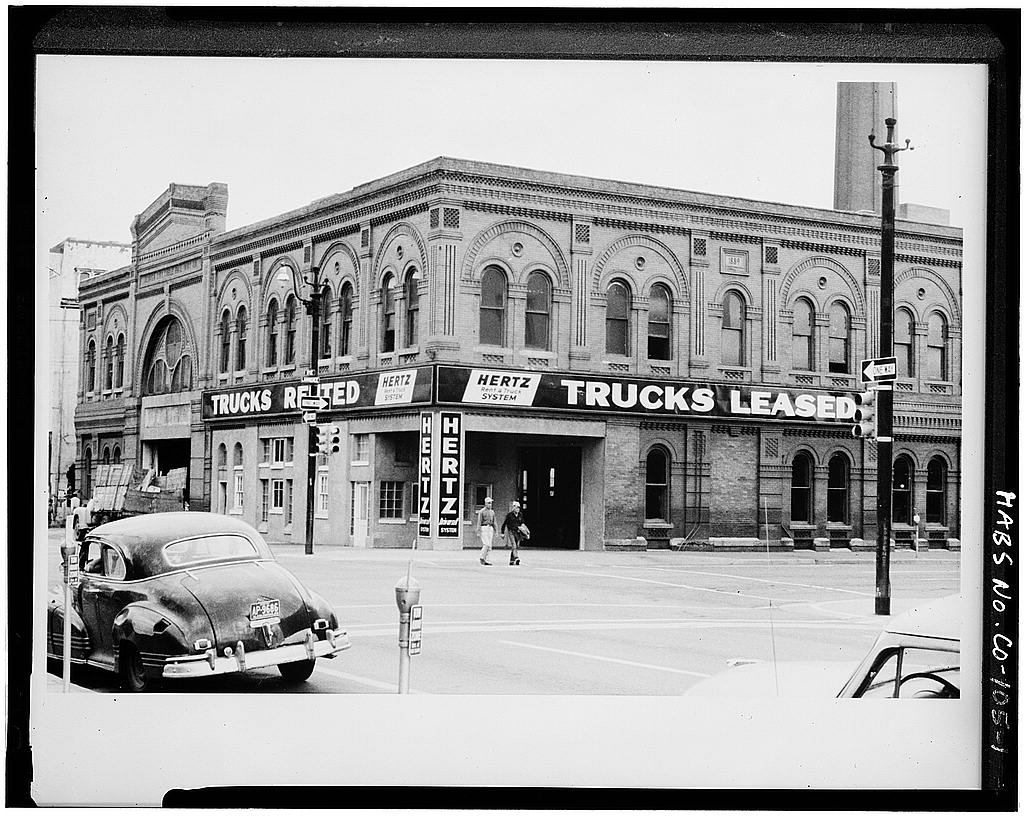
The Denver City Cable Railway Company Building, Lawrence & 18th Streets, when it was used by Hertz Rent-a-Car (1959) (Source: Historic American Buildings Survey, Creator, Hertz, and Denver City Rail Way Company, Barrett, William Edmund, photographer. Denver City Cable Railway Company, Lawrence & 18th Streets, Denver, Denver County, CO. Denver County Colorado Denver, 1933. Documentation Compiled After. Photograph. https://www.loc.gov/item/co0264/. July 2026 Picture of the Month. |
|
The main entrance to the Denver City Cable Railway Company Building. Herz did not cover the Denver City Cable Railway Company over the door (1959) (Source: Historic American Buildings Survey, Creator, Hertz, and Denver City Rail Way Company, Barrett, William Edmund, photographer. Denver City Cable Railway Company, Lawrence & 18th Streets, Denver, Denver County, CO. Denver County Colorado Denver, 1933. Documentation Compiled After. Photograph. https://www.loc.gov/item/co0264/.). |
|
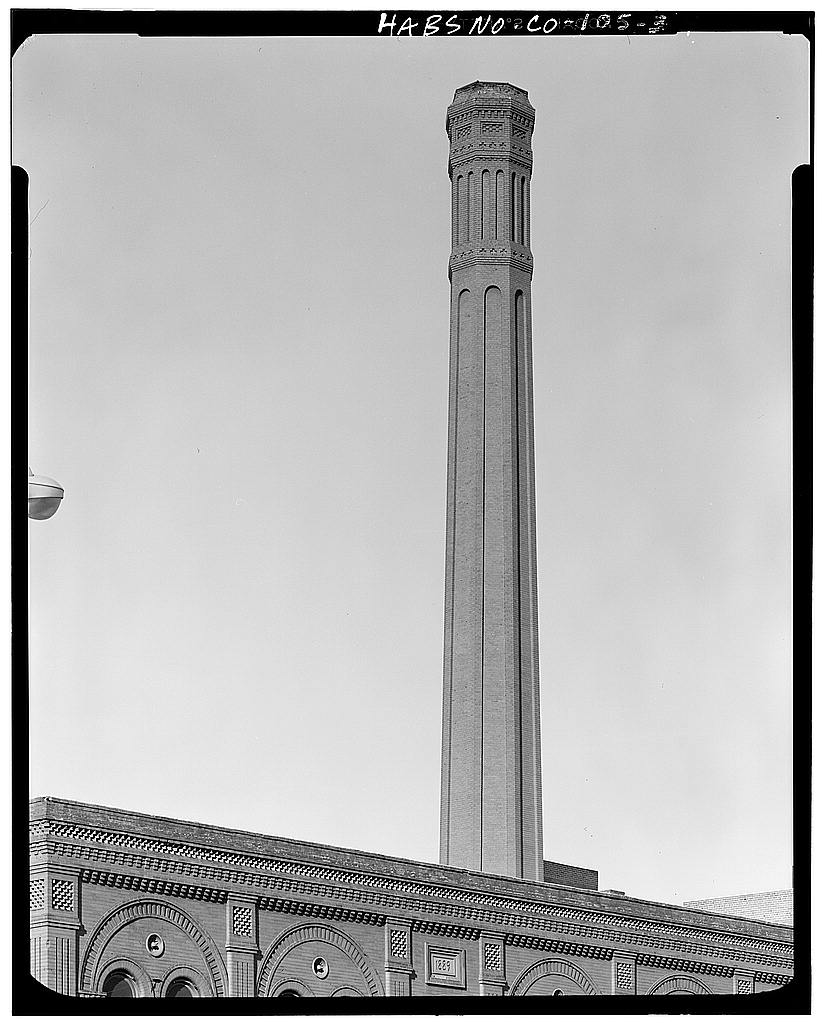
The Denver City Cable Railway Company Building's distinctive polygonal smoke stack. (1959) I can't find out what date the chimney was demolished (Source: Historic American Buildings Survey, Creator, Hertz, and Denver City Rail Way Company, Barrett, William Edmund, photographer. Denver City Cable Railway Company, Lawrence & 18th Streets, Denver, Denver County, CO. Denver Colorado Denver County, 1933. Documentation Compiled After. Photograph. https://www.loc.gov/item/co0264/.). |
Go to top of page.
The Cherrelyn Horse Car

|
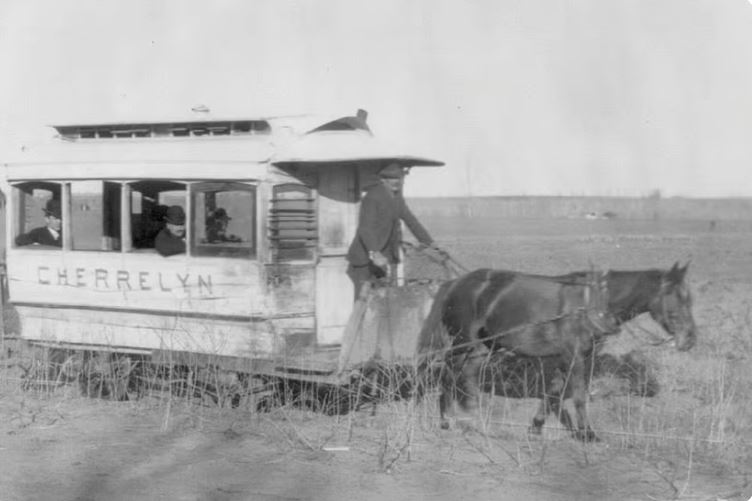
John Bogue, driver, stands on the front platform. The horse stands on the back platform. |
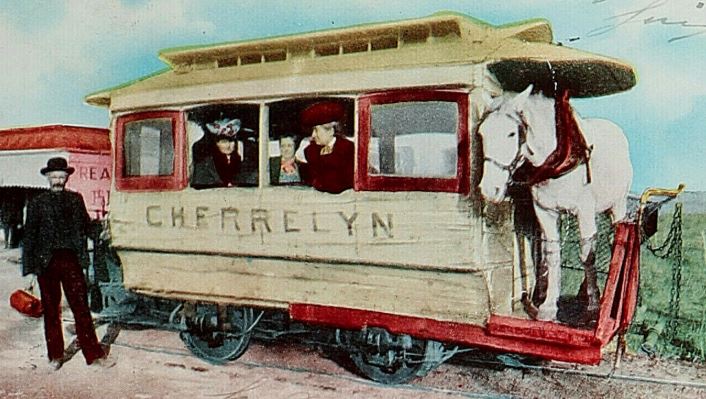
From 1883 to 1910, an unusual horse car line ran in Englewood, south of Denver, Colorado. A horse pulled a car from Hampden and Broadway up a steep hill on Broadway to Quincy. At the top of the hill, the horse backed onto the rear platform, and the car proceeded down the hill by gravity. This line became a major tourist attraction and was a popular subject for postcards. I understand the car is still on display in the Englewood Civic Center.
|
"Cherrelyn, a horsecar on country road outside Denver, Colo." by Frances Benjamin Johnston (Source: public domain image via Wikimedia Commons). |
|
Driver John Bogue poses proudly with the Cherrelyn horsecar on a colorful postcard. |
Similar lines ran in West Denver and Southern California.
It is a popular story that when the horses used on these lines were sold to farmers, that they would pull plows uphill, but not down.
Go to top of page.
Mount Manitou Incline Railway

|
The Mount Manitou Incline Railway. |
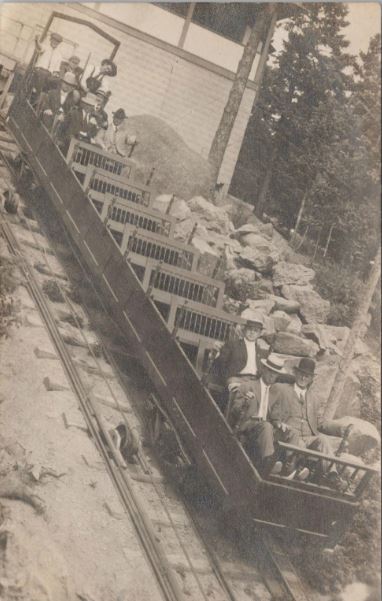
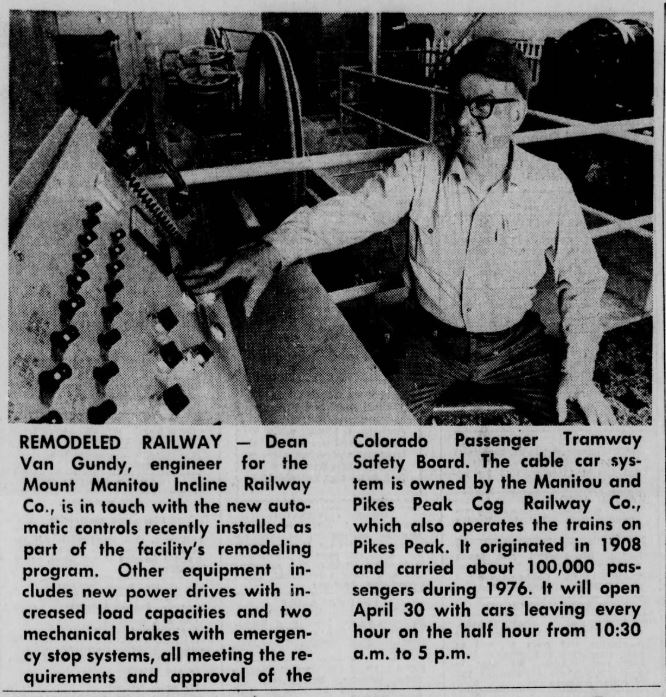
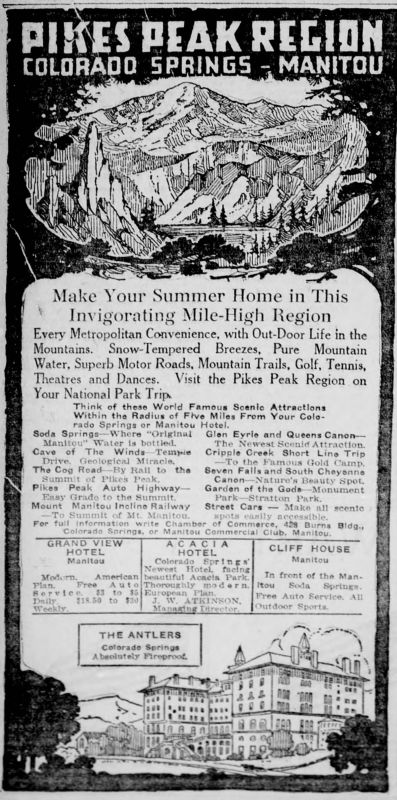
The Mount Manitou Incline Railway was built in 1907 to give access to water tanks, which provided water pressure to the town of Colorado Springs. It soon began carrying passengers who wanted to see the view from Mount Manitou. The incline was owned and operated by the Manitou and Pike's Peak Cog Railway. The incline was abandoned in 1990 because of a rock slide.
|
The upper station of the Mount Manitou Incline Railway. |
|
from the Colorado Springs Gazette-Telegraph, 23-April-1977. No thumbnail. |
The incline's right of way is now a hiking trail. Hikers must make a free reservation and sign a waiver.
|
from the Muskogee Times-Democrat, 14-June-1917. No thumbnail. |
Go to top of page.
Manitou and Pike's Peak Cog Railway

|
Manitou and Pike's Peak Cog Railway train at the summit. |
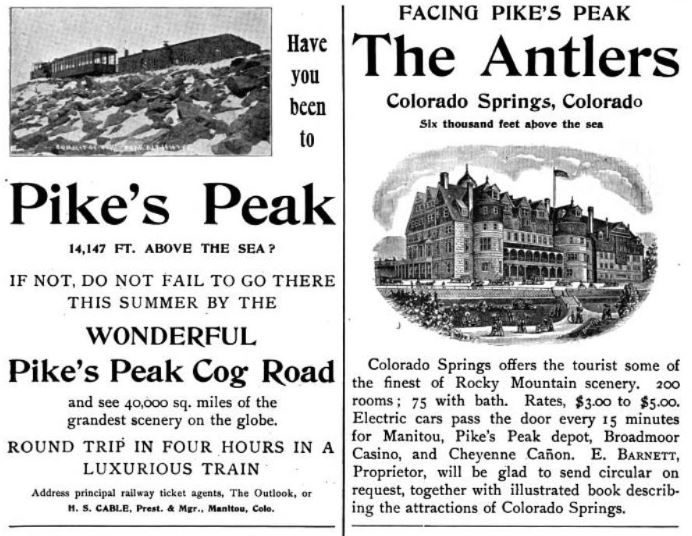
Zalmon G Simmons founded the Manitou and Pike's Peak Cog Railway in 1888. The Abt rack system reached the summit of Pike's Peak in 1891. Self propelled Diesel-electric cars replaced steam locomotives in 1965.
|
from The Outlook, A Family Paper, 15-June-1895. No thumbnail. |
The Manitou and Pike's Peak Cog Railway calls itself "World’s Highest Cog Railway." I'm not sure if that is true, but 14,115 feet is pretty darn high.
In March, 2018 the railway announced that it would not open for the 2018 season. There was concern that the current owners, the Broadmoor Hotel, were evaluating whether they should continue in the train business. In November, 2018 they announced that the line would reopen in 2021.

|
The Pike's Peak Cog Railway website. |
Go to top of page.
Royal Gorge Incline Railway

|
The Royal Gorge Incline Railway. |
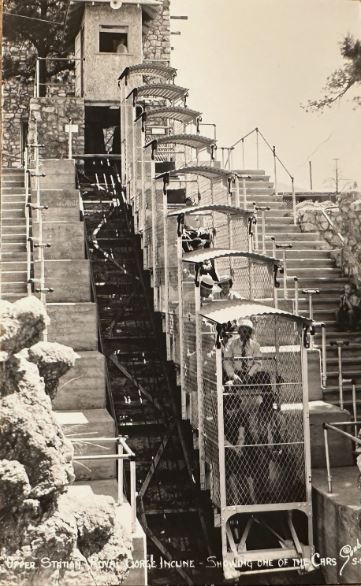
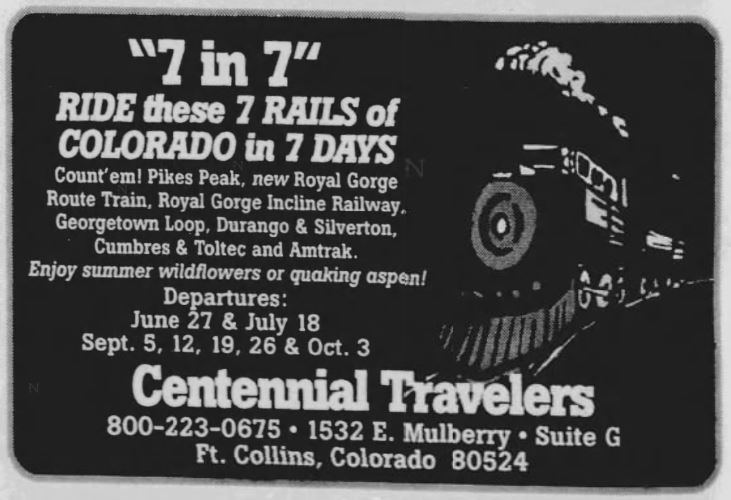
The Royal Gorge Incline Railway carried passengers from the edge of the Royal Gorge 1,550 feet down to the Arkansas River at the bottom. It opened on 14-June-1931. The Royal Gorge Fire on 12-June-2013, one of many wildfires over the years, damaged the incline beyong repair. I am sorry that I missed it.
|
One of the unique cars of the Royal Gorge Incline Railway at the top station. |
|
from LNP Lancaster Online, 25-April-1999. No thumbnail. |
Go to top of page.