|
Where Should I Go from Here?
Visit the Map
If you came to this page from an outside link, you may want to see the Picture of the Month and visit my main page. |
- Melbourne - Melbourne Tramways & Omnibus Company
- Sydney - New South Wales Government Tramways
- Dunedin - Cable Tramways in Dunedin
- Wellington - Kelburn Cable Car
- Katoomba Scenic Railway
- Penang Hills Railway (It's not in Australia, but it's in the same hemisphere)
- Victoria Street Cable Life (January, 1893. Volume IX, Number 1.)
Melbourne - Melbourne Tramways & Omnibus Company

|
The first Melbourne cable train is preserved at Scienceworks. Photograph used with kind permission of Andrew Cox at the Ballarat Vintage Tramway. Jul, 1998 Picture of the Month. |
I've started this section with a minimum amount of information about Melbourne's cable trams. I would happily accept any information from people who know more than I do. Thanks to Peter Vawser for supplying several useful items. There must be many people living in Melbourne who still remember the cable trams.
Melbourne had an extensive network of cable trams, which was remarkably long-lived. Its longetivity was remarkable because most lines did not have heavy grades.
line: Spencer Street-Richmond
opened: 11-Nov-1885. Spencer from Bourke to Flinders, Flinders to Wellington Parade, Bridge Road to Hawthorne Bridge
powerhouse: Bridge Road, NE at Hoddle Street. Demolished for a left turn lane.
grip: Single-jaw side grip.
gauge: 4'8 1/2"
cars: dummy & trailer trains. double-ended.
turntables: crossovers
crossings:
line: North Fitzroy
opened: 02-Oct-1886.
powerhouse: Victoria Parade, NE at Brunswick Street
line: Victoria Bridge
opened: 22-Nov-1886.
powerhouse: Victoria Parade, NE at Brunswick Street
line: Clifton Hill
opened: 10-Aug-1887.
powerhouse: Nicholson Street, SE at Gertrude Street

|
"What the Gripman Sees." Taken on a Nicholson Street cable dummy. A photo from the 31-March-1939 Melbourne Argus. |
line: Nicholson Street
opened: 30-Aug-1887.
powerhouse: Nicholson Street, SE at Gertrude Street
line: Brunswick
opened: 01-Oct-1887.
powerhouse: Brunswick Road, NW at Black Street
line: Johnston Street Bridge (Carlton)
opened: 21-Dec-1887.
powerhouse: Johnston Street, N side near Brunswick Street
line: Brighton Road
opened: 11-Oct-1888.
powerhouse: Saint Kilda Road, SE at Bromby Street
line: Prahran
opened: 26-Oct-1888.
powerhouse: Toorak Road, NW at Chapel Street
line: North Carlton
opened: 09-Feb-1889.
powerhouse: Rathdown Street, SW at Park Street
line: Toorak
opened: 15-Feb-1889.
powerhouse: Toorak Road, NW at Chapel Street
line: North Melbourne
opened: 03-Mar-1890.
powerhouse: Queensberry Street, SW at Abbotsford Street
line: West Melbourne
opened: 18-Apr-1890.
powerhouse: Queensberry Street, SW at Abbotsford Street. Converted into apartments.
line: South Melbourne
opened: 17-Jun-1890.
powerhouse: City Road, S side near Cecil Street
line: Port Melbourne
opened: 20-Jun-1890.
powerhouse: City Road, S side near Cecil Street
line: Windsor-Saint Kilda Esplanade
opened: 17-Oct-1891.
powerhouse: Wellington Street, N side near Marlton Crescent
Independent line
line: Northcote
opened: 18-Feb-1890.
powerhouse: High Street, NE at Martin Street. Now occupied by Brown's Motors, an automobile service and repair business.
notes:
The entire system was operated by one company, the Melbourne Tramways & Omnibus Company. The first line opened on 11-Nov-1885. The company was founded by Francis Boardman Clapp, an American emigrant who had purchased the Victorian rights to Andrew S Hallidie's cable patents.
The local councils of Melbourne formed the Melbourne Tramways Trust to build tracks and powerhouses for new lines, which were then leased to the Melbourne Tramways & Omnibus Company. The company also operated connecting horse tram lines. Later, other companies built electric lines.
Engineer George S Duncan, who had built the Roslyn Tramway in Dunedin, New Zealand, the first cable tramway outside of San Francisco, was also responsible for the Melbourne Tramways & Omnibus Company's lines. His brother Alfred Duncan, who had been the engineer for the North Sydney cable car line in Sydney, Australia, later came to work on the Melbourne lines.
The first order of grip cars and trailers was built by the John Stepenson Company of New York, NY.
The major cable lines survived until the 1920's, after the city formed the Melbourne & Metropolitan Tramways Board (1919) to consolidate public transit. The first major line to close was the Windsor-Saint Kilda Esplanade line on 25-Aug-1925. The Richmond line closed on 29-Jun-1927. Other lines closed until the Great Depression stalled conversions. The last Melbourne cable tram operated on 26-Oct-1940.
Here are some newspaper articles related to the closing of the cable tram operation:
Northcote was built as an independent line but was eventually taken over by the Melbourne & Metropolitan Tramways Board.
Portland Cable Trams Inc has restored a Melbourne cable tram, which it operates with Diesel power. The grip car is a reproduction, but the trailer, Number 95, is original. They started service in 2002. The track is 3.7 kilometers.

|
Mal Rowe took this unique photograph inside the recently uncovered Melbourne cable conduit. May, 2007. Photo by Mal Rowe. All rights reserved. |
In May, 2007, Mal Rowe reported in the TramsDownUnder Yahoo Group that road work in Abbotsford Street, North Melbourne had uncovered cable tram tracks of the West Melbourne line. Mal reported that "The track, the slot, and even a glimpse of the yoke and tunnel are all there to see. The paving blocks are red-gum blocks ... still in good condition 70 years after being buried and who knows how long after being laid!" Thanks to Bill Bolton for pointing out Mal's report. Thanks to Mal for the use of two of his photographs.
Mal followed up with a report that the section of track may be added to the Victorian Heritage Register. Some part of it may be conserved.

|
Mal Rowe took this photograph of cable tram tracks discovered under Abbotsford Street in North Melbourne. The white stripes, cleaned up by Mal to make them more visible, are marble markers that signalled the gripman to drop the rope. May, 2007. Photo by Mal Rowe. All rights reserved. |
The Melbourne Public Transport Corporation Photographic Archive has many wonderful pictures of cable trams.
Visit David Hoadley's Trams of Australia for information about all kinds of Australian trams.
Clive Mottram's Tramway and Trolleybus Images, has a nice collection of transit-related photos in Australia. Thanks to Clive for providing some useful information for this article.
There is an interesting site about an existing Australian funicular, the Katoomba Scenic Railway (which is not in Melbourne).
|

|
Gertrude Street Cable Winding House, photographed in 2001 by Bob Murphy. He believes the building is still used as Central Control. Thanks to Bob for the picture. |

|
A view of the North Melbourne Winding House, photographed in 2001 by Bob Murphy. He points out that it emphasizes that trams still run on the old cable routes. This is an A class tram. Thanks to Bob for the picture. |

|
Another view of the North Melbourne Winding House, Queensberry Street, SW at Abbotsford Street, photographed in 2001 by Bob Murphy. Thanks to Bob for the picture. |

|
Another view of the North Melbourne Winding House, also photographed in 2001 by Bob Murphy. Note the stump of the chimney in the rear. Thanks to Bob for the picture. |

|
The North Carlton Winding House, photographed in November, 2008 by Bob Murphy. Bob reports that it "is pretty intact though there is an apartment house in the centre of the old tramshed. The facade is intact. The engine house is untouched except for a bitumen floor which is used for parking by the apartment dwellers. The North Carlton engine house and tramsheds went into operation on 9 FEB 1889. Unusually there was only one cable out of that engine house at 13,617' long." Thanks to Bob for the picture. February, 2009 Picture of the Month. |

|
Another view of the North Carlton Winding House, photographed in November, 2008 by Bob Murphy. Thanks to Bob for the picture. |

|
Another angle of the North Carlton Winding House, photographed in November, 2008 by Bob Murphy. Thanks to Bob for the picture. |

|
The North Carlton Tram Shed, next to the Winding House, photographed in November, 2008 by Bob Murphy. Thanks to Bob for the picture. |

|
The South Yarra Winding House at Toorak Road and Chapel Street. Reports indicate that it will be torn down in 2016. Google Maps Streetview Image updated April 2015. Copyright 2016 Google. |

|
Collins Street with two cable trams. Photographed by William Henry Jackson in 1895. (Source: World's Transportation Commission Photograph Collection (Library of Congress) Call Number: LOT 11948, no. 660). |

|
The view from the gripman's position on a Melbourne cable dummy at the Bylands Tram Museum. Photographed in February, 2006 by Bob Murphy. Thanks to Bob for the picture. All rights reserved. |
In February, 2006, Bob Murphy visited the Melbourne Tram Museum in Bylands near Melbourne. The museum is operated by the Tramway Museum Society of Victoria.

|
A beautifully preserved Melbourne cable dummy and trailer at the Bylands Tram Museum. Photographed in February, 2006 by Bob Murphy. Thanks to Bob for the picture. All rights reserved. |

|
A rear 3/4 view of Melbourne cable dummy and trailer 299 at the Bylands Tram Museum. Note 299's Bombay roof. Photographed in February, 2006 by Bob Murphy. Thanks to Bob for the picture. All rights reserved. |

|
A closer rear view of Melbourne cable trailer 299 at the Bylands Tram Museum. I like the colors and lettering used on the rear dash. Photographed in February, 2006 by Bob Murphy. Thanks to Bob for the picture. All rights reserved. |

|
Car 253 is a replica of a Melbourne cross-bench horse tram, built on an original cable tram truck. The Zoological Gardens horse tram line operated until 1923. This tram, pulled by horses, was used to carry guests at Bylands before the electrical overhead was in place. Photographed in February, 2006 by Bob Murphy. Thanks to Bob for the picture. All rights reserved. |

|
A unique item preserved at the Bylands Tram Museum is this steel wheeled wagon used for hauling reels of cable from the ship to the cable tramway powerhouse. Photographed in February, 2006 by Bob Murphy. Thanks to Bob for the picture. All rights reserved. |

|
Another view of the steel wheeled wagon used for hauling reels of cable from the ship to the cable tramway powerhouse. Photographed in February, 2006 by Bob Murphy. Thanks to Bob for the picture. All rights reserved. |

|
A real estate ad instructs those interested in the Hoffman Tramway Estate, Brunswick to "Take Brunswick Electric Tram from William Street, City, DIRECT TO ESTATE, OR Brunswick Cable Tram, to Corner Sydney Road and Dawson Street (Brunswick Town Hall)." Melbourne Argus, 03-October-1925. No thumbnail. |

|
Thanks to Stuart James for sharing this photograph:
"...the man in the middle is Fredrick S. Smith, (my great-grandfather) taken in either the
Gertrude Street or St Kilda Road engine house of the Melbourne Tram and Omnibus Company. It
turned up recently when I was helping my father sort out some old family photos."
Stuart goes on to report that his great-grandfather "...was appointed to Psyche Bend in Mildura in 1897 as engineer at the pump station. However due to family pressure (no pun intended) he did not take up this remote position. I have a copy of the letter from Monash Anderson, Consulting Civil, Hydraulic and Mechanical Engineers and Surveyors, dated Feb 12th 1897 confirming, with regret his withdrawal. Before working for the Melbourne Tram and Omnibus Co. he was employed as engineer by the Insurance Company's Fire Brigade in Melbourne. He resigned from the tramways when it became clear that the steam and cable era was in decline (to avoid the indignity of being sacked) and worked for various other firms in Melbourne, including the Avery Scale Company ... While working at the St Kilda Road winding house and living in South Yarra he would often walk to and from work through Fawkner Park. The story goes that he had been threatened on a few occasions by thugs, so reflecting his sea going back ground, he made up a short truncheon from cable, leather plaited complete with wrist strap; I am no sure if he ever had to use it or not." Stuart's grandmother gave him the truncheon. All rights reserved. |

|
A Northcote cable tram rear-ended a bus during rush hour at Bourke and Spring Streets. (source: Melbourne Argus, 09-March-1928) |

|
Cable tram dummies that one sat in Richmond Park were burned after being damaged by vandals. (source: Melbourne Argus, 30-May-1928) |

|
The last cable tram on the South Melbourne line was wrecked by the crowd that turned out. (source: Melbourne Argus, 16-March-1937) |
Go to top of page.
Sydney - New South Wales Government Tramways
Sydney claims to be the only Australian city to have used horse, steam, cable, and electric traction.
line: North Sydney

|
North Sydney cable tram. Smaller version. Photo courtesy of Ric Francis. December, 2001 Picture of the Month. |
opened: 22-May-1886. Alfred Street from Milsons Point Wharf to Junction, to Blue, Miller to Ridge Street
extended: 17-Jul-1893. Miller to Falcon Street to Lane Cove Road (later Pacific Highway) at Crows Nest
powerhouse: Miller and Ridge.
grip: single-jaw side
gauge: 4'8 1/2"
cars: dummy & trailer trains. double-ended. Some trains carried two trailers.
turntables: crossovers. Turntable at Miller and Ridge removed when line was extended.
crossings: N/A

|
North Sydney ferry terminus at Milsons Point. Cable tram in foreground. Photo courtesy of Ric Francis. |
|
North Sydney cable train. Photo courtesy of Ric Francis. |
line: King Street (aka Ocean Street)

|
King Street cable trams. Photo courtesy of Ric Francis. |
opened: 19-Sep-1894. King Street from Darling Harbour, Saint James Road, College, Boomerang and William Streets, Bayswater Road (outbound) and New South Head Road to Ocean Street, Edgecliff. Upper William Street South (inbound).
powerhouse: Rushcutter's Bay, adjacent to Rushcutters Bay Park.
grip: single-jaw side
gauge: 4'8 1/2"
cars: dummy & trailer trains. double-ended. Grip cars and trailers carried air brakes starting in 1895. The compressor was driven off of the axle of the grip car.
turntables: crossovers
crossings: N/A
notes: Melbourne had a comprehensive system of cable tramways, but Sydney had two isolated lines in places where no other form of traction was practical.
The North Sydney line connected the township with the main ferry wharf for the North Shore, climbing a steep rise from the waterfront. The severity of the grade led to the choice of cable traction rather than steam or electricity.
"The North Shore cable tramway was formally opened yesterday by His Excellency Lord Carrington with considerable ceremony, the proceedings being witnessed by several thousand spectators. The new line is about a mile and a half in length, extending from Molson's Point to the St. Leonards public reserve. The event is one of considerable importance, not only because ot the improved facilities it gives for communication in the rapidly growing suburb of North Shore, but also because it marks the introduction of a new system of locomotion, this being the first cable tramway opened in the colony." -- North Sydney Line Opens (Melbourne Argus, Monday, May 24 1886)
George S Duncan's brother Alfred, also an engineer, worked on the North Sydney system.

|
| From the Sydney Morning Herald, 22-October-1886. |

|
| From the Sydney Morning Herald, 23-October-1886. |
The cable line operated successfully, but the Depot to Crows Nest extension was converted to electricity in 1898, and the rest of the line to Milsons Point on 10-Feb-1900. 13 North Sydney grip cars and 6 trailers were transferred to the King Street line. Five of the grip cars were converted to use the King Street grip and the rest were converted to be open trailers. Seven more trailers were transferred in 1903.

|
A fly-wheel for the Ocean Street cable tramway, at the Hudson Brothers' Works in Clyde. I like the dude in the bowler. from "Sydney's New Tramway. The Ocean-Street Cable Line.", Australian Town and Country Journal, 11-August-1894. December, 2011 Picture of the Month. |

|
The interior of the powerhouse of the Ocean Street cable tram line. From "Cable Trams in Sydney.", Australian Town and Country Journal, 06-July-1895. |
In 1890, when a new tram line was proposed along King Street to replace a horse omnibus, there was some controversy about what form of traction it should use. It was argued that electric lines were cheaper to build, but others argued that electric traction was still in an experimental stage, and that poles supporting the trolley wires would block the street. On the other hand, cable traction had proved its worth in Melbourne and North Sydney.
|
From The Street Railway Journal, November, 1893. Volume IX, Number 11. The new cable line in Ocean Street, Sydney, New South Wales, has just been completed. |
"The new cable tramway from Erskine-street, Darling Harbor, to Ocean-street, Woollahra, a distance of about two miles, was opened for traffic to-day. The line, which traverses King-street and opens up the eastern suburbs around the harbor, has been a very costly one, £160,000 having been expended upon it." -- Sydney/King Street Line Opens (Adelaide Advertiser, Thursday, September 20, 1894)
King Street grip cars and trailers were fitted with air brakes soon after the line opened in 1895. Reservoirs were recharged by compressors driven by the wheels.
In 1898, the speed of the King Street City (inner) cable increased from 8 to 9 miles per hour. Speed changes were not a common occurence in the industry, as it required modifications to the driving equipment.
An electric line to Rose Bay connected with the King Street cable line. The cable cars hauled the electric cars to Darling Harbour. King Street was electrified by March, 1903, but the last cable tram did not run until 14-Jan-1905 because of extensive tests to make sure that electric operation was safe on the gradients, and delays in the delivery of new electric equipment.

|
The Ultimo powerhouse supplied many of the electric lines that replaced Sydney's cable tram lines. From "The Sydney, Australia, Tramway System.", The Electrical World and Engineer, 06-December-1902. |
The Ballarat Vintage Tramway preserves car 12. Car 12 started life as North Sydney cable trailer 18. The Electric Supply Company of Victoria purchased 12 trailers in 1905 and had them rebuilt as electric single-truck California cars. Car 12 retired by 1935 and became part of a home. She was rescued in 1990 and is under restoration.
Thanks to Ric Francis and Bill Bolton for providing photos and information for this article.
Go to top of page.
Dunedin - Cable Tramways in Dunedin
I'm still collecting information about Dunedin cable trams, so I thought I would throw in a couple of pictures to tide me over. Dunedin is important because it had both the first and the last Hallidie-type cable trams outside of San Francisco.
Go to top of page.
Dunedin and Roslyn Tramway Company
line: Rattray Street
opened: 24-February-1881. Rattray Street from MacLaggan Street to Highgate
extended: ??-???-1900. Rattray Street from MacLaggan Street to Princess Street.
extended: ??-Aug-1906. Highgate to Frasers Road
powerhouse: At Highgate. Replaced by powerhouse in the Kaikorai Valley. Replaced by new powerhouse at Highgate
grip: Single-jaw side grip, wheel operated. Later lever operated.
gauge: 3'6"
cars: open dummies with one glassed-in end, double-ended. Also a coal car and a water car to supply powerhouse.
turntables: crossovers
crossings:

|
A Roslyn cable tram near the pull curve next to Saint Joseph's Cathedral. February, 2006 Picture of the Month. |
notes:
The Roslyn Tramway was the first Hallidie-type cable tramway built outside of San Francisco.

|
| Partners John Reid and George S Duncan promoted a cable tramway for several years before they could get it built. (Source: Otago Daily Times, 14-February-1879) |

|
| The prospectus offers 5,000 shares at £2 each. (Source: Dunedin Evening Star, 15-April-1880) |

|
| Reid and Duncan solicited tenders for various parts of the work on the tramway. (Source: Dunedin Evening Star, 04-October-1880) |

|
| Testing of a section of the line was underway by early February, 1881. (Source: Otago Witness, 05-February-1881) |

|
| "The greatest difficulty experienced as yet is getting the points to work properly..." The line was built with a single track with passing loops. If the points (switches to Americans) didn't work, the line didn't work. (Source: Otago Daily Times, 07-February-1881) |

|
| By mid-February, the company was advertising for employees. "Dummy Engineers" would be called gripmen. (Source: Otago Daily Times, 16-February-1881) |

|
| David Proudfoot built a horsedrawn tram line in Dunedin in 1879. (Source: Otago Daily Times, 16-February-1881) |

|
| By February 19, the tramway was completed "and works both up-hill and down in a very satisfactory manner." Otago Daily Times, 19-February-1881 |

|
| An advertisement announces that Dunedin New Zealand's Roslyn Tramway has started service (Source: Dunedin Evening Star, 24-February-1881). January, 2016 Picture of the Month. |

|

|
| Passengers were riding the cars and paying 3 Pence. (Source: Otago Daily Times, 25-February-1881) |

|
| The tramway was important to real estate development. (Source: Dunedin Evening Star, 05-March-1881) |

|
| By March, the line was carrying 1000 passengers each day. (Source: Clutha Leader, 18-March-1881) |

|
| The advantage of these Rooms is that they are "opposite Roslyn tram terminus." (Source: Otago Daily Times, 09-April-1881) |
Its engineer, George S Duncan, created two important devices: the pull curve and the slot brake. The pull curve allowed cars to climb the curve by Saint Joseph's Cathedral. The slot brake allowed cars to descend the steep hills more safely. (See How Do Cable Cars Work? for more information)
The line was built as a single track with passing loops. The down-bound cars dropped rope and coasted through the passing loops. The line was double-tracked in 1884. The cable ran at 7.95 miles per hour.
The line was replaced by buses on 26-October-1951.

|
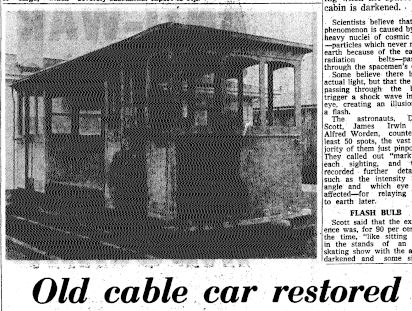
Roslyn cable tram 95. Photo by Peter Ehrlich. All rights reserved. September, 2005 Picture of the Month. |
In May, 2005 Peter Ehrlich, recently retired Muni motorman, visited Australia and New Zealand. At the Ferrymead Heritage Museum, he found Roslyn cable tram number 95, from Dunedin.

|
Another view of Roslyn cable tram 95. Photo by Peter Ehrlich. All rights reserved. |
|
| In 1971, former Roslyn Tramway car 91 was restored and sent to the Ferrymeade Museum. (Source: The Christchurch Press, 30-July-1971) |
Go to top of page.
Mornington Tramway
line: High Street
opened: 23-March-1883. High Street to Mornington
powerhouse: Eglinton Road.
grip: Single-jaw side grip, lever operated.
gauge: 3'6"
cars: open dummies with one glassed-in end, double-ended. Also a coal car and a water car to supply powerhouse.
turntables: crossovers
crossings:

|
| The Mornington Tramway's opening date is proposed. (Source: Hawke's Bay Herald, 08-February-1883) |

|

|
| The Mornington Tramway's cars were tested on the Roslyn tramway. (Source: Hawke's Bay Herald, 08-February-1883) |

|
| The Mornington Tramway's cable is installed. (Source: Dunedin Evening Star, 07-March-1883) |

|
| The Mornington Tramway was successfully tested. (Source: Dunedin Evening Star, 07-March-1883) |

|
| The Mornington Tramway started service. (Source: Otago Daily Times, 21-March-1883) |

|
| An ad says that the Mornington Tramway has started service "TO-DAY". The same ad appeared on two other pages. (Source: Otago Daily Times, 21-March-1883) |

|
A 10-February-1903 fire destroyed the winding house and all the rolling stock of the line but one car. (Source: Otago Witness, 18-February-1903) |

|
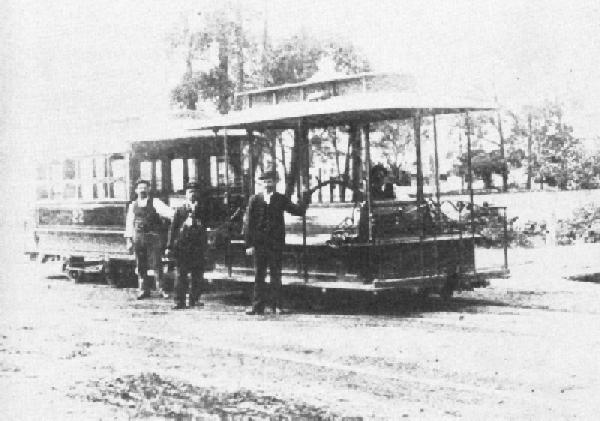
The only car that survived the fire of 10-February-1903. (Source: Otago Witness, 18-February-1903) February, 2016 Picture of the Month. |
notes:
The Mornington Tramway was the last Hallidie-type cable tramway to operate outside of San Francisco, closing on 02-March-1957.
The Friends of Ferrymead Tramway are restoring a Mornington tramway grip tram and trailer. One day they may operate on the restored Mornington line.
Update 01-December-2016: The Dunedin Heritage Light Rail Trust has proposed a project with four steps to revive cable traction in Dunedin, New Zealand, the first and last city outside of San Francisco to have Hallidie-type cable car lines.
Step one would be to build a temporary museum in Mornington Park. The museum would house three Dunedin cable trams, one from the Mornington Tramway and two from the Roslyn Tramway. One of the Roslyn trams will be restored onsite. There will be a track that extends outside so people can view one of the trams and climb on it.
The remaining steps would build a 1.5km line on the High Street with a terminal and powerhouse in the park. Original cable trams would be used as rolling stock.
Update 01-July-2018: Thank you to Mac Gardner for providing this information.

|
Thanks to Mac Gardner, here is a future view of the temporary museum being built near the former terminal of Dunedin's Mornington Line. It will display two cable trams and a trailer. All rights reserved. July, 2018 Picture of the Month. |
The Dunedin Heritage Light Rail Trust and the High Street Cable Car Society are advancing a project with four steps to revive cable traction in Dunedin, New Zealand, the first and last city outside of San Francisco to have Hallidie-type cable car lines.
Step one is to build an Interim Cable Car Building in Mornington Park. This temporary museum would house two Dunedin cable trams and a trailer, the trailer from the Mornington Tramway and Two trams from the Roslyn Tramway. One of the Roslyn trams will be restored onsite. There will be tracks that extend outside so people can view one of the trams and climb on it. The work started in October, 2017.
An article from the 31-October-2016 Otago Daily Times.
I wish great success to the Dunedin Heritage Light Rail Trust and the High Street Cable Car Society.

|
Thanks to Mac Gardner for letting me know about the website of the Dunedin Heritage Light Rail Trust and the High Street Cable Car Society, who are advancing a project with four steps to revive cable traction in Dunedin, New Zealand. Their website rolled out in August, 2018. |

|
Mornington Tramway restored trailer 111 being loaded on to a truck trailer for the trip to Dunedin (source: "Dunedin on the Up With Return of Historic Cable Cars," stuff.co.nz, 07-Jun-2018). |
Update 01-September-2020: Thank you to Mac Gardner for providing this information.

|
The Dunedin Heritage Light Rail Trust is advancing in its quest to restore part of the Mornington Tramway.
The Trust has published a beautiful 2021 calendar with photos of the original Dunedin cable trams in operation and photos of the historic cars restored in 2020. If you would like to buy a copy of the calendar, it is available on their website.
Update 01-June-2021.
Bus Driver Nick has posted a nice video about a visit to the Interim Cable Car Building in Mornington Park. Thank you to Bus Driver Nick for letting me share his video.

|
A 2022 map showing how to use public transit to reach the Interim Cable Car Building in Mornington Park. |
|
Otago Daily Times, 11-March-1885. As the system of cable traction as applied to city railroading is at the present time attracting considerable interest throughout the large cities of the world, a brief sketch of the progress of this invention may prove of interest to our readers. The system of cable traction for cities was invented by Mr Hallidie, of San Francisco, where the first lino was built in 1873, and since that time four other lines have been constructed and are running regularly, with great financial success; while at present two other lines are being built and several others projected in San Francisco. In Chicago the transforming of about five miles doubletrack horse-tramway into cable was completed some time since, and the success attending the running of this trial portion has induced the converting of all the horse-tracks into cable lines. Throughout the United States, the cities of Philadelphia, Cincinnati, Providence, and New York are now arranging to lay down a system of cable lines. In London a cable tram is mow running on Highgate Hill, and the extension to Hampstead Hill will follow. The system is thought so favourably of in London that a large and influential company have purchased the patent rights for the United kingdom from Mr Hallidie, at a cost of £70,000, and intend arranging for the laying down nf cable trains throughout Great Britain. In New Zealand we have the Roslyn and Mornington lines being the first built out of San Francisco, while several lines are projected in this Colony and Australia. From careful comparisons, taken from actual work in San Francisco, it is shown that the difference In working expenses is vastly in favour of cable traction. On a cable and horse tramway three mlles in length, double track (cable running six miles per hour, against an average of four milea and a half per hour on tbe horse-line), and allowing interest on cost of construction and equipment at 6 per cent. per annum, there is a saving in favour of cable traction of 57 per cent. The Hornington tramway ia a cable railway, constructed under Hallidie's system, is of 3ft 6in gauge, and built with a double track. The city terminus is at tho intersection of High and Princes streets, from which point it runs up High street, crossing tho Town Belt, aud terminates at Maryhill terrace, Hornington. The length of the main line is one mile, with a total vertical rise of 130 ft. The gradients traversed range from the level up to l in 6 1/4. The portion through the city is built in a straight line, and on entering the Town Belt tho line is deflected by a curve, having a radius of 264ft, and runs thence in a line parallel with Eglinton road to the terminus, where the car and engine-bouses are located on the property of tho Company. The extension line is half a mile in length, and overcomes grades of 1 in 3 3/4. The cable by which the cars are propelled is manufactured from thw best cruciblo steel. It is 3in in circumference, built of six strands, consisting in tho aggregate of 114 wires. It was costructed undor the supervision of Mr Hallidie's representative in London, and is laid up in a perfect manner. The cable in carried on the straight portions of the line by means of cast-iron sheaves about 11in in diameter, placed 30ft apart, and at the city terminus turns round a terminal sheave 10ft In diameter. This terminal is mounted on a self-adjusting malleable-iron bogle, to which a tension gear of about two tons is attached, and by this means a steady strain is always kept on the cable. At the Mornington terminus the rope is deflected at right angles by two 8ft sheaves into the enginehouso, and, after passing over the driving-clip pulleys, undorgoes a further process of tension before again passing into the street. At the crown of all streets where there are heavy down grades, large sheaves are provided, and the rope is kept down on rising gradients by means of depression-pulleys running about lin below tho street level. The tube, or rope-tunnel, is built throughout in a very substantial manner, the contractors being Messers Edgar and Co. The portion from Clarke street downwards consists entirely of concrate and iron, and the roadway between the rails and stone curbs is laid in cement. From Clarke street upwards tho tube is built of concrete, iron, and timber, the timber portion being easily removed and replaced at a small cost in after years when it is found necessary. At the city terminus the tracks converge, and are connected by a siding; and here much difficulty was experienced in construction, and considerable ingenuity is displayed in the arrangement of the various mechanical contrivances. At the Mornington terminus the lines are connected by a turntable. The engine and car-houses aro located at tho Mornington terminus of the main line. The building measures 120ft by 60ft, and is built in two storeys, the upper portion being used exclusively for the cars, while the lower storey gives a roomy engine and boiler-house. The engines which supply the inothe power are of the high-pressure horizontal type --three in number-- cylinders 13in in diameter and 27in stroke. They are fitted with Hartnell's patent automatic expansion gear, and are capable of working up to a maximum of 79 h.p. each. The steam is supplied by two boilers 10ft by 4ft 3in, of tho multitubular cylindrical pattern; and tho connection between engines and boilers, together with the system pf heating the water, is very complete. At present only two engines are used; the other is held in reserve in case of repairs being required. The engines and boilers were constructed by Messrs Marshall and Sons, of Kngland. The driving gear is very complete and substantial, and was turned out by Messrs Kincaid, M'Queen, and Co., of this city. Provision was made for attaching the necessary driving gear for the extension, so that no stoppage of traffic was necessary while this work was being effected. A notable feature in the system of driving is the "take-up," by mpans of which the slack of the rope is taken up from time to time, thus avoiding the cutting and re-splicing of the rope when the tension-sheave has exhausted its travel at the city terminus. The dummy-cars were manufactured by Messrs Cossons and Black, and the excellent workmanship throughout reflects much credit on that firm. The grips and brakes are worked entirely by levers, and are so simple in application that any risk of accident is reduced to almost an impossibility. An important detail in the construction is the water supply for tha engines. This is effected by means of a plunger pump, located near Alva street. The pump is driven by the wire rope, and the power is taken off the up and down rope and transmitted to the pump by a simple mechanical arrangement. The water is pumped up a vertical height of 120 ft, and for a length of about 2000 ft. It is delivered in the engine-house at the rate of 36O gallons per minute. This work was carried out by Messrs A. and T. Burt; and it will effect a material savlng in the working expenses. The city and extension termini and engine-houee are connected by telephone. It is worthy of note that, excepting the supply of rails, wire rope, and ordinary cars, the whole of the work has been carried out locally. |
|
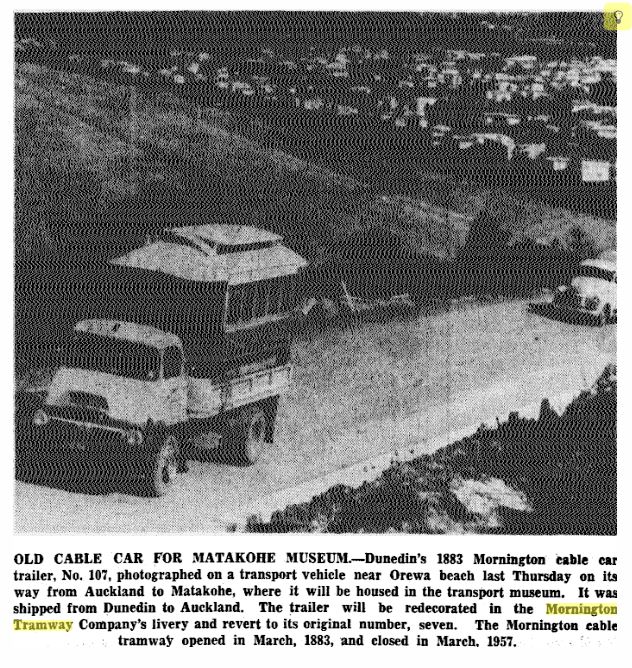
| In 1958, former Mornington Tramway trailer 167 was restored and sent to the Transit Museum in Matahoke. (Source: The Christchurch Press, 01-October-1958) February 2026 Picture of the Month |

|
The Mornington Extension. |
Go to top of page.
Maryhill Extension

|
An 1895 view of Maryhill Tramway car 9 with unusual roof and windows. Photograph by William Henry Jackson. Thanks to Len Foley for pointing out that this was the Maryhill and not the Roslyn line. (Source: World's Transportation Commission Photograph Collection - Library of Congress. CALL NUMBER - LOT 11948, no. 688 ). March, 2016 Picture of the Month. |
line: Glenpark Avenue
opened: 05-March-1885. Glenpark Avenue from powerhouse
powerhouse: Eglinton Road.
grip: Single-jaw side grip, lever operated.
gauge: 3'6"
cars: two open dummies burned in the powerhouse fire in 1903. Replaced by a single car.
turntables: crossovers
crossings:
notes:
The line's roller coaster profile led people to call it "The Big Dipper."
The line closed on 29-October-1955.

|
Another 1895 view of Maryhill Tramway car 9 with the members of the World Transportation Commission. (Source: World's Transportation Commission Photograph Collection - Library of Congress. CALL NUMBER - LOT 11948, no. 686) |

|
| "...the car descends the steepest grade in the world." (Source: Timaru Herald, 06-March-1885) |

|
| "The Mornington extension tramway-line was formally opened yesterday afternoon ... The visitors made a very satisfactory trip along the newly laid line..." (Source: Otago Daily Times, 11-March-1885) |
|
Otago Daily Times, 11-March-1885. Yesterday afternoon was fixed for the formal opening of the newly-completed Mornington extension tramway-line, and a number of gentlemen by invitation of the directors proceeded to Mornington at 2 o'clock. The directors of the Company present were: Messrs H. Bastings, J. Hazlett, N. Y. A. Wales, G. Penwick, J. E. Denniston, and W. Watson; also Messrs J. Bathgate, L. O. Beal, J. C. Brown, M.H.R., J. Mitchell, T. Brown, J. Mills, Mackenzie (Colonial Bank), and Grant (railway traffic manager). The visitors were conveyed in detachments along the extension line, and on their return to the engine-shed the following toasts were proposed:-- Mr H. BASTINGS, chairman of directors, asked those present to drink prosperity and success to the Mornington Tramway Company. Up to that time there had been no formal opening of the line, the directors, as men of business, being actuated by the feeling that it would be supeifluous to expend any of the shareholders' money in an elaborate ceremony. But he did think that, having now completed that extension, it was only right to place on record before the public that in this part of the world we had established a cable tramway system which, he might say without egotism, was the greatest undertaking of its kind in the world.--(Hear.) He might say that the grade --one in three and a-half--was steeper than had been attempted anywhere else. The speaker had travelled through Victoria and New South Wales, and saw that, so far as tramways were concerned, both these great countries were at least 25 years behind New Zealand. This showed the energy that existed in this city, and he was sure the result would be that the line would prove a paying one. It was thought by many people mere folly to construct a line up High street --that there was not enough traffic. But they had found during the last two years that if all the cabs and conveyances in the city bad been put upon High street it would have been impossible for them to carry up to Mornington the number that the Company had carried. They had carried an average per week of 8000 people, and he was happy to say that the traffic had increased, and the returns for the last three months exceeded considerably those for the corresponding three months of the previous year. The Company would no doubt, there fore, be able to pay in the future, as in the past, a dividend of 10 per cent, to its shareholders. On March 21,1883, the original line was opened, and since then they had never had even one hour's stoppage, nor the slightest accident. There was a theory that it was necessary to have two ropes for working such a line, but the Company had found themselves always able between midnight and the hour for commencement next morning to insert a new rope, so that no stoppage of the traffic need be ever anticipated. As far as fares were concerned, the directors, with due regard to the interests of the shareholders, had brought down the price to tho minimum--viz., return ticket from the Grand Hotel to Maryhill sixpence; and he thought everyone would admit that the directors had acted with public spirit in endeavouring to allow the public to travel as cheaply aB possible. Although they were anxious to get a dividend for the shareholders, they know this could only be done by catering properly for the public, and bringing the cost of travelling down to a minimum. It would not be right if he concluded without remarking that the success of this undertaking was due in a great measure to the very spirited firm of Reid and Duncans.--(Hear.) One member of that firm, Mr George Duncan, who, as they knew, was the engineer of that line, had made the cable tramway system his special study, and had travelled over nearly the whole world to see what improvements had been made in the system. His hearers must, with him, be proud to know that Mr George Duncan, who had grown up amongst them, was now carrying out in Melbourne one of the largest systems of trams in the world. The length of that system would be 64 miles, and it would cost upwards of a million of money. For himself, as chairman of the Company, he felt proud at the completion and succees of the present work, which did infinite credit to the community, and he hoped that it would prove only the introduction to many more like it through the length and breadth of New Zealand.--(Applause;) Mr N. Y. A. WALES, who was entrusted with the toast of "The Mayor and Corporation of Dunedin," said he was pleased to agree with Mr Bastings' reference to tho engineering arrangements of that line, and wished to congratulate the firm which had carried it out. He was not going to let it go forth, though, that this was the only tramway Mr George Duncan had constructed. His maiden effort was the Roslyn line, and while the speaker did not envy the Mornington Company their success, he thought Mr George Duncan had gained his laurels first in the construction of the Roslyn line, and he heartily congratulated him. In proposing the toast entrusted to him, he might say that it was possible to travel in all parts of the world and find few cities to compare with Dunedin as regarded the work done in improving the streets and beautifying the surroundings. This was due in a great measure to the men whom we had elected to the Council during the last few years; Cr ESTHER returned thanks, briefly apologising for the absence of the Mayor. Cr SPEDDING also replied, saying that he hoped in a few years to see similar tram-lines carried through the whole city. The city itself would reap a great advantage from this, and the Council should give every help to the various companies, because the result would be a general increase in the value of property in the municipality, and this would tend to the advantage of the borough as well as of property-owners by increasing the rates. Mr J. B. DENNISTON said he had been asked to propose "The Health of the Mayor and Councillors of the Borough of Mornington he supposed, on account of his being a director of the Company, an inhabitant of the borough, and an ex-member of the municipal body. In all such undertakings as this the Company and the Corporation were dependent upon each other, nnd he thought in the present case the Company and the Corporation had been mutually satisfied. The Corporation had been frank and liberal on the one hand, and on the other he thought they would admit that the Company had fully "implemented"--to use a Scotch phrase-- the agreement with them. There had been some small delay in completing the work, but considering all things it had been carried out quickly and efficiently, and the Corporation had not been too ready to insist upon details, The speaker did not wish to be egotistical, but he would venture to claim some credit for having seen what he might term the strategical importance of the spot on which they then stood as the point to which the line should be brought, and then carried right through along the only straight piece of road in Mornington. This was a red-letter day for the borougb, and one to which, as a burgess, he had looked forward. Tho line now completed linked the remotest corners of the borough with the centre of the city, and it made them scarcely a borough, but a part of the city so far as communication was concerned. He was sure they would all look back to it as inaugurating a new era for Morningtou, which he claimed was the best, most salubrious and charming borough in the place, --(Mr Wales: "Next to Roslyn.") The speaker made no exception at all. In proposing the toast he expressed a hope that the Company would maintain the same friendly relations with the Corporation that they had done so far. Cr NICOLSON, in the absence of the Mayor, returned thanks, and said he was sure the opening of the line would add importance to the borough, and greatly enhance the value of property. Mr George FENWICK said that as a member of the board of management of the Mornington Tramway Company, he had been asked to propose a toast which he felt sure would meet with very cordial acceptance--the health of the engineers, Messrs Reid and Duncans, and the Company's retiring manager, Mr J. W. Duncan. It gave him extreme pleasure to speak in commendatory terms of the great assiduity, carefulness, end faithfulness that had characterised Mr Duncan in the discharge of his duties during the whole period of his connection with the Company. The success achieved was due to him in a great measure, by reason of his care for every detail at the first starting of the Company. Then to his brother, Mr George Duncan, who as engineer of the line had displayed such special aptitude for this class of work, was due, as Mr Bastings had justly said, a large share of credit for the efforts which had mado that line at once the best-constructed and the best-managed cable tramway in the world, They all knew that America was the home of this cable-tramway system. Mr George Duncan had made a special visit to America, had seen how the system was best applicable to Dunedin, and had at once brought his practical knowledge to bear, and by the assistance of his partner the line bad been initiated and brought to a successful termination. Mr Bastings, in referring to Mr George Duncan, had said that he was now engineer to an undertaking for the construction of one of the largest cable-tramway systems in the world. This could not but be gratifying to all of them, but to the speaker it was particularly gratifying that one of our younger citizens, with whom he had been associated at school here, should now be engineer for so important an undertaking. Then there followed the fact that Mr Jas. Duncan was associated with Mr Bastings in another very important enterprise, they having entered into an arrangement to construct a cable-tramway in Sydney. The Melbourne system was to cost a million of money, but, if the speaker was not mistakon, before the New South Wales people had done, theirs would cost perhaps a million and a half or two millions. They did things on a large scale over there, and although it was only a mile and a half of line that Messrs Bastings and Duncan were about to contract at present, the system would, he had no doubt, in the end be extended to the suburbs. The large population of the place was certainly capable of supporting such an enterprise. There was only one thing further to mention. The extension tramway upon which they had just made such a successful trip was left in charge of Mr Alfred Duncan, who, although young, bad displayed almost as great capacity as his brothers. Mr George Duncan had prepared the plans, and he left them in the hands of a very capable assistant indeed when his younger brother took them over. Mr REID, in responding to the toast on behalf of the firm, said that whilst he naturally co-operated with his partners, the whole credit of the cable tramways rested with Messrs Duncan. Since the construction of the Mornington tramway the Roslyn line had been lookad on by some as a very paltry affair, but he wished, in justice to his partners, to say that he considered the Roslyn line really the engineering feat. Before its construction three things were held essential by the patentees of the system--first, a double line, one up and one down; second, that the line must be straight; and third, that whatever the subsequent grade, there must be a little level starting-place. As they knew, Mr George Duncan had constructed the Roslyn line without any of these conditions, and it might be mentioned that since its completion Messrs Hallidie had asked permission to patent certain of his details. Mr BASTINGS then proposed health and prosperity to the Roslyn Tramway Company, coupling the name of Mr A. C. Begg with the toast. Mr BEGG, in responding, said he quite admitted that the Mornington line was more elaborate than theirs, but it must not be forgotten that tho Roslyn Company were the pioneers of the cable-tramway system, not only in New Zealand but in the Australasian Colonies. The Roslyn line was the first constructed out of America, and the Mornington Company had, of course, benefited by their experience. The Roslyn Company did not grudge this, but still they had been left to bear tho brunt and the expense of experiments which the Mornington Company had benefited. Mr BASTINGS proposed the health of the Company's employes, coupled with the name of Mr Forsyth, who was succeeding Mr James Duncan, the late manager and Mr FORSYTH briefly replied. Mr HAZLETT proposed the health of Mr Bastings, their late chairman, who was about to leave for Sydney, and who, if he displayed the same energy there that he had done in Dunedin, would do well for the works in contemplation, and also for himself. Mr BASTINGS, in returning, thanks, said he should return to Dunedin as soon as he possibly could. The proceedings then terminated, and the party returned to town. |

|
| March 2026 Picture of the Month |
|
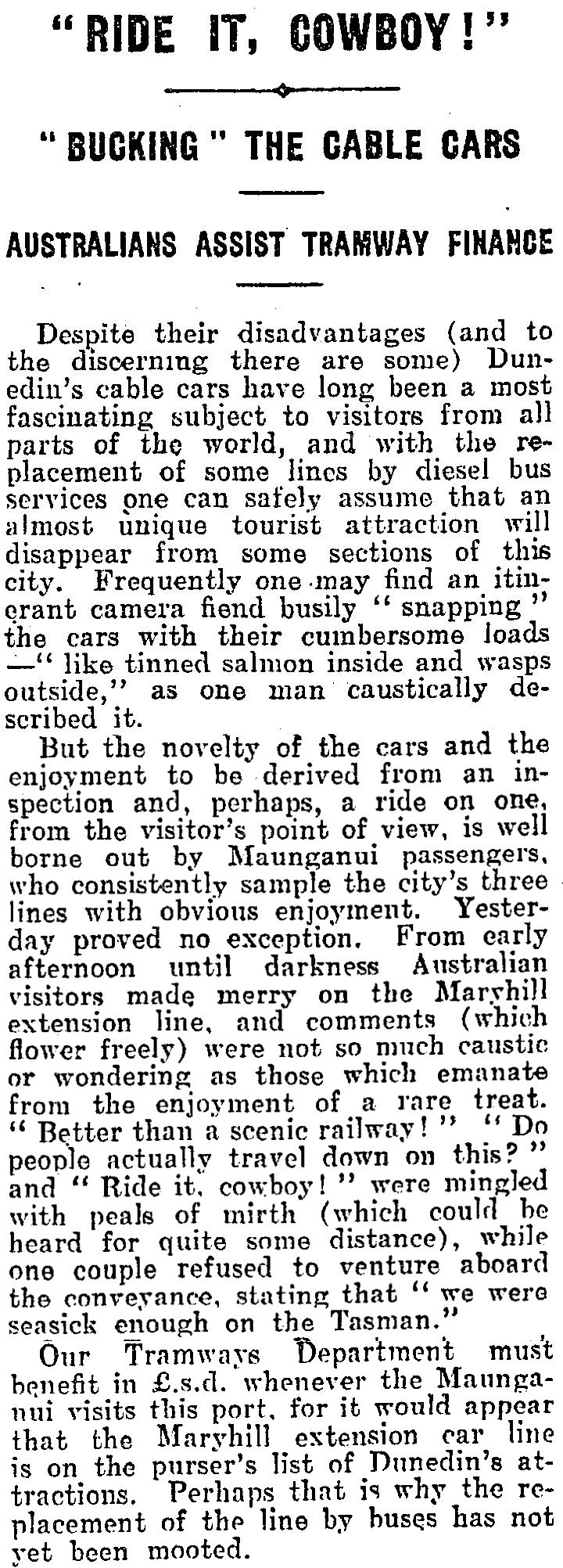
| This 1939 article describes how the cable trams were popular with tourists from Australia. "...Australian tourists made merry on the Maryhill extension line." (Source: Dunedin Evening Star, 15-March-1939) |
Go to top of page.
Kaikorai Tramway

|
A Kaikorai cable tram crests a hill. Note the pram hooked to the front dash. (Source: The Kaikorai Cable Tram. Amateur film by William Hood Davidson, 1947. Hocken Collections.) May, 2016 Picture of the Month. |
line: Stuart Street
opened: 06-October-1900. Stuart Street at the Octagon to
powerhouse: Eglinton Road.
grip: Single-jaw side grip, lever operated.
gauge: 3'6"
cars: Combination cars at one time. Later dummy and trailer trains.
turntables: Nairn Street to switch trams into shed. Crossovers at terminals.
crossings:
notes:
The Kaikorai Tramway's Stuart Street line paralleled the Roslyn Tramway's Rattray Street line.
The line closed on 31-July-1947. Newspaper stories say that the operating certificate of the powerhouse boiler expired at midnight and the cable was worn out. The line was replaced by Diesel buses until trolley buses could take over.

|
| Construction of the Kaikorai Tramway was underway in October, 1899. (Source: Otago Witness, 19-October-1899) |

|
| An ad calls for an experienced platelayer, a person who lays and maintains tracks. (Source: Dunedin Evening Star, 23-October-1899) |

|
| By late January, the Kaikorai tramway was nearly complete. The note about the borough taking over the tramways is interesting. (Source: Bruce Herald, 23-January-1900) |

|
| The Kaikorai tramway was nearly complete to the outer terminal. The equipment was on order. (Source: Otago Witness, 25-January-1900) |

|
| The Kaikorai tramway was estimated to be a month away. (Source: Otago Daily Times, 14-August-1900) |

|
The Trinity Weslyan Church on Stuart Street. |

|
| The trustees of the Trinity Weslyan Church on Stuart Street were opposed to the company's plan to operate trams on the Sabbath. (Source: Dunedin Evening Star, 03-September-1900) |

|
| Cable laying was underway in mid-September. (Source: Dunedin Evening Star, 17-September-1900) |

|
| More about cable laying. The original cars for the line are described as combination cars rather than dummy and trailer trains. (Source: Otago Daily Times, 18-September-1900) |

|
| Cable laying was complete and the cable was spliced. (Source: Dunedin Evening Star, 22-September-1900) |

|
| The tramway machinery was being tested. (Source: Otago Daily Times, 25-September-1900) |

|
| A tramway car was being tested. (Source: Otago Daily Times, 28-September-1900) |

|
| An ad says the tramway is complete and will be open after government inspection. (Source: Otago Daily Times, 11-October-1900) |
|
Otago Daily Times, 24-October-1900. The formal opening of the Dunedin and Kaikorai tramway line took place on the 9th. inst. About 40 gentlemen attended at the power house, at the invitation of Mr E. Roberts, the engineer, and among them were Messrs H. V. Haddock, A. Sligo, C. Tilburn, J. Wright, and E. A. Smith (directors of tho Dunedin and Kaikorai Tram Company), the Mayor of Dunedin (Mr R. Chisholm), Crs Sim, Wodderspoon, and Kemnitz (representing the Roslyn Borough Council), Messrs J. Roberts, R. Hudson, D. R. Bunson, J. Ryley, A. H. Burton, R. B. Denniston, C. Watt, Mirams (city surveyor), Morrison, Weatherall, Pool, James, Ferry, Loudon, and LiddelL Most of the company were conveyed to the power house from the Octagon by the Tram Company's cars, and, after the visitors had inspected the machinery, a number of toasts, including "The Queen," "Local Bodies", (proposed by Mr A. H. Burton, and responded to by the Mayor of Dunedin, Mr R. Chisholm, and Cr Kemnitz, of the Roslyn Borough Council), "The Engineer" (proposed by Mr A. Sligo), "The Contractors" (proposed by Mr E. Roberts, and responded to by Messrs Ferry, Poole, W. Burt, James, and Mark Sinclair), '"The Chairman and Directors" (proposed by Mr John Ryley and acknowledged by Mr Haddock), and "The Visitors" (proposed by Mr J. Wright and replied to by Mr J. Roberts). Mr E. Roberts, in giving a short history of the undertaking, said it was as far back as December, 1894, that the first meeting was held between Mr John Wright, Mr Park, and himself as to the prospects of starting a line to Roslyn. After that a public meeting was held, at which the idea was enthusiastically supported. In 1895 the first meeting of shareholders was held. After the incorporation of the company a very long delay ensued. The public looked askance at the matter. The directors, however, managed to keep the ball rolling, and in 1897 they managed to finally get through with the concessions. He (the speaker) subsequently went to Sydney and Melbourne to acquaint himself with the latest tramway matters, and in the meantime they went on getting land under the Public Works Act and so forth. On the day after Labour Day last year, Mr Ferry started his contract, so it would bo seen that he had not done badly.—(Applause.) The company were now only awaiting another gripper, and then they would get a permanent start—a matter of only a day or so.—(Applause.) The line commences at the Octagon, and runs straight up Stuart street on a grade var}'ing from linls to level; then, crossing over York place into Albert street, it continues on a grade averaging! in 10 to London street. A slight curve here occurs, and the'line continues on an upward grade through land acquired from tho High School Board of Governors thence across the High School flat on a slight grade to the Queen's Drive. It then mounts the hill through laud acquired from, the Otago Presbyterian Ghureh Board, to High street. Roslyn, the grades varying, and then there is a slight descentat Littlebourns, and at High street the line crosses the Roslyn Company's electric line. After negotiating a short piece of level in School street it turns to the left, and joins the North Taieri road, which it follows, in descending grades averaging 1 in 10, to the terminus at Church street, Kaikorai Valley. The total length is .90 chains, and the track is double throughout. The total ascent from Burns Monument to the summit at High street is 485 ft. The power house, near the Kaikorai Valley terminus, is 118 ft long and 35ft 6in wide, and is built of timber and iron. The rolling stock is of the combined car and dummy type, the cars being very roomy and comfortable. |
|
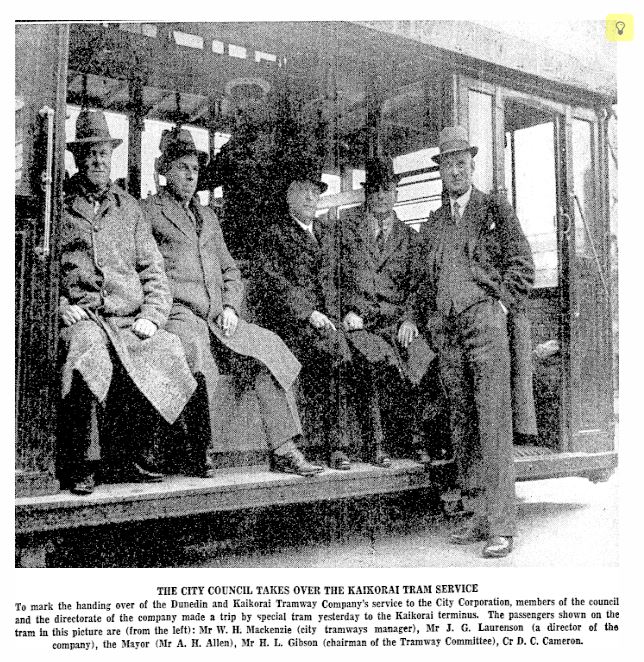
"The City Council Takes Over the Kaikorai Tram Service." In 1939 the Dunedin City Corporation took over the Dunedin and Kaikorai Tramway Company's assets and operations. Members of the City Council take a ride on a grip car with representatives of the Tramway Company. (Source: Otago Daily Times, 24-May-1939) |
|
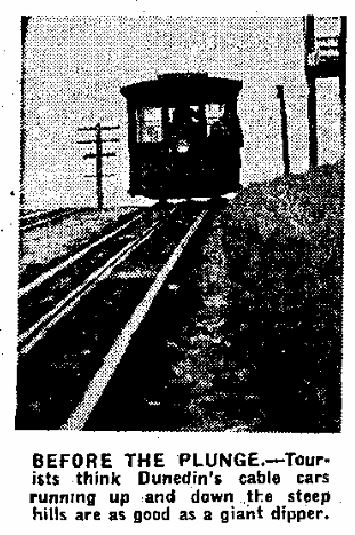
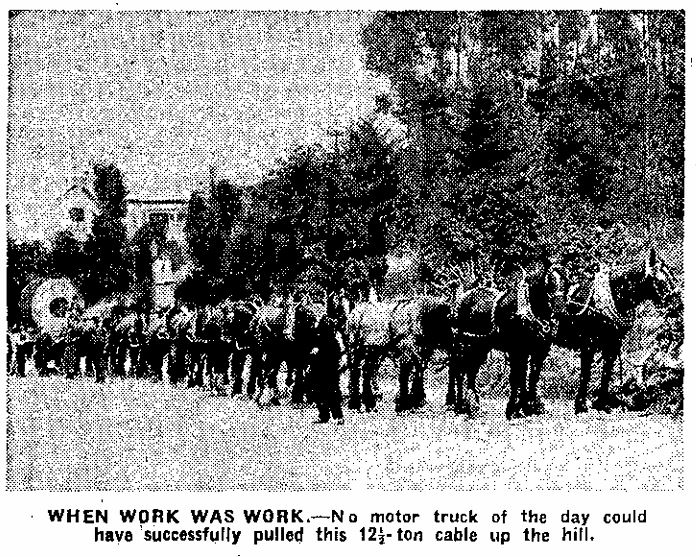
Dunedin Evening Star , 28-June-1947. End of the Road for Kaikorai Cable CarsDunedin's "Antiques" Have Given Many Years of Service"Cr." is an abbreviation for "Commander." -- JT The Kaikorai cable car service from the Octagon will soon be abandoned. The revocation order from the Government has been applied for by the city transport department, and new Diesel buses to replace the picturesque vehicles which have rumbled up Stuart street since the beginning of the century are already being run in on the flat. The story of the Kaikorai cable cars is largely a history of the Dunedin and Kaikorai Tram Co. Ltd. That concern was the last of the private transport services to be bought by the municipality, being taken over in 1939. Dunedin's cable cars have long been a feature of the city, and after the first of the three lines is dismantled many will remember the service with affection. The Kaikorai service is old; most of the original plant is in use, and the trams are the same vehicles, with minor alterations, that were put on the line when it was first opened. The line is not now a paying proposition, and progress dictates that it must go. But once upon a time, before the arrival of the internal combustion engine, it was regarded as the most modern form of transport. PROJECT IS BORNSupporters of a proposal to run a new tram line from the Octagon to Kaikorai held a meeting in the Roslyn Council Chambers on December 13, 1894. The ‘Star’ next day reported that the meeting was "well attended and characterised by much enthusiasm." Mr J. A. Millar, M.H.R., presided. Speakers complained that Roslyn had been kept back for want of easy and rapid communication with Dunedin. It was a rising suburb, and one in which they rarely saw empty houses, it was said. The following resolution was carried with acclamation:-- The meeting, having heard the explanation of the promoters, and recognising the benefit which would accrue to the district by the initiation of a system of cable trams from the centre, of the city to the Kaikorai and Halfway Bush, respectfully requests the Roslyn Borough Council to give every assistance towards completion of so desirable an undertaking." Mr Edward Roberts was chairman of the interim committee, but when the company was formed soon afterwards, Mr H. V. Haddock became chairman of directors. It was not until March 19, 1896, that the first general meeting of shareholders was held in the Roslyn Council Chambers. EARLY ENCOURAGEMENTIn the meantime, between 7,000 and 8,000 shares, had been allotted. A deputation had waited on the City Council and put forward their requirements, and the reply had been that the council was prepared to obtain the authorising order provided the line was at once or ultimately made double, and that a crossing from the top or Albert, street on to the Town Beit was arranged. The annual report at the meeting said that the City and Roslyn Councils had met the directors in a fair and liberal spirit. Practically all the concession needed from the Roslyn Council had been granted, and the line of the tramway had finally been settled. "The Order in Council empowering the construction of the new tram line from Kaikorai Valley via Stuart street has been signed by the officer administering the Government and the deeds of concession between the City Corporation and the Dunedin and Kaikorai Tram Company were exchanged this morning," said the ‘Star’ on May 22, 1897. "These documents were applied for in January, 1896, and notwithstanding the constant pressure from the company, have not been available till to-day." HOPES DASHEDThis gave a hint of the difficulties the company had been facing since its last meeting, and at the second annual general meeting on June 4, 1897, Mr. Haddock, attacked the City Council in forthright terms. He declared that the directors were unable to explain the very scandalous delay and veiled obstruction that had been brought against their most strenuous efforts during the preceding 12 months. The hope of arranging easily with the City Council and the Roslyn Borough Councils had proved bitterly disappointing. The City Council had insisted on the line being made double at once, and had asked for a deposit of £SOO to cover estimated expenses. A rental of £75 a year for the use of streets within the city boundary was considered exorbitant, and to cap their troubles there had been a delay in receiving the authorised order. The difficulties with the Roslyn Borough Council -- mostly small matters -- were settled after some delay. FREE TO BEGINThe company was then free to begin the construction of the tramway. It had, in fact, to start the construction of the line "to a substantial extent within three months, and complete it within 12 months," a task which in these days would be considered herculean. On June 29, 1897, a formal beginning was made on the building of the line, the work being directed by Mr Roberts. The land needed was acquired without difficulty, with the exception of a small strip owned by the High School Board of Governors, who refuged flatly to grant the land. The company applied to take it under the special authority of the Governor in Council, and the matter was finally settled.
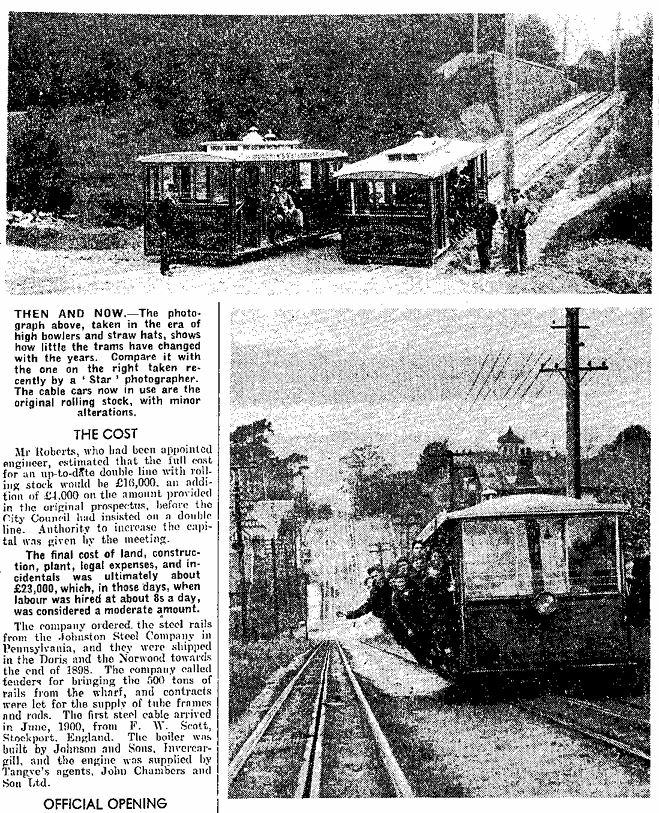
THEN AND NOW. -- The photograph above, taken in the era of high bowlers and straw hats, shows how little the trams have changed with the years. Compare it with the one on the right taken recently by a 'Star’ photographer. The cable cars now in use are the original rolling stock, with minor alterations. THE COSTMr Roberts, who had been appointed engineer, estimated that the full cost for an up-to-date double line with rolling stock would be £16,000, an addition of £4,000 on the amount provided in the original prospectus, before the City Council had insisted on a double line. Authority to increase the capital was given by the meeting. The final cost of land, construction, plant, legal expenses, and incidentals was ultimately about £23,000, which, in those days, when labour was hired at about 8s a day, was considered a moderate amount. The company ordered, the steel rails from the Johnston Steel Company in Pennsylvania, and they were shipped in the Doris and the Norwood towards the end of 1898. The company called tenders for bringing the 500 tons of rails from the wharf, and contracts were let for the supply of tube frames and rods. The first steel cable arrived in June, 1900, from F. W. Scott, Stockport, England. The boiler was built by Johnson and Sons, Invercargill, and the engine was supplied by Tangye’s agents, John Chambers and Son Ltd. OFFICIAL OPENINGThe official opening was on October 6, 1900, when the Mayor of Dunedin (Mr R. Chisholm) and the directors, Messrs H. V. Haddock, A. Sligo, C. Tilhurn, J. Wright, and E. A. Smith gathered at the powerhouse for the occasion with the engineers and others interested. The ‘Star,’ giving nearly two columns to a description of the function, added that the trams were built by Mark Sinclair, "who has made a very creditable job." The line was opened for passenger traffic on October 22, 1900, and 23 weeks later the trams had carried 250,000 passengers. The number of passengers carried annually in the succeeding years was over 750,000. The early running of the lino was not altogether free from trouble. Various small mechanical faults caused a series of stoppages. Then the finances of the company were not in the initial stages satisfactory, because the share capital had not been fully subscribed. The directors had, according to Mr Haddock, become responsible for a large sum in order to finish the lino and get it in running order. Six months after the opening 7,000 shares were still unsold. The revenue, which was increasing, was then £4,300 yearly, and the expenses about £2,500, leaving £1,700 to £1,BOO to pay interest and sinking fund. PERSONAL TRIBUTESAt the first annual meeting after the opening of the line held on April 26, 1901, Mr Haddock said that two men connected with the company deserved the highest praise. Mr Roberts, as engineer, had devoted great care and attention to the work of building the tramway, and had given them a thoroughly up-to-date line. The other was Mr A Ferry, first manager of the company, who had carried on his contract for laying the track in a manner deserving the highest credit. The meeting showed its agreement by electing both these gentlemen to tho board, which also consisted of Messrs A. Sligo, C. Tilburn, C. Greenslade,, F. A. Smith, and A. Thomson, besides the chairman, Mr Haddock. Only a few days after the opening of the line the first electric tramway in New Zealand was also opened, that from Roslyn to Maori Hill. The cable company had a dispute with this new enterprise in the early stages, it being alleged that the electric tram company was overcharging passengers who changed trams at Highgate. The matter was eventually settled. IMPORTANT DEVELOPMENTSTransport matters were intensely interesting to everybody in those days, and it was alter a long-standing and virulent dispute that the City Council took over the horse trams to convert the service to an electric one. This occurred on March 21, 1901, the price paid being £45,000. A sensational fire destroyed the Moniington cable car sheds in February, 1903, but they were rebuilt aud the service passed to the council in 1919. The Roslyn line was acquired in February, 1921. In August, 1903, the Kaikorai company' paid its first dividend of 6 per cent., and once the initial debt had been wiped off its affairs continued to prosper. The courtesy and consideration of the employees in those early days are still remembered by the older generation in Dunedin. Most of the men were happy in their jobs, and the public were given service with a smile. Swinging monkey-fashion along the side of a crowded car was not easy for a conductor with clippers in one hand. It was an all-weather job too, but most of them stayed to graduate as gripmen. The gripman is an expert in a specialised job, and he knows it. Many oldtimers on Dunedin’s cable cars have spent all their lives in the same service, and know they have done well. The company had only two chairmen of directors. Mr Haddock presided until 1923, and was succeeded next year by Mr Alex. Sligo, a son of the member of the original board. Mr Ferry was manager for only a short time, and was succeeded in 1901 by Mr J. Hunter, who held the position until 1922. The manager from 1922 to 1939 was Mr J. A. Paterson. CITY TAKES OVERWhen the City Council took over the line in 1939 a long and at times acrimonious argument developed. The company was loth to go into liquidation, and the various exponents of private and municipal enterprise waged a verbal war which will be remembered by most residents of Dunedin at the time. It is not the purpose of this article to re-open issues so recent and contentious; it is sufficient to say that the service was formaly taken over on May 23, 1939, when the company’s second 21-year lease expired, the price being £8,500. Steady depreciation in the plant necessitating costly replacements caused the line to show a loss, and in 1944 Cr McCrae told the council that a loss of £1,814 on the cable car system resulted almost wholly from the Kaikorai line.
|
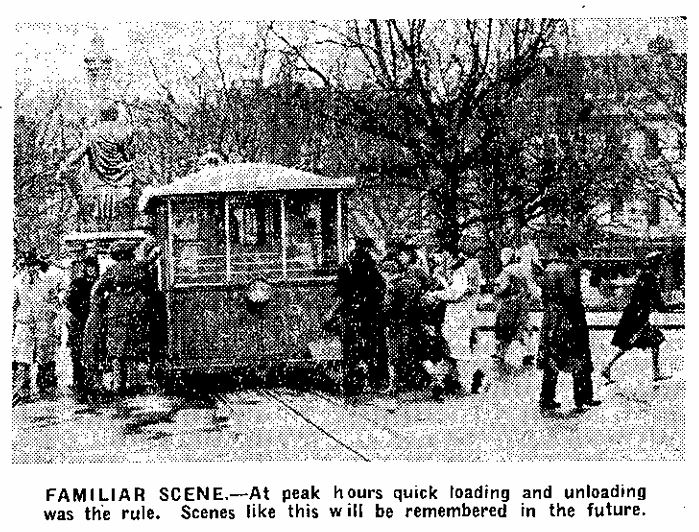
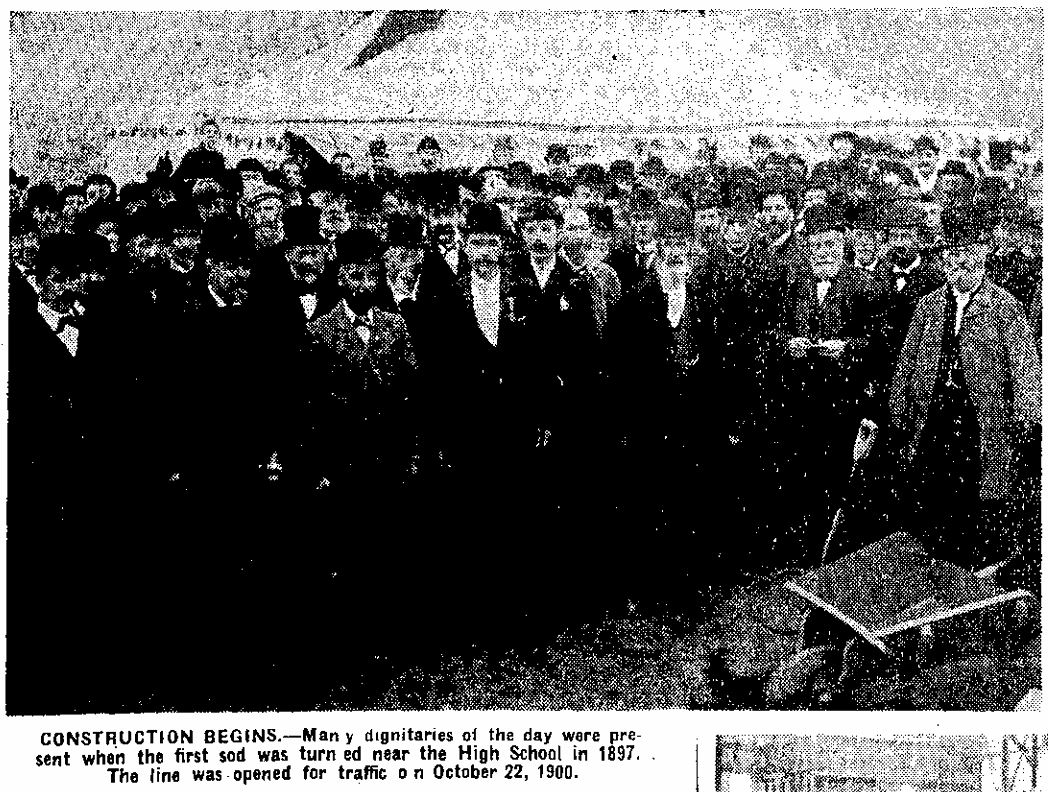
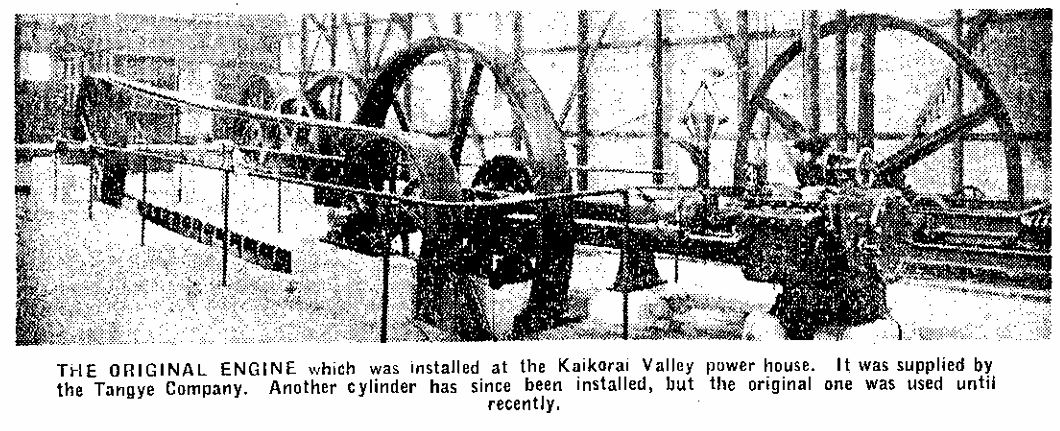
|
Dunedin Evening Star , 01-August-1947. "THE OLD ORDER CHANGETH"Last Tram To Kaikorai, Buses Now"Cr." is an abbreviation for "Commander." -- JT
Sentence of extinction, which was passed on the Kaikorai cable service recently, was carried out unexpectedly last night, when the last of these uncomfortable, if picturesque, vehicles gripped the rope at the Octagon at 1.10 for the 10 minutes’ trip to the sheds. Diesel buses took up the service this morning, and will continue in operation until the trolly bus system is installed. No revocation order has been received from the Government, although repeated requests have been made by the City Council or the authority to stop the service. The expiration at midnight of the license for the system’s steam boilers, and the possibility of a very large expenditure to put the plant in order beore the certificate could be renewed, were the main factors which prompted the decision to change over from to-day. The stopping of the service means that the, City Council’s plans for the Albert street extension scheme can be put into effect immediately. KEPT A SECRET.The decision to stop the cable car service with the last trip last night was a well-guarded secret. The chairman of the Transport Committee, Cr. J. McCrae, waited impatiently throughout yesterday for advice from the Minister of Transport, Mr O’Brien, authorising the City Council to convert the service to diesel buses.. The request for a revocation of the license was made several-weeks ago and, despite repeated requests for permission, no authority had been received from Wellington at the close of business yesterday. The decision was reached at 5.45 p.m. that the famous cable-car service would stop at 11.20 p.m. The "devil and the deep blue sea" were quoted by Cr. McCrae to-day, when telling the 'Star’ why a decision had to be made yesterday. The certificate permitting the steam plant to remain in operation expired at midnight yesterday and, if the cable-car service was to be continued, expensive repairs to the boiler would have to be undertaken immediately. Not only would copper tubing have to be replaced, but the possibility of perhaps replacing the boiler itself bad to be'considered. ' Before the certificate to use the plant is granted, a severe hydraulic cold water pressure test is made, and the department’s engineers believe that the thin shell of the 40-year-old boiler might not withstand the strain. Four years ago a two-foot patch had to be placed on the boiler where star cracks were spreading from the valves. BUSES’ NEW TIMETABLE.A number of through buses will run to Wakari as from next Monday, this new service being possible with vehicles that are not restricted in their operation to particular routes. A total of 56 trips a day will be made from the Octagon to Bunting’s Store, as well as 36 feeder services via Nairn street, round Wakari, and along Chapman street. CARS’ FATE NOT SETTLED.Because of the sudden decision to stop the service, the Transport Committee has not yet considered the future of the various assets used on the line. The squat cable cars will remain in the Kaikorai tram sheds until the committee decides what to do with them. Suggestions have been made that they could be auctioned for use as "batches" or sheds, as they are well constructed and have a fair amount of room in the interior sections. Most of the machinery will be sold, and a large part of it for scrap metal only. Some of the more valuable equipment is expected to find a good market. The steam plant is considered entirely unsuitable for use in providing emergency power. The rope used in the line is practically finished and, if the service had been continued, it would have been necessary to buy a new rope at a cost of anything up to £2,000, according to Cr. McCrae. It is intended, to use the discarded rope for repair work on the cables used in other linos. CAR SHED FOR HALL?The main car shed at the terfninus will possibly be disposed of to the Roslyn and Kaikorai Ratepayers’ Association. The question of whether it will continue to bo used on its present site is not settled, but the president of the association, Mr E. Sunderland, told the ‘Star’ to-day that his organisation was prepared to spend the money necessary to reconstruct and renovate the building. "A hall is very necessary in the district and the shed would be most suitable," he added. The existing unsightly area of ground immediately behind the car sheds, which is almost an acre, will be cleaned up and drained' for use as a reserve. It will then be'handed to the Reserves Department. All the employees on the line have been either redistributed among the other services conducted by the transport department or held temporarily at Kaikorai for stock-taking purposes. ROSLYN LINE NEXT."The passing of the Kaikorai cable cars marks the end of a very valuable service to the community," said Cr. McCrae to the ‘Star.’ The next cable service to go would probably be Roslyn, which at present was only operating for half the traffic day, Diesel buses handling the off-peak passengers, "We shall have to consider replacing the Roslyn service as soon as possible," Cr. McCrae added. "It is just about in the same state as the Kaikorai plant." The Mornington plant was considered to be in good order. LAST RIDE FREE.Cr. McCrae, as chairman of the Transport Committee, told passengers on the last car that the ride would be free. Those who travelled in the Wakari bus at the end of the tram journey received a souvenir ticket. Five minutes after the cable car reached the Kaikorai terminus at 11.20 p.m., the engines in the boiler house were cut off for the last time. A brief ceremony was held in the sheds, when tributes were paid by Cr. McCrae and other speakers to the men who had operated the service. In the locker room at the sheds Cr. McCrae told the men how much their excellent service had been appreciated by the City Council. There was always a feeling of regret at such a time, but the council had to keep abreast of transport developments. Diesel buses would run until the trolly buses took over, he said. This further change would be determined largely upon the progress made with the new Albert street highway. Mr. Sunderland, who was amongst the 12 passengers to make the last trip, recalled that he was one of the earliest shareholders of the company. He paid tributes to the men who had operated the service throughout its career, mentioning particularly Messrs Alexander Goodlet, Robert Forsyth, and H. Hunter. WAY OPEN TO BEGIN ALBERT STREET EXTENSION SCHEME"For my part, I want to see, the Albert street extension scheme moving, and the way is now clear," the chairman of the Works Committee of the City Council (Cr. L. J. T. Ireland) told the ‘Star’ this morning. "Plans and specifications for the project are practically complete, and when the tram lines are lifted and telegraph poles are shifted, we can call for tenders. for the work," he added. The City Council still, had to acquire one leasehold property near the HighGate intersection and the interest in the Presbyterian Church Board of Property land. The other leaseholds bad been acquired by negotiation, a result that could be regarded With considerable satisfaction. Although the council was hesitant to invoke the provisions of the. Public Works Act and take the remaining property under a court order, that step would be taken as a last resort. The trial holes sunk at the Highgate intersection to test the nature of the foundations for the traffic bridge that is to be constructed had given satisfactory results, Cr. Ireland added. RATEPAYERS’ PRESIDENT GETS LAST TICKETThe last ticket sold on the Kaikorai cable car service wass secured by Mr E. Sunderland, the president of the Roslyn-Kaikorai Ratepayers’ Association. This is the second, "final" ticket held by Mr Sunderland, for he also has the last ticket sold when the service passed from the control of the Roslyn and Kaikorai Tram Co. The number of the ticket issued last night was 48505; the ticket sold to him bn "May 23, 1939, was 56510.
|

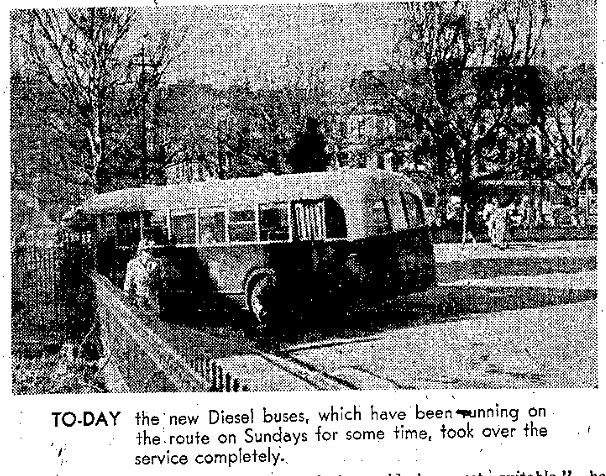
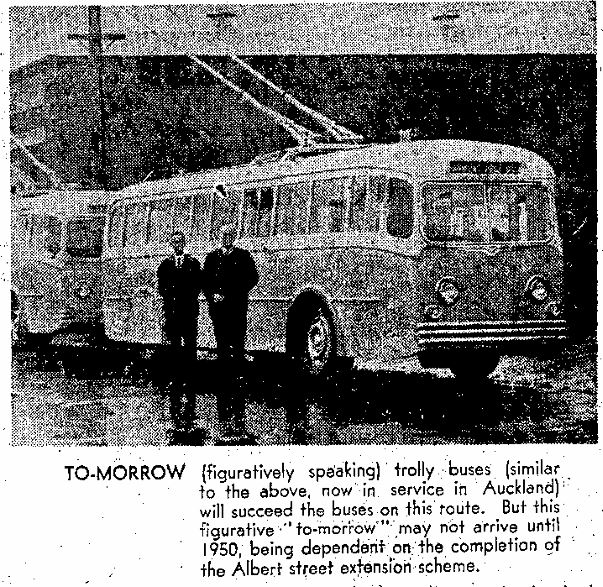


|
A Kaikorai cable tram, seen from another tram in a screen capture from a video. William Hood Davidson shot the movie in 1947, the year the line went out of business. (Source: The Kaikorai Cable Tram. Amateur film by William Hood Davidson, 1947. Hocken Collections.) |

|
Dunedin and Kaikorai Tramway Company Limited. Power House. (Source: The Kaikorai Cable Tram. Amateur film by William Hood Davidson, 1947. Hocken Collections.) |

|
A Kaikorai cable tram leaves the terminal. Another grip tram is back at the terminal. The pedestrian hops on while the tram is moving. (Source: The Kaikorai Cable Tram. Amateur film by William Hood Davidson, 1947. Hocken Collections.) |

|
A Kaikorai cable tram crests a hill. (Source: The Kaikorai Cable Tram. Amateur film by William Hood Davidson, 1947. Hocken Collections.) |

|
Kaikorai cable tram 3. (Source: The Kaikorai Cable Tram. Amateur film by William Hood Davidson, 1947. Hocken Collections.) |
Go to top of page.
Elgin Road Extension

|
Tracks along Elgin Road await the completion of the rest of the extension (Source: Otago Witness, 28-June-1905). |
line: Glenpark Avenue
opened: 06-October-1906. Mailer Street and Elgin Road from powerhouse
powerhouse: Eglinton Road.
grip: Single-jaw side grip, lever operated.
gauge: 3'6"
cars: One closed grip car.
turntables: crossovers
crossings:

|
The only car of the Elgin Road Extension "on the day of the trial run." Tramway employees pose with the car. Enhanced using ChatGPT. Original image. (Source: Otago Witness, 10-October-1906). June, 2026 Picture of the Month. |

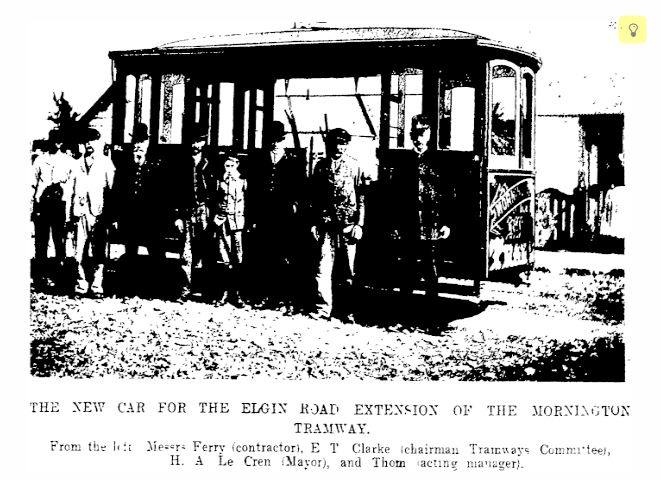 ) )
|
Another view of the only car of the Elgin Road Extension "on the day of the trial run." Big shots pose with the car. (Source: Otago Witness, 10-October-1906). |
notes:
This was the last new cable tramway built. There was controvery about whether it should use cable traction, or something powered by petrol, either a railcar or a bus.
The had a lot of curvature, which wore out the cable. The line closed on 22-January-1910.
The tram went to Maryhill, where it ran until that line closed in 1955. It is preserved at the Toitu Otago Settlers Museum.

|
| The Elgin Road extension was nearing completion. The new engine had been installed and the cable was "ordered from home". The contractor started to build the single car. (Source: Otago Daily Times, 13-January-1906) |

|
| A gentleman argues that it would have been better to buy a "petrol car" (motor tram?) for the extension, rather than using cable traction. (Source: Otago Daily Times, 13-January-1906) |
|
Dunedin Evenig Star, 26-October-1909.
|
| Cost of running for the year ended June 30, 1909 (as per balance-sheet) | £1,518 | 9 | 2 |
| Number of passengers carried (93,454), at, say, Id each... | 389 | 7 | 10 |
| Loss in running | £1,129 | 1 | 4 |
| Interest to be paid on original cost of laying down the extension, £14,000, at 4-1/2 per cent, per annum | 630 | 0 | 0 |
| Total: | £1,759 | 1 | 4 |
But, in addition, there is the allowance for depreciation, which, if put at the low estimate of 2 1/2 per cent., would entail an annual charge on £14,000 of 350 0 0
Annual total loss ...£2,109 1 4
It is the logic of such figures, coupled with the fact that there is practically no hope of their being materially changed, that has reluctantly compelled a majority of the Council to consider the proposal of closing the extension. But while it is neither desirable nor possible to continue so heavy a loss indeterminately, we are in sympathy with those ratepayers who maintain that the mere fact that there is a financial deficit on the Elgin road extension when it is treated separately from the main line is not the sole and final consideration that should concern them.
The question Does it pay? cannot be answered in quite the same terms when it is asked in reference to a municipally or nationally-owned public utility. What a private individual or syndicate and what a Corporation or Government should do with a line of railway that does not yield a surplus of revenue over expenditure must be viewed from different standpoints. The individual (or company) simply says: " The line does not pay, but as I have engaged in this work to earn dividends if I cannot earn them , I shall stop the running of the line." A municipality, however, cannot so argue. It has to consider the indirect as well as the direct returns, the convenience of the ratepayers as a whole, and resultant advantages that cannot be expressed in terms of pounds sterling. Whether the line of route taken by the Elgin extension be the right one or not, or whether mistakes have been made in the past, are now matters outside the range of profitable controversy. The question that has to be decided is not even whether the Elgin extension, as distinct from the rest of the system, pays or does not pay, but What is the best and most profitable policy for the Borough of Morninghill as a whole. Will it pay the borough to close the line? is as importaut a question to discuss as Does the Elgin extension pay? Judged from the stand-point of cash returns, the extension does not pay, but it is conceivable that the announcement that the extension had'been closed down would also not pay the borough. There is, in brief, not.only room, but serioua necessity, for some workable scheme of compromise between the" two parties, and we cannot think that sucn a scheme is beyond the wisdom and power of the people of Morningion to evolve.

|
Thank you to Rick Giles for reporting that a contractor replacing water pipes in Dunedin's Elgin Road unearthed a section of the buried conduit of the short-lived Elgin Road Extension, the last new Hallidie-type cable tramway, which only operated from 1906 to early 1910. Deciding it would be too hard to remove the concrete and iron conduit, the contractor laid the new pipes along side it and buried it again. (Source: Otago Daily Times, 29-Jnne-2026) All rights reserved. |
Go to top of page.
Wellington - Kelburn Cable Car

|
The Kelburn Cable Car, a funicular in Wellington, NZ. |
The Kelburn Cable Car, a funicular, has operated since 22-Feb-1902. Take a ride on the Cable Car and visit the Wellington Cable Car Museum site to learn more.

|
In February, 2022, the Wellington Cable Car celebrated its 120th birthday. |
In late 2005, they received grip car 3, which had been restored to its 1905 appearance. Grip Car 1, which was alread on display at the museum, and Grip Car 2, which is housed at the Wellington Tramway Museum at Mackays Crossing, Paekakariki, both look the way they did in the 1970's.

|
The COVID-19 virus required some new rules when the cable car returned to service. |
Update 01-June-2021.
Bus Driver Nick has posted a nice video about a visit to the Wellington Cable Car. Thank you to Bus Driver Nick for letting me share his video.

|

|
In November, 2021, the Kelburn Cable Car allowed dogs to ride the line as a test. Naturally, the 101st canine passenger was a Dalmation. The experiment was a success. |

|
2021-2022 Christmas Timetable. |

|
2022 Easter Hours. |

|
2022 Annual Maintenance Shutdown. |

|
2022 Stop Bullying campaign. |

|
2024-2025 Christmas Timetable. |

|
2025 Annual Maintenance Shutdown. |

|
About the extended 2025 Annual Maintenance Shutdown. |
Go to top of page.
Katoomba Scenic Railway

|
An ad for the Katoomba Scenic Railway. From the Sydney Farmer and Settler, 27-October-1937. |

|
A story about the Katoomba Scenic Railway. From the Sydney Farmer and Settler, 27-October-1937. |
Katoomba, New South Wales is in the Blue Mountains. The Katoomba Scenic Railway is part of a privately owned tourist attraction called Katoomba Scenic World. The Katoomba Scenic Railway is not a Hallidie-type cable tramway but is a funicular railway. Management claims that it is the steepest cable-driven funicular railway in the world. It descends over a cliff, through a short tunnel, and into a rainforest in the Jamison Valley. The steepest section is on an incline of 128 percent.
The railway was built in the 1880s to provide a connection to the outside world for a coal and oil shale mining operation in the Jamison Valley. Tourists started riding the line on weekends in 1928. The mine closed in 1945, but the railway remained open to carry tourists.
In early 2013, the railway was closed for about three months for a complete rebuilding. The current cars are enclosed, with big windows and seats whose angle can be adjusted.
The Katoomba Scenic World website.
Go to top of page.
Penang Hills Funicular Railway

|
Penang Hills car on the lower section. |

|
A 1950's view of cars at the passing loop in the upper line. |

|
A 1999 view of cars at the upper passing loop. |
Ric Francis has written a book about the Penang Hills Funicular Railway. Thanks to Ric for providing the illustrations and the information about the line.
The Malaysian island of Penang was administered by the British Empire as part of the Straits Settlements (Penang, Malacca, and Singapore). The lowlands around the port of Penang are hot and humid. British administrators and colonists wanted to get away to the higher, cooler Penang Hill, and decided that a funicular railway was the way to get there. A line was completed in 1906, but it didn't work and the company that built it went under.

|
Postcard view of the cars of the original, unsuccessful Penang Hills Railway. |
The Straits government organized a new project after the First World War. The Penang Hills Funicular Railway was designed by Arnold R Johnson, who had studied funiculars in Switzerland. The funicular opened to the public on 21-Oct-1923, and was immediately popular, both because it provided access to the cooler upper air and because of the beautiful views.
Until 2010, the Penang Hills Funicular Railway had two independent sections. The upper and lower sections each had two counterbalanced 40-passenger cars. Each car had automatic brakes which would apply if the cable broke or otherwise lost tension. Each section had a passing loop in the middle and intermediate stops. A winding house at the top of each section was electrically driven.
The funicular carries both passengers and freight in special wagons (cars in American).
The line is currently owned by the Penang Government and operated by the George Town City Electricity Supply Department.
After an eight-month shutdown in 2003, caused by an equipment failure, the line received a RM2.5mil rebuilding. After delays caused by difficulty in locating materials, the line reopened in August, 2004.
On Sunday, 24-Apr-2005, a load of tourists was trapped on the hill for three hours when a brake malfunctioned. Later that week, the State Tourism Development and Environment Committee requested RM40mil for a thorough overhaul of the system, citing its importance to tourism.
Ric Francis reports that on 21-February-2010, the line made its last run in its original form. The upgraded system will run directly from the top to the bottom. The work is scheduled to be complete by 28-September-2010, but people regard that date with skepticism.
An 07-May-2011 report in the FuniMag photoblog says that the rebuilt line reopened 25-April-2011.
Ric Francis and Colin Ganley have published a book, Penang Trams, Trolleybuses and Railways. It is a detailed history of public transit Penang. I particularly enjoyed the drawing which illustrated the liveries used at different times. This is on-topic for this site because of the Penang Hills Railway, a funicular.
If you are interested in reading this enjoyable book, it is available from Areca Books.
The official site of the Penang Hill Railway.

|
Looking down the Penang Hills incline. |

|
Penang Hills car with baggage wagon at bottom station, before the rebuilding. |

|
A modern car, pushing a freight wagon, approaches the tunnel on the upper section, before the rebuilding. |

|
Penang Hills car at bottom station, after the rebuilding. 2011 photograph. |

|
Penang Hills cars at the passing loop, taken from the other car. 2011 photograph. |

|
An old Penang Hills car at the currently unused old lower passing loop, taken from a new car. 2011 photograph. |

|
The former Penang Hills middle station. The old track on the right holds an old car which is on display. Note the sharp angle of the new track on the right. 2011 photograph. |

|
Penang Hills car at the top station. 2011 photograph. |

|
In 2011, Malaysia issued the Highland Tourist Spot set of stamps, including one for the Penang Hills Funicular Railway. |

|
As part of the 2022 Penang Hill Festival, veterans of the line gave a talk about its history: "A Century-Year-Old Tale of Penang Hill Railway." |
Go to top of page.
Selected Items from The Street Railway Journal
|
Home/
What/
How/
Where & When/
Who/
Why
Chronology/
Miscellany/
Links/
Map/
Bibliography
Copyright 1996-2026 by Joe Thompson. All rights reserved.
Last updated 01-July-2026