| Where Should I Go from Here? Visit the Map |
This page lists some of the funiculars, inclines, and counterbalances that have operated in Northern California. The list is not complete and I always welcome suggestions, information, and pictures
- The Fairfax Incline Railway
- Telegraph Hill Railroad, San Francisco
- Fillmore Hill Counterbalance, San Francisco
- Shasta Springs Incline
- Shadowbrook Restaurant, Capitola
- Yosemite Lumber Inclines
- Yosemite Portland Cement Incline
- Mount Tamalpais Weather Station Incline
- Hetch Hetchy Inclines
- Private Funiculars

|
Looking up the line of the Fairfax Incline Railway. Click on the thumbnail to see a larger version. Use your browser's "Back" button to return. |
Fairfax is a pretty suburb in Marin County, north of San Francisco. The Northwestern Pacific Railroad extended its third rail electric line through Fairfax to Manor, on November 15, 1913. This sparked a development boom in Fairfax.
The promoters of Fairfax Manor, a hilly subdivision of Fairfax, built the single tracked 1500 foot long Fairfax Incline Railway in 1913 to help sell lots on Manor Hill along Redwood, Spruce, Scenic and Tamalpais Roads. The incline connected with the Northwestern Pacific commuter trains, which connected with ferry boats to San Francisco.
The real estate market softened in the late Twenties and died during the Great Depression. The incline was abandoned in 1929.
The Fairfax Historical Society has a nice web site with a section on the incline railroad.

|
The Fairfax Incline Railway's single car next to a promotional sign which
reads:
THIS IS THE STARTING POINT OF THE FUNICULAR-INCLINE RAILROAD 1500 FT. 500 FT RISE OPERATED BY ELECTRIC POWER FAIRFAX MANOR THE FIRST IN EVERYTHING Click on the thumbnail to see a larger version. Use your browser's "Back" button to return. September, 2000 Picture of the Month. |

|
In 1923 the Fairfax Incline Railway raised its fare one cent. (Source: San Francisco Examiner, 1923-07-03, Page 7). |
Go to top of page.
Telegraph Hill Railroad

|
Looking up Greenwich Street as two cars enter the passing track (Source: [group 2:9a], Jesse Brown Cook Scrapbooks Documenting San Francisco History and Law Enforcement, ca. 1895-1936, BANC PIC 1996.003--fALB, The Bancroft Library, University of California, Berkeley). |
The Telegraph Hill Railroad was not a cable car line by my definition; it was a funicular railway, which used two cars attached to a finite cable. The car going downhill helped to counterbalance the car going uphill.

|
A notice that the Telegraph Hill Observatory offered concerts every Sunday at 2pm. The last part of the climb up Greenwich must have been a stiff hike before the railroad started operation. From the 09-July-1882 Daily Alta California. |
The pavilion opened on 04-July-1882. The Telegraph Hill Railroad opened on 01-June-1884. The pavilion and the railroad were promoted by Frederick O Layman and Gustav Sutro. The railroad ran along Greenwich Street, from Powell Street to the Pioneer Park Observatory, a large wooden resort near the present location of Coit Tower. The steam engine which drove the cable was in the basement of the pavillion. The railway used a single track with a passing siding at the middle. After a bad accident and declining traffic, the line closed in 1886. Parts of Greenwich Street on which the line ran are no longer graded. P
The pavillion remained open for some time, but must have been very difficult to reach.
Some contemporary newspaper articles:
- "This afternoon Mayor Blake returned to the Board of Supervisors, with his veto message, the order granting the Telegraph Hill Railroad franchise. " (Sacramento Daily Union, Saturday, May 13, 1882)
- "Articles of incorporation have been filed with the Secretary of State of the Telegraph Hill Railroad Company of San Francisco," (Sacramento Daily Union, Monday, May 15, 1882)
- "At noon on the Fourth the Pavilion at the top of Telegraph Hill, recently erected by the Telegraph Hill Railroad Company, was thrown open to the public." (Sacramento Daily Union, Thursday, July 6, 1882)
- "The Telegraph Hill Railroad Company... has filed an application in the Supreme Court for permission to disincorporate." (Sacramento Daily Union, Thursday, July 27, 1882)
- "Application of Ihe Telegraph Hill Railroad Company to be dissolved and dlsincorporated. Granted. " (San Francisco Call, Thursday, August 31, 1882)
- "The new cable railroad up Telegraph Hill is about ready to commence operations." (San Francisco Call, Saturday, May 24, 1884)
- "The receipts of the Telegraph Hill Railroad Company average $60 per day. " (Sacramento Daily Union, Saturrsday, September 6, 1884)
- "Telegraph Hill Observatory to be Restored" (San Francisco Call, Wednesday, December 22, 1886)
- "This property is sold to close out tbe affairs of the Telegraph Hill Railroad Company. " (Alta California, Thursday, April 10, 1890)

|
A notice that the Telegraph Hill Railroad was looking for bids from contractors to build the line. From the 16-December-1883 Daily Alta California. |

|
The Telegraph Hill Railroad's destination was the Pioneer Park Observatory. Note the funicular car at the upper terminal and the time ball on the roof. The time ball dropped at noon to allow captains on the bay to set their chronometers. I remember when a later version of the ball was located on the Pacific Bell Building on New Montgomery. (Source: San Francisco Public Library, San Francisco Historical Photograph Collection, AAC-1540). |

|
Gustav Sutro, one of the founders of the Telegraph Hill Railroad. |
from Poor's Directory of Railway Officials, 1887P. 233 Telegraph Hill Street (Cable) R.R. Co. operates 0.59 miles of road and owns 2 cars. Gustave Sutro, Pres. & Treas., Charles D. Werner, Sec., Supt. & P.A. -- GENERAL OFFICE, Greenwich & Kearney Sts., San Francisco, Cal. |
from Rand, McNally & Co.'s Guide to Southern California Direct: Narrative, Historical Descriptive, with Notes on California at Large by James William Steele, 1886P. 118-119 A remarkable elevation, both in the old times and now, is the small mountain called Telegraph Hill, standing immediately south of the entrance to the harbor (Golden Gate). It has not been long since it was necessary to climb the steep ascent on foot if you wished to enjoy what is, on a clear day, a fine prospect. Now, the means of climbing Telegraph Hill add considerably to the attractiveness of the excursion. It is a cable car which seems to be attached permanently to the rope. The car is stopped and started again by means of an electric signal made by the conductor, which is responded to at some distant point by stopping the cable, instead of letting go of it as usual. Whether this is a measure of safety on perhaps the steepest decline ever climbed by cars, or a mere matter of convenience, it strikes the average passenger very forcibly with its ingenuity. The observatory on Telegraph Hill is very completely furnished with telescopes, field-glasses and other conveniences, and has also a restaurant, and is used by the population as a pleasure resort. |

|
A notice that the Pioneer Park Observatory and the Telegraph Hill Railroad were to be sold at auction. From the 13-April-1890 San Francisco Call. |

|
Looking up Greenwich Street from Columbus in January, 2013. The Telegraph Hill Railroad followed this street, including a portion which no longer exists. |

|
The Telegraph Hill Observatory, with a car of the Telegraph Hill Railroad. The article says the Observatory will be restored and reopened. It says the railroad's two cars "have lain quiet in the Howard-street roundhouse for many years." (Source: "New Telegraph Hill," San Francisco Call, 26-January-1895, page 12). |
Go to top of page.
Fillmore Hill Counterbalance

|
URR counterbalance cars carrying crowds to the opening of the 1915 Panama Pacific Exposition. Photograph courtesy of the Museum of the City of San Francisco. |
Counterbalances were sometimes used on electric streetcar lines that needed to climb steep hills. Typically, a finite cable that ran in a conduit under the street had a device at each end to which a car could attach itself. Cars would start at the top and the bottom at the same time; the weight of the descending car helped to pull the ascending car, and the weight of the ascending car helped to prevent the descending car from running away. Counterbalances replaced parts of cable car lines in Providence, Rhode Island, Seattle, Washington, and Saint Paul, Minnesota.

|
Fillmore Hill Counterbalance car. (Source: "Ascending Grades by Electric Force", by SL Foster, Street Railway Journal, June, 1896) |
The Fillmore Hill counterbalance was built in 1895 by the Market Street Railway as part of its cross-town Fillmore Street electric line. The blocks from Broadway to Green were far too steep for electrics to ascend and descend unaided; the counterbalance solved the problem. Passengers would transfer from double truck electric cars at the top of the hill to a single truck car attached to the cable by a plow. When the car reached the bottom of the hill, it released the plow and ran on to Bay Street. The line was extended to Marina Boulevard on 29-Aug-1925.
Two newspaper articles describe accidents on the counterbalance. The 1907 article describes a pair of cars running as a train, but not, as far as I know, in multiple unit:
- Car Crashes Down Fillmore Hill/Fastenings Give Way and Passengers Narrowly Escape Serious Harm (San Francisco Call, Wednesday, August 8, 1906)
- Cars Crash Together On The Fillmore Hill/Rod Gives Away, but Cable Holds and Serious Mishap Is Averted (San Francisco Call, Monday, July 8, 1907)

|
Fillmore Hill Counterbalance cars coupled together to run in Multiple Unit for the Panama-Pacific International Exposition. (Source: "Two-Car Trains on 25 Per Cent Grade," Electric Railway Journal, 22-May-1915.) April, 2015 Picture of the Month. |
The counterbalance was the only United Rail Roads (successor to the original MSR) line which directly reached the 1915 Panama Pacific Exposition, held at the Marina. The 19-Polk came within a block of the eastern entrance. URR had all the single truck cars rebuilt as PAYE (Pay as You Enter) cars with MU (multiple unit) capabilities. The cars ran as trains only during the Exposition.
Counterbalances don't deal well with load fluctuations, because one car or train must go up and one must go down at a time. They are also complicated to deal with at the beginning and end of the work day. MSR (successor to URR) stored a weighted dummy car at the Turk and Fillmore car house. A regular 22 Fillmore car towed it out to the top of the hill. The attendant attached it to the cable, and it counterbalanced the last car up. It stayed in the middle of the intersection of Fillmore and Green, marked with a red lantern, all night. Automobiles often ran into it. In the morning, it counterbalanced the first car coming down. Then a regular 22 Fillmore car towed it back to the barn.
The counterbalance last ran on 05-Apr-1941. It was replaced, along with the Castro Street cable line and the 24 Divisadero streetcar line, by a single diesel bus line.
The rest of the 22 Fillmore line remained an electric streetcar line until 31-Jul-1948. Since 16-Jan-1949, the 22 Fillmore trolley bus line has covered the route. The blocks between Broadway and Green are too steep even for the trolley buses, which detour one block west to Steiner.

|
Two single truck motor cars operated as a two-car train. (Source: "Street Railways in the West", by Charles N Black, AERA (American Electric Railway Association), July, 1915) |

|
A postcard showing Market Street Railway counterbalance cars on the Fillmore Street Hill. The white fronts on the cars were a patented safety feature. The camera looks downhill from Broadway. November, 2008 Picture of the Month. |

|
Two counterbalance cars meet at Fillmore and Chestnut, near Marina Middle School in 1937. There must have been a third car waiting at the top of the hill. (Source: San Francisco Public Library, San Francisco Historical Photograph Collection, AAC-8451). |

|
Counterbalance car 624 meets its partner at Fillmore and Vallejo. From the 24-Apr-1940 San Francisco News: "Motorists proceeding eastward on Vallejo-St and approaching the Fillmore-St intersection are faced with this problem. The two cable cars on Fillmore-St's steep hill always cross at Vallejo-St, but one reaches the intersection just enough ahead of the other to divert a stranger's attention. Mr. Fixit suggests that a warning be placed on Vallejo-St, on each side of the intersection. This view, looking east across Fillmore-St, shows the added hazard of having to look over the hill. Notice, too, the youngsters clinging to the side of the cable car" (Source: San Francisco Public Library, San Francisco Historical Photograph Collection, AAC-8540). |

|
At the corner of Fillmore and Broadway, Fillmore Hill counterbalance car 623 waits for passengers to transfer from a 22-Fillmore streetcar before it plunges down the hill. Photo circa 1940. (Source: OpenSFHistory / wnp37.04185.jpg). November, 2018 Picture of the Month. |

|
The Ferry Building decorated to celebrate the 100th annivesary of the Panama-Pacific International Exposition. March 2015. |

|
A window wrap on the Wells Fargo branch at California and Drumm says to "Party Like It's 1915." Wells Fargo, a major sponsor of the centennial, had a new exhibit at its San Francisco History Museum. February, 2015. |
from Electric Railway Review, 19-May-1814P. 1054 Plans for Reconstructing Fillmore Hill Line, San Francisco. -- Nothing will be done until some time in June on the changes planned by the United Railroads, San Francisco, Cal., for the Fillmore Street hill funicular line. This hill is one of the obstacles that block the company from securing ready access to the exposition. The actual grade on Fillmore Street hill is 24 per cent. The company operates over it now by means of a cable attached to ascending and descending cars. |

|
Information about the Fillmore Hill line. From San Francisco Blue Book and Club Directory, JJ Hoag, 1904. |
Go to top of page.
Shasta Springs Incline

|
The car of the Shasta Springs Incline drops towards the valley floor. |
Mount Shasta, in Siskiyou County, is part of the Cascade Range. It was created by a volcano. It was considered to be sacred by local Klamath tribes, and is still consiered sacred by some peopl
Shasta Springs was a resort That existed in the late Nineteenth Century until the mid-20th Century. It was a popular stop on Southern Pacific's scenic Shasta Route ("The Road of a Thousand Wonders") The water of the Springs, at the base of the steep canyon of the upper Saramento River, were thought to have medicinal properties. When the Victorians said spring water had "medicinal properties," they believed that drinking and soaking in the mineral water would be theraputic.
|
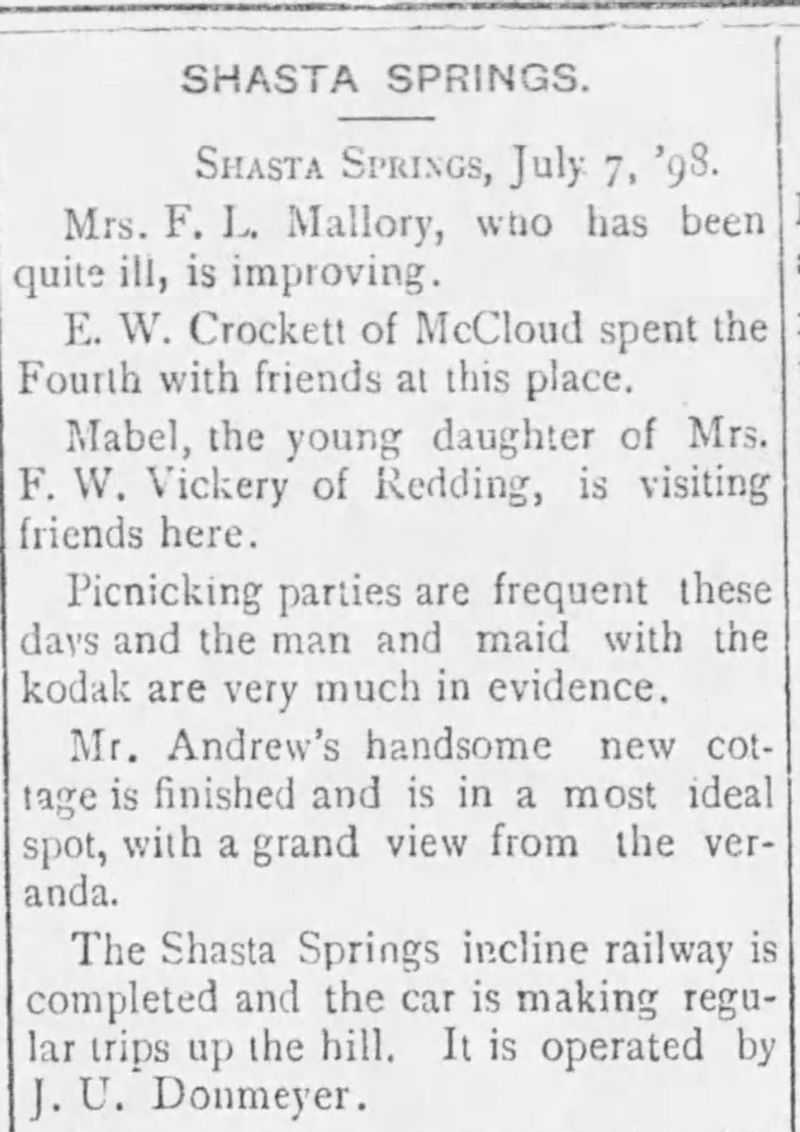
This item indicates that the Shasta Springs Incline was operating by July, 1898 (Source: Dunsmuir News, 1898-07-09). . |
The Shasta Springs Incline carried passengers from the canyon to the top of the bluff. It started operating in 1898.
|
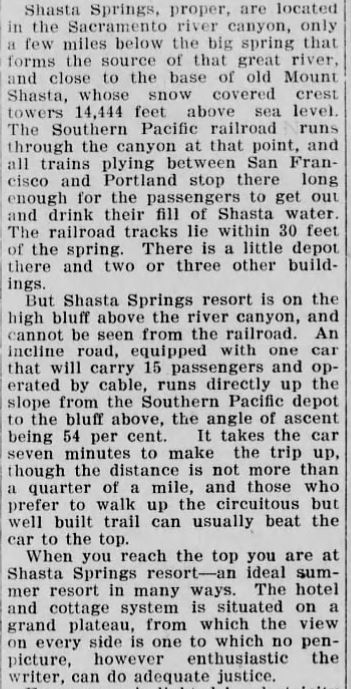
This item describes the Shasta Springs resort and its incline (Source: Merced County Sun, 1912-06-07). . |
|
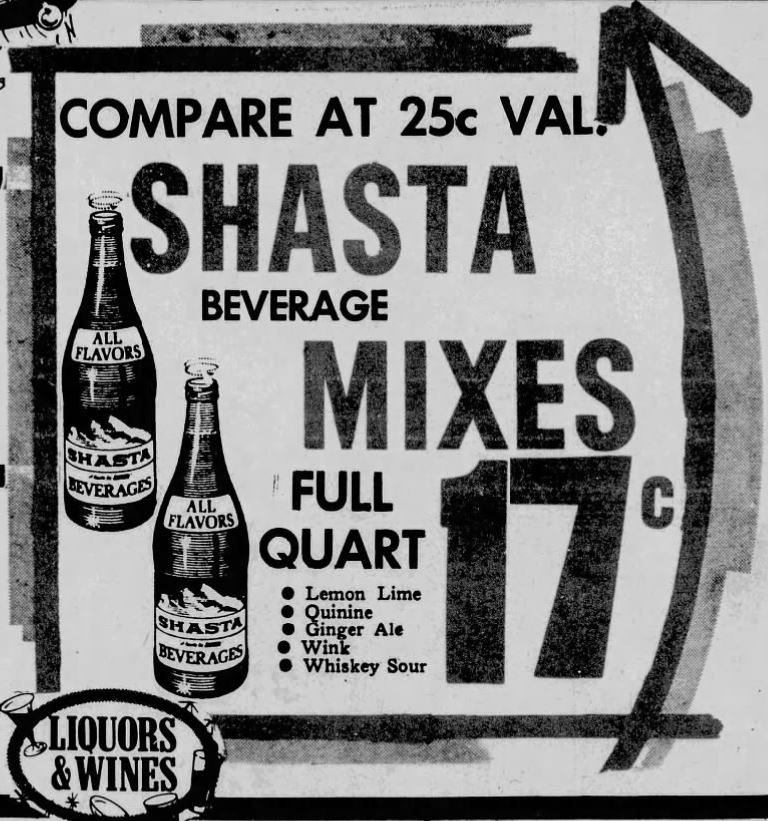
An ad for Shasta Beverages, which by 1968 were not made using water from the Springs (Source: Fairfield Republic, 1968-12-29). |
Water from the springs was the original source of bottled mineral water and later soft drinks produced by Shasta Beverages. My grandmother bought Shasta Ginger Ale.
|
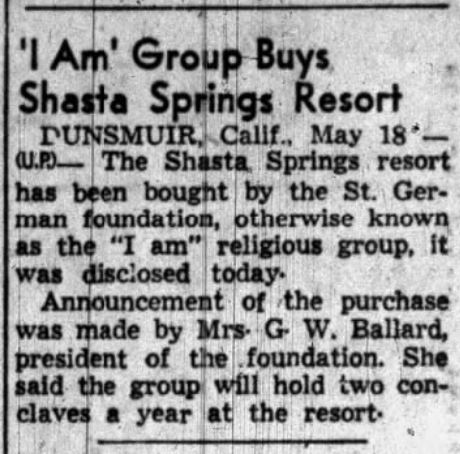
This item describes the sale of the Shasta Springs resort (Source: Turlock Journal, 1951-05-18). . |
The resort closed in the 1940s or early 1950s. It was purhased by a religious organization, the I AM Movement. The Saint Germain Foundation owns the property.
All of the buildings in the canyon, including the Southern Pacific station, the bottling plant and the incline, are gone.
|
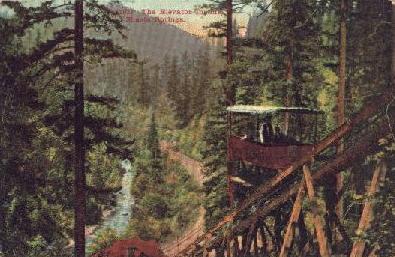
An early postcard of the Shasta Springs incline, showing the steep mountainside which it climbed. |
Go to top of page.
Shadow-Brook Restaurant, Capitola
|
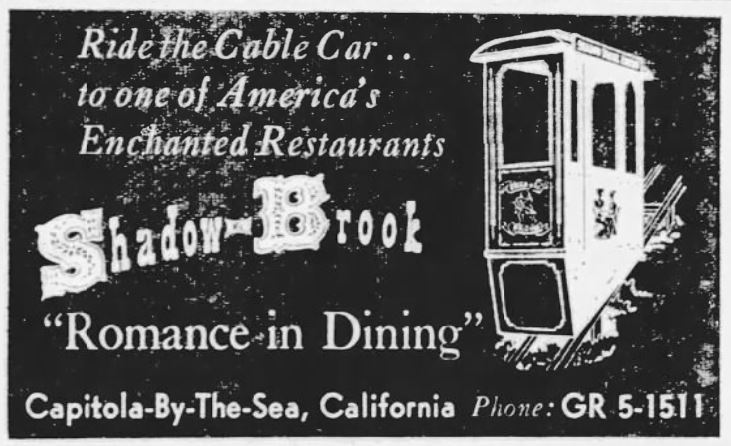
An ad for the restaurant boasts about its "cable car." (Source: San Francisco Chronicle, 1959-06-15). |
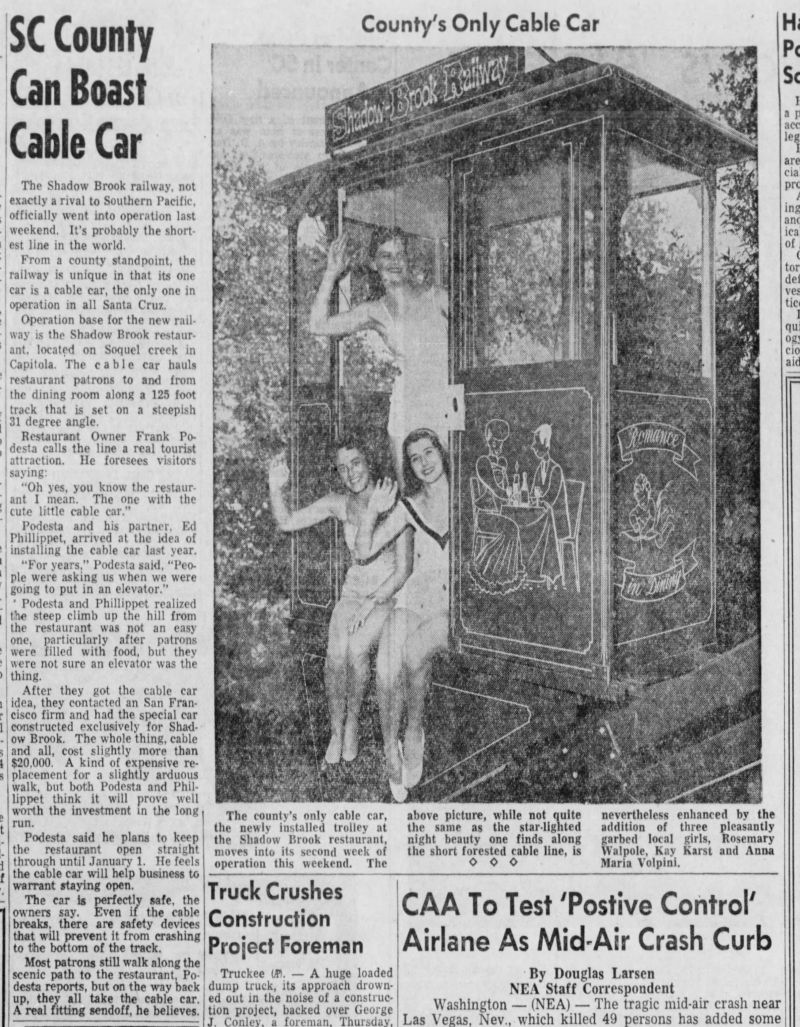
Shadow-Brook is an elegant restaurant in Capitiola by the Sea, south of Santa Cruz. It opened in 1947. In 1958, a "cable car" was added to allow guests to ride down and (especially) up the steep slope, which drops towards Soquel Creek.
|
Customers demanded a way to get from the restaurant to the parking lot (Source: Santa Cruz Sentinel, 1958-05-11). |
Go to top of page.
Yosemite Lumber Inclines
Go to top of page.
Yosemite Portland Cement Incline
Go to top of page.
Mount Tamalpais Weather Station Incline
Go to top of page.
Hetch Hetchy Inclines
Go to top of page.
Private Funiculars
|
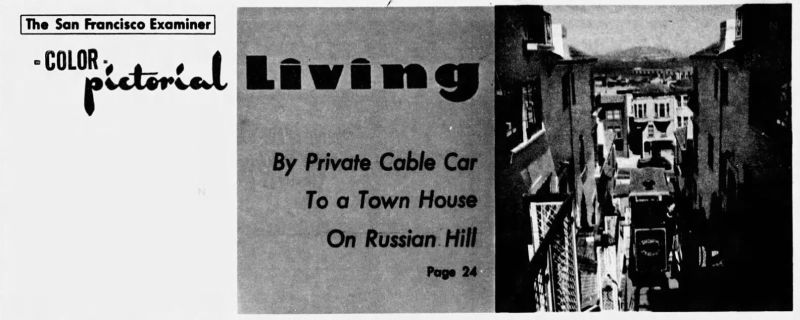
A private funicular on San Francisco's Russian Hill. It still serves a group of townhouses. (Source: San Francisco Examiner, 1960-10-02). November, 2025 Picture of the Month. |
San Francisco's hilly streets have encouraged some people to create private funiculars and inclines, some of which are still operating.
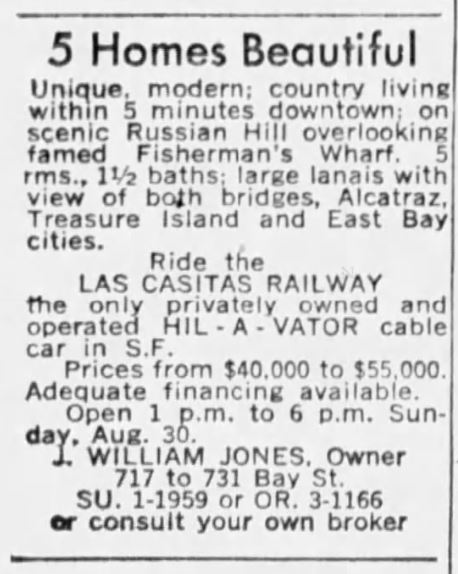
The Las Casitas Railway is a Hil-A-Vator that serves a group of townhouses.
|
|
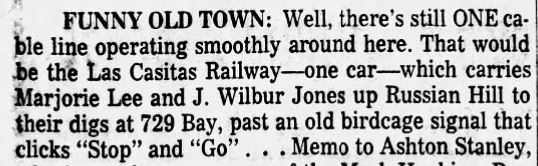
Herb Caen's famous column reported on the Las Casitas Railway (Source: San Francisco Chronicle, 1960-10-02). |
|
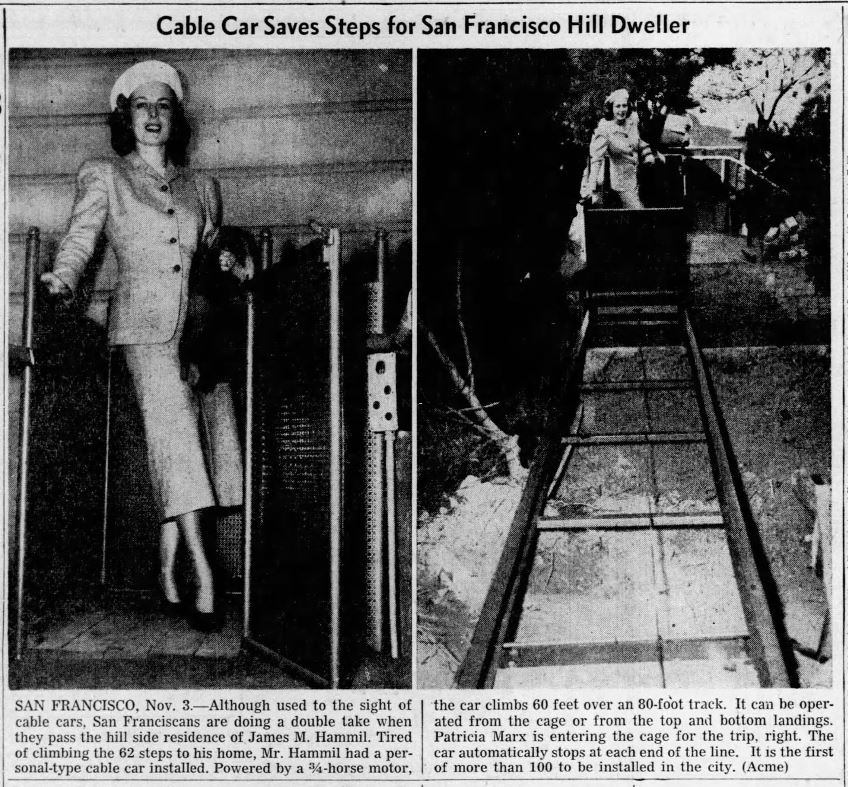
Some San Francisco people built private funiculars to deal with steep approaches to their homes. James M Hammil built this one to reach his Russian Hill home. (Source: Buffalo News, 02-November-1949). |
|
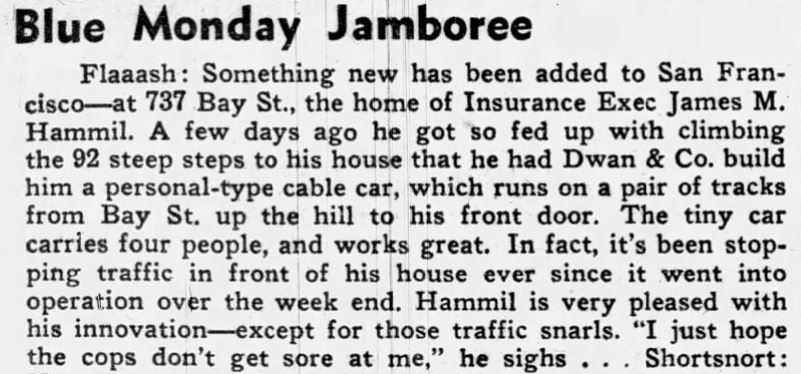
Herb Caen's famous column reported on John Hammil's funicular (Source: San Francisco Chronicle, 24-October-1949). |
Go to top of page.