|
Where Should I Go from Here?
Visit the Map
If you came to this page from an outside link, you may want to see the Picture of the Month and visit my main page. |
The Chicago lines, the first in the United States outside of San Francisco, demonstrated that cable technology could work in a harsher climate than San Francisco's
- Cable Car Operating Companies
- Chicago Miscellany
Chicago City Railway

|
A Chicago City Railway train on State north of Adams Street. The third car in the train is an electric car being hauled into the Loop area. January, 2000 Picture of the Month. |
line: State Street
opened: 28-Jan-1882. From State and Madison on Madison to Wabash. Wabash to Lake. Lake to State. State to 39th Street. The loop on Madison, Wabash, Lake, and State was shared with the Wabash/Cottage Grove line.
revised: 1887. Extended on State to 63rd Street.
revised: 1892. Loop revised to run on Madison, Wabash, Lake and State, but it no longer shared track with the Wabash/Cottage Grove line.

|
Read about the Main Power Station of the Chicago City Railway. (source: The Street Railway Journal, August, 1889). January, 2021 Picture of the Month. |
powerhouse: 21st Street and State
powerhouse: 52nd Street and State
grip: Hovey double-jaw side grip
gauge: 4'8 1/2"
cars: double-ended dummy & trailer trains. Trailer 209, 1934 replica with some original parts, is preserved at the Illinois Railway Museum
turntables: none
crossings:

|
A three car (grip car and two trailers) Chicago City Railway Wabash/Cottage Grove Avenue train terminates at Jackson Park. (source: Chicago Tribune Historical Photographs; CTA). January, 2020 Picture of the Month. |
line: Wabash/Cottage Grove Avenue
opened: 1882. From Wabash and Madison on Wabash to Lake. Lake to State. State to Madison. Madison to Wabash. Wabash to 22nd Street. Cottage Grove Avenue to 55th Street. The loop on Madison, Wabash, Lake, and State was shared with the State Street line.
revised: 22-Nov-1887. Extended on 55th Street to loop on Jefferson and Lake Avenues at Jackson Park.
revised: 1888. Extended on Cottage Grove Avenue to 67st Street to Oakwoods Cemetery.
revised: 1891. Extended on Cottage Grove Avenue to 71st Street.
revised: 1892. Loop revised to run on Madison, Michigan, Randolph, and and State. It no longer shared track with the State Street line.
powerhouse: 55th Street and Cottage Grove Avenue
grip: Hovey double-jaw side grip
gauge: 4'8 1/2"
cars: double-ended dummy & trailer trains.
turntables: none
crossings:
notes: The Chicago City Railway built the first United States cable car lines outside of San Francisco. Its lines helped to demonstrate that cable technology could work in a harsher climate than San Francisco's; they were also the first lines run entirely on flat ground. The Chicago City Railway's routes were the busiest lines in the industry, and among the most profitable. As a pioneer, the company was a frequent subject of newspaper stories about accidents. Some people kept score:
- Chicago -- Gripman Killed (Saint Paul Daily Globe, Friday, February 03, 1882)
- Chicago -- Third Fatality (Sacramento Daily Record-Union, Saturday, March 25, 1882)
- Chicago -- Fifteenth Victim (Saint Paul Daily Globe, Monday, September 04, 1882)
- Killed by a Cable Car. (New-York Tribune, Wednesday, November 6, 1893)

|
Charles B Holmes (Source: The Street Railway Journal December, 1891). |
Charles B Holmes, the president of the Chicago City Railway, had visited San Francisco in 1880 or 1881 to study its cable railways. He licensed the cable trust's patents and secured the services of Asa Hovey, who had designed the Sutter Street Railway. Holmes' success led to the spread of cable technology beyond San Francisco. Hovey's powerful side grip was the model for most of the industry.
Holmes gave an early interview while the company was making the transition from horse cars to cable cars on State Street:
In his book A Treatise Upon Cable or Rope Traction, J Bucknall Smith quotes from a questionnaire that the town clerk of Edinburgh, Scotland submitted to the city clerk of Chicago in late 1883. "In general has the working of the cable tramway system been proved to be a success?" The answer was "Complete success in all respects. This winter just closed was by far the most severe for many years and the cable system operated without the loss of a single trip."
The original loop on State and Wabash was operated by a lower speed auxilliary cable driven by reduction gears powered by the main cables.
Chicago cable railways often ran trains with three trailers, which was an unusual practice. The city eventually limited trains to two trailers. Smith reports that, as an experiment, a grip car hauled ten trailers. In later years, cable trains often hauled electric cars from outlying lines into the Loop.

|
The Chicago City Railway's Wabash/Cottage Grove Avenue cable trains carry crush loads of passengers to Chicago Day at the World's Columbian Exposition on 09-October-1893. (source: The Scientific American, January 27, 1894). October, 2018 Picture of the Month. |
The company's South Side Wabash/Cottage Grove Avenue line was in a good position to benefit from people attending the 1893 World's Columbian Exposition.
Chicago cable railways tended to step up the speed of cables on the outer parts of lines. The outermost cables on the Wabash/Cottage Grove Avenue line ran at 14 miles per hour.
Cable cars lasted longer in Chicago than in any other US city with flat streets because of three primary factors:
- The Chicago City Railway and the other companies had large numbers of horse car lines that they wanted to electrify first
- The franchises of all the companies were due to expire around the turn of the century and the companies did not want to invest in new technology until they knew where they stood.
- Many people opposed overhead trolley wires in the Loop area.
The operating companies negociated with the city and produced the Settlement Ordinance on 04-Dec-1905. This agreement extended the franchises of the transit companies, but required them to convert their cable lines to electric. The city continued to apply pressure on the operating companies:
The former Chicago City Railway converted the State Street line on 22-Jul-1906, and the Wabash Avenue line on 21-Oct-1906. An article from a San Francisco newspaper described the wild last trip on State Street:
Bill Vandervoort, keeper of the Chicago Transit and Railfan Web Site, reports that near the "... intersection of 55th Street and Cottage Grove Avenue, on Chicago's south side ... the cable car powerhouse had been at the northeast corner, where the 55th Street branch cars made the turn. East 55th Street was largely redeveloped during the 1960's, and that includes the buildings now at the northeast corner of 55th Street and Cottage Grove Avenue. I recently learned why a significiant sized lawn exists between those buildings and the street. It is because at the immediate corner, the previous existance of the cable car infrastructure made it too difficult to construct building foundations". Bill has a photo of this location, along with some still-standing powerhouses, on his site.
The Library of Congress' American Memory Project has an Edison film taken in the summer of 1897 at State and Madison. It shows a cable train turning the corner. The QuickTime version is only about 1.5 megabytes and is well worth viewing.

|
An advertisement for DB Fisk, wholesale, millinery, and fancy goods merchant, located at Wabash and Washington Streets. A Chicago City Railway train with two trailers is visible in the foreground. June, 2000 Picture of the Month. |

|
A Chicago City Railway train passes under an El station on State near Van Buren. |

|
A tinted postcard view of State Street at night, with Chicago City Railway cable trains. July, 2000 Picture of the Month. |

|
A stereoscopic view of "State Street north from Madison". January, 2010 Picture of the Month. |

|
A large tinted postcard view of State and Madison. |

|
MK Bowen was appointed superintendent of the Chicago City Railway in 1891. From the May, 1895 Street Railway Journal |
from Poor's Directory of Railway Officials, 1887P. 237 Chicago City (Cable) Ry. Co. operates 104.35 miles of road, owns 1,659 horses, 729 cars, 3 dummies, 22 snow-ploughs and 5 sweepers. DirectorsS. B. Cobb, D. E. Pearsons, S. W. Allerton, C. L. Hutchinson, E. M. Phelps, D. G. Hamilton, C. B. Holmes, Chicago, Ill. -- C. B. Holmes, Pres., Supt. & P. A., S. B. Cobb, Vice-Pres., John Strong, Supt. & Pur. A., H. H. Windsor, Sec., T. C. Pennington, Treas., C. J. Luce, Mast Tr Rep., J. B. Wright, Mast Car Rep.. -- GENERAL OFFICE, 2010 State St., Chicago, Ill. |
from Report of Special Committee of the City Council of Chicago on the Street Railway Franchises & Operations, 1898P. 43-44
THE CHICAGO CITY RAILWAY COMPANY. The Chicago City Railway Company was incorporated by special Act of the Legislature, February 14, 1859, and by its charter became the owner of the franchise granted, or intended to be granted by the Common Council of Chicago, August 16, 1858, to Henry Fuller and others. This franchise was the first under which street railways were operated in the City of Chicago, and included a system of lines extending over both the South Side and the West Side. The main line for the South Side, beginning at Lake and State streets, stretched over State street to Thirty-first street, the southern city limits, and included a branch on Cottage Grove avenue to Thirty-first street, and another on Archer avenue to Halsted street. The West Side branch of the system consisted of a line on Madison street, from State street to Western avenue, the city limits on the west. On May 23, 1859, another franchise was granted to the company for a connected system, including numerous streets on the West Side and some on the South Side. On or about August 1, 1863, however, this company sold to the newly incorporated Chicago West Division Railway Company all the West Side lines, including their extensions into the business center, the price paid being, according to report, $200,000. Since that time the Chicago City Railway Company has confined its operations to the South Side, and has developed an extensive system, including the major part of the surface lines in that division of the city. Furthermore, with the exception of the line on Sixty-third street, between Ashland avenue and Central Park avenue, leased in 1896 from the Southwest Chicago Rapid Transit Company, none of the lines operated by the Chicago City Railway Company appear to have been acquired by lease and without any specific grant. Up to 1881 the grants to this company had authorized the use of animal power only, though some of its lines had, prior to that time, been operated by dummy engines. On January 17 of that year, however, an ordinance was passed by the City Council permitting the company to equip all or any of its lines with the cable system, and similar permission was a little later given by the Trustees of the Town of Lake and the Trustees of the Village of Hyde Park. Accordingly the lines on State street and Cottage Grove avenue were, in 1882, converted to that system. Moreover, beginning in 1893, and under specific authority therefor, the company began to install the overhead electric system, and within the following three years all its horse car lines, with a few trivial exceptions, were converted to that system. The mileage of the company in 1888 comprised 135 miles of single track, 34 miles being operated by cable power and the balance by horse power. In 1897 the total had reached 184 miles, 35 of which were operated by cable power, 7 1-2 by horse power, and 141 1-2 by overhead electric trolley. The passengers carried in 1888 were 52,200,000; in 1890, 67,734,000, and in 1897, 95,621,000. The gross receipts for these years were, respectively, $2,610,009.00, $3,436,000, and $4,816,000, while the percentage of cost of operation to gross receipts decreased from 69.85 per cent in 1889 to 60.40 per cent in 1897. During this period of conversion to mechanical power, and particularly during the first eight years of the current decade, the finances of the company underwent a very marked expansion. The capital stock, which was $3,000,000 in 1888, and $5,000,000 in 1890, reached its present figure of $12,000,000 in 1896, and the bonded indebtedness, which stood at $4,000,000 in 1888, was increased in or about 1892 to its present amount, $4,619,500. The total capitalization, therefore, at the end of 1897 was $16,619,500. The 12 per cent dividends which were paid on the stock for many years prior to 1890 have been maintained since that time, and in 1893 two extra dividends were distributed among the stockholders, one of 12 per cent in cash, amounting to $1,050,000, and the other of stocks and bonds of the Alley Elevated Railroad, amounting to $2,250,000. In other words, the total dividends of that year amounted to almost exactly 50 per cent on the stock. P. 269-270 ("L. S. & M. S. R. R." is the Lake Shore & Michigan Southern Railroad. - JT) CABLE LINES AS OPERATED JANUARY 1, 1898.(Unless Otherwise Indicated the Track is Double).CHICAGO CITY RAILWAY COMPANY.STATE STREET LINE
COTTAGE GROVE AVENUE LINE
FIFTY-FIFTH STREET BRANCH Fifty-fifth street, from Cottage Grove avenue to Jefferson avenue.
|
Go to top of page.
Chicago West Division Railway
opened: 1886. Lake Street near 40th.
extended:
powerhouse: ?
grip: Rasmussen non-grip
gauge: 4'8 1/2"
cars: converted horse cars. double ended?
turntables: ?
crossings: N/A
notes: The Chicago West Division Railway, a horse car operator since 1861, allowed the Rasmussen Cable Company to install a demonstration of its non-grip system on a short stretch of track on Lake Street in 1886. The Rasmussen system was intended to allow horse car lines to be converted quickly and cheaply to cable traction.
The Rasmussen Cable Company promoted Charles W Rasmussen's patents for a system which was intended to be inexpensive to install and to operate. Rasmussen's system used small four-wheeled trucks which were attached to the cable at about 6 foot intervals. The trucks ran on rails formed into the sides of the small conduit. The driving sheave in the powerhouse had slots at suitable intervals for the trucks; this was simpler than the drivers and idlers with multiple wraps needed for regular cable traction. Curves were also simpler. The tracks in the conduit banked around the curves, allowing the trucks to ride around. The rolled iron conduit required an excavation only 8 inches deep. The company claimed it could be laid between the rails of an existing horse car line.
Hobart W McNeil made many changes in an effort to get the system to work.
A button attached to the cable at each end of each truck provided the point of contact with the non-grip mechanism. In Chicago, the mechanism consisted of a large cog wheel attached under the floor of a horse car. The cog wheel passed through the slot of the conduit and the teeth of the wheel engaged the buttons on the cable. A goose neck on the car's platform controlled a brake on the cog wheel. Loosening the brake would allow the wheel to rotate and the car to stop. Tightening the brake would stop the wheel and impart motion to the car.
The Rasmussen system was able to make a car move, but the demonstration highlighted severe problems with the original Rasmussen system. Normal stretching of the cable made the distance between the trucks vary so that the slots on the driving wheel and the cogs of the cog wheels had trouble engaging the trucks and the buttons.
Based on the minimal success of this demonstration, the Rasmussen Cable Company's successor, the United States Cable Railway Company made another installation in Newark, New Jersey. They made several changes in the non-grip mechanism.
The Chicago West Division Railway did not choose to pursue cable traction. In 1887, it was leased for 999 years by the West Chicago Street Railroad, which adopted cable traction in 1890.
|
|
From Verbatim report of the Annual Meeting of the American Street-Railway Association, 1884.
|
|
|
from Poor's Directory of Railway Officials, 1887P. 237 Chicago West Division R.R. Co. operates 46.5 miles (all double track), owns 3,977 horses and 750 cars. DirectorsB. H. Campbell, Wm. H. Bradley, S. B. Cobb, Jerome Beecher, Henry Field, Wm. H. Ryder, J. R. Jones, Chicago, Ill. -- J. R. Jones, Pres., B. H. Campbell, Vice-Pres., Geo. L. Webb, Sec. & Treas., De Witt C. Cregler, Supt., E. A. Blodgett, Pur. Agt., Martin Connell, Mast. Tr. Rep., B. McDevitt, Mast. Car Rep.. -- GENERAL OFFICE, 59 State St., Chicago, Ill. |
Go to top of page.
North Chicago Street Railroad

|
North Chicago cable trains at the south portal of the LaSalle Street tunnel. Note the short grip car on the train entering the tunnel. February, 2000 Picture of the Month. |

|
A North Chicago Street Railroad train at Clark Street and North Avenue. Note the two trailers. (Source: Chicago Public Library Digital Collection, Repository number RLVCC 1.1056. All rights reserved). February, 2020 Picture of the Month. |
line: Clark Street
opened: 26-Mar-1888. From La Salle and Monroe on Monroe to Dearborn. Dearborn to Randolph, Randolph to La Salle (tunnel under the Chicago River), to Illinois to Clark to Diversy. Inbound La Salle to Monroe.
revised:
powerhouse: La Salle and Illinois
powerhouse: Clark and Elm (a former swimming pool and skating rink)
grip: Low and Grim (really) top grip
gauge: 4'8 1/2"
cars: Single end combination cars replaced by grip and trailer trains
turntables: Loops
crossings:
| Intersection | Company | Status |
|---|---|---|
| La Salle/Washington | WCSRR | superior |
| La Salle/Madison | WCSRR | superior |
| Dearborn/Madison | WCSRR | superior |
| Dearborn/Washington | WCSRR | superior |

|
The North Chicago Street Railroad's powerhouse at Clark and LaSalle Streets is currently occupied by Gino’s East River North, a pizzaria. Google Maps Streetview Image updated June 2018. Copyright 2020 Google. |
line: Wells Street
opened: 26-Mar-1888. From La Salle and Monroe on Monroe to Dearborn. Dearborn to Randolph, Randolph to La Salle (tunnel under the Chicago River), to Illinois to Wells to Wisconsin. Inbound La Salle to Monroe.
revised:
powerhouse: La Salle and Illinois
powerhouse: Clark and Elm (through a blind conduit)
grip: Low and Grim (really) top grip
gauge: 4'8 1/2"
cars: Single end combination cars replaced by grip and trailer trains
turntables: Loops
crossings:
same as Clark Street
line: Lincoln Street
opened: Feb 1889. From La Salle and Monroe on Monroe to Dearborn. Dearborn to Randolph, Randolph to La Salle (tunnel under the Chicago River), to Illinois to Clark to to Centre to Lincoln to Wrightwood. Inbound La Salle to Monroe.
revised:
powerhouse: Lincoln and Wrightwood
grip: Low and Grim (really) top grip
gauge: 4'8 1/2"
cars: Grip and trailer trains
turntables: Loops
crossings:
same as Clark Street
line: Clybourn Street
opened: May 1891. From La Salle and Monroe on Monroe to Dearborn. Dearborn to Randolph, Randolph to La Salle (tunnel under the Chicago River), to Illinois to Wells to Division to Clybourn to Cooper. Inbound La Salle to Monroe.
revised:
powerhouse: Clark and Elm (through a blind conduit)
grip: Low and Grim (really) top grip
gauge: 4'8 1/2"
cars: Single end, double truck combination cars
turntables: Loop, powered turntable at outer terminal
crossings:
same as Clark Street
notes: The North Chicago Street Railroad was not well loved.
For one thing, the promoters, the Widener-Elkins syndicate and Charles T Yerkes were from Philadelphia, where Widener-Elkins had built a cheap and unsuccessful cable railway. Yerkes had done time in the Pennsylvania penitentiary for misappropriation of funds, and so was widely trusted.
For another thing, the North Chicago was as poorly designed as the Philadelphia Traction Company had been. The company recycled the La Salle Street tunnel, which the city had built in 1871. La Salle Street lies between the company's two main lines, on Clark and Wells. This required trains passing to and from the tunnel to drop cable and coast. This was made more difficult by the company's use of a top grip, which lengthened the distance needed to drop and pick up cable. Many cars could not make the change on momentum, and the company had to use a team of horses to help them around. The powerhouse located at La Salle and Illinois had to issue a cable which went through many contortions to carry cars to Wells and Clark, and through the tunnel and around the downtown loop. Andrew D Whitton, the engineer, later added a short auxilliary cable to carry cars from the tunnel to Clark and Wells.
The top grip, another bad idea, was an effort to avoid paying patent royalties to the Cable Railway Trust. In 1887, the company was sued by cable engineer Henry Root for infringing on his patent for a conduit: A Californian's Suit (Sacramento Daily Record-Union, Wednesday, December 21, 1887)
The entire system was undependable and prone to breakdown. Despite that, and despite Yerkes' poor repute, the company made money because it served a growing area of Chicago and many amusements, including the Ferris Wheel, which was moved near the outer terminal of the Clark Street Line after the 1893 World's Columbian Exposition.
The company continued to operate horse cars. In 1890, one ran away and plunged into the Chicago River: JUMP FOR YOUR LIVES/A Runaway Street-Car Plunges Into the Chicago River (San Francisco Morning Call, Sunday, October 03, 1890)
In 1899, Yerkes merged the North Chicago and West Chicago companies into the Chicago Untion Traction Company, the predecessor of the Chicago Surface Lines. Yerkes made good money from his investment: COMPENSATION OF CAPITAL/Sample Instance of the Value of Street Railway Franchises. (Omaha Daily Bee, Saturday, July 1, 1899)
The Settlement Act of 1905 (see Chicago City Railway) allowed the company to convert its cable lines. The Clark Street line was converted on 21-Oct-1906.

|
The 30-May-1897 issue of the Saint Paul Daily Globe carried an illustration with
a poem about a bicyclist's encounter with a cable car:
There was a little maid, And she had a little wheel. In front of cable cars she loved to roam, roam, roam. But like a stupid dunce She slipped her pedal once And lugged her bike in pieces to her home, home, home. |
In recent years, many transit companies have added bike racks to their buses or allowed bicycles aboard their trains. The North Chicago Company considered carrying bicycles in 1897. I don't know if they followed through. I have never seen a photo of a cable car carrying a bike: Street Cars May Carry Wheels (Saint Paul Daily Globe, Sunday, May 30, 1897)

|
1895 - North Chicago cable cars at Dearborn & Madison. |

|
North Chicago cable trains at the portal of the LaSalle Street tunnel. Illustration from Harper's Weekly. |

|
North Chicago cable train. |

|
North Chicago Street Railroad mortgage bonds offerred as a "conservative investment." From the 03-July-1901 New York Tribune. |
The powerhouse at 500 North LaSalle Street still stands. It was "Michael Jordan's The Restaurant(tm)" for many years and is now Lalo's (River North) Restaurant.
|
The LaSalle Street powerhouse was "Michael Jordan's The Restaurant (tm)" for many years. This is an advertising magnet (No thumbnail). February, 2010 Picture of the Month. |

|
This is an advertising pin for "Michael Jordan's The Restaurant(tm)" (No thumbnail). |
from Poor's Directory of Railway Officials, 1887P. 237 North Chicago City Railway Co. operates 37 miles (reduced to single track) of road, owns 1,790 horses and 316 cars. DirectorsV. C. Turner, Jacob Rehm, Hiram Crawford, W. C. Gandy, Geo. L. Dunlap, Chicago, Ill. -- V. C. Turner, Pres. & Supt., Jacob Rehm, Vice-Pres., Hiram Crawford, Sec. & Treas., Aug. W. Wright, Supt., Tr. & Const., F. L. Threedy, Asst. Supt., John M. Roach, Pur. Agt., J. M. Miller, Mast Car Rep.. -- GENERAL OFFICE, 441 N. Clark St., Chicago, Ill. |
|
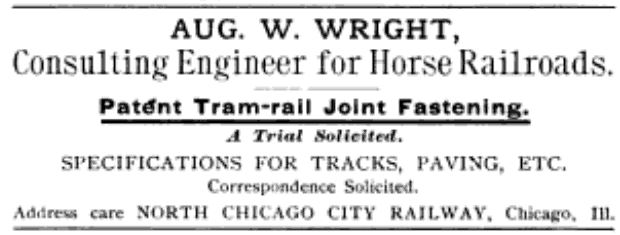
An ad for Augustine W Wright, "Consulting Engineer for Horse Railroads". He also worked on cable railroads, including the Los Angeles Cable Railway/Pacific Cable Railway. Note that he is to be contacted care of the North Chicago City Railway, where he was superintendant of track and construction. From the April, 1885 Anerican Railroad Journal. |
from Report of Special Committee of the City Council of Chicago on the Street Railway Franchises & Operations, 1898P. 44-47
THE NORTH CHICAGO STREET RAILROAD COMPANY. This company was incorported by the same act of February 14, 1859, which incorporated the Chicago City Railway Company, and with similar powers, its prescribed field for operation being the North Division of the city. On May 23, 1859, the grant of an extensive group of streets in that part of the city was made to the former company, and other grants followed from time to time, as a result of which it developed and had exclusive control of the street railways on the North Side of the city until 1886. In March of that year, however, Mr. Charles T. Yerkes and his associates acquired control of the property of this company by purchasing a majority of the stock. On May 18, 1886, these parties were incorporated as the North Chicago Street Railroad Company, and on May 24 following, and under their management, the former company executed a lease of all its property to the latter company for 999 years, with a guaranty of 30 per cent dividends (my italics - JT) on the $500,000 stock of the lessor company. The subsequent grants for the North Side were for many years made exclusively to the North Chicago Street Railroad Company, and this company now controls, as owner or as lessee of the old company, the major part of the street railways in that portion of the city. A very important fraction of the street railway traffic of that section, however, is now carried on by four or five minor companies, organized, managed and owned by Mr. Yerkes and his associates, and some times using in part the tracks of the North Chicago Street Railroad Company. These companies in part do an entirely independent business, with routes entering the business center of the city over lines of the older company, and in part they act as "feeders" to the lines of that company. But, in either case, being independent organizations, they charge separate fares, and maintain no transfer relations with the lines of the old company. Further comment upon this situation is made in the letter of transmittal (supra). Up to 1886 the grants made to the North Chicago City Railway Company authorized the use of animal power only, and, with the exception of a limited use for a time of dummy engines, no other power was utilized. On June 7, 1886, however, and following the lease mentioned, the Common Council of Chicago authorized this company, or its assignee or lessee, to use the cable system on any or all of its existing lines, and under this permit and similar permissions in later grants, the trunk lines on Clark street, Wells street, Lincoln avenue and Clybourn avenue, with connections into the business center, were, in 1888 and 1889, converted to that system. Permits for the use of electricity as a motive power on existing horse car lines were granted at different times from 1892 on, and under these all the horse car lines operated by the North Chicago Street Railroad Company, with one or two minor exceptions, were, during the years 1894 to 1896, inclusive, converted to the overhead electric system. The mileage, which, in 1885 comprised 35 3-4 miles of single track, and in 1890, 77 miles, of which 17 miles were cable, reached in 1896 its present total of 100 miles of single track, of which seventeen are operated by cable power, two by horse power and eighty-one by overhead electric trolley. The total number of passengers carried in 1890 was 39,481,000, and in 1897, 56,354,000. The gross receipts for these years were repectivcly $1,897,000 and $2,836,000, while the percentage of cost of operation to gross receipts decreased from 55.09 per cent in 1890, to 46.83 per cent in 1897. The financial operations of the two companies during this period of mechanical development, were very much expanded. Prior to the lease in 1886 the capital stock of the North Chicago City Railway Company was $500, 000, and the bonded debt was $500,000. The former has remained unchanged, but the latter has since been increased to $3,000,000. The capital stock of the North Chicago Street Railroad Company, at its organization, was made $5,000,000, and the company soon issued bonds to the amount of $1,500,000. Up to December 31, 1897, the outstanding stock had been increased to $6,600,000, and the bonded debt to $4,931,000. The combined capitalization of the two companies on that date was $14,780,900. The amount of " water " in this capitalization is discussed farther on. Mr. Yerkes and his associates, in acquiring possession of the property of the North Chicago City Railway Company, purchased $250,100 of its stock, or one share more than a majority, paying therefor $600 per share. The lease thereafter executed required the lessee company to carry the indebtedness of the lessor company, and also provided for an annual dividend of 30 per cent on the $500,000 stock of the lessor company. The lessee company thereupon proceeded to do two things: First, in order to pay for the stock which it had purchased, it raised the necessary amount by issuing 5 per cent first mortgage bonds, covering all its property, and secured by the deposit of the $250,100 stock so purchased. Then it turned over to the United States Construction Company, composed of Mr. Yerkes and his associates, its own $5,000,000 stock as the contract price for the conversion by the Construction Company of the trunk lines to the cable system. This conversion, including power houses and entire equipment, according to an official statement by Mr. Yerkes ... cost the Construction Company about $4,000,000, but, according to estimates referred to in that table, actually cost less than $3,000,000. Since the lease the 30 per cent dividends guaranteed have been paid upon the $500,000 stock of the lessor company, and the dividends on the stock of the lessee company, starting at 5 per cent in 1887, and reaching 11 1-2 per cent in 1892, have since then stood regularly at 12 per cent, while an extra dividend of $1,100,000 (one-half in stock at par and the other half in certificates of indebtedness afterwards exchanged for stock at par) was distributed to the stock-holders in 1895. P. 271-272 CABLE LINES AS OPERATED JANUARY 1, 1898.(Unless Otherwise Indicated the Track is Double).NORTH CHICAGO STREET RAILWAY COMPANY.CLARK STREET LINE
WELLS STREET LINE
LINCOLN AVENUE LINE South and southeast of intersection of Clark street and Wells street, cars interchange between Clark Street Line and Wells Street Line.
CLYBOURN AVENUE LINE
|
Go to top of page.
West Chicago Street Railroad

|
A West Chicago train on Madison Street. March, 2000 Picture of the Month. |

|
This West Chicago Street Railroad powerhouse at Washington and Jefferson Streets still stands in altered condition. I don't know why that big blank wall is there in front. Google Maps Streetview Image updated August 2019. Copyright 2020 Google. March, 2020 Picture of the Month. |
line: Milwaukee Avenue
opened: 07-Jun-1890. From Fifth Avenue and Washington on Fifth to Madison, Madison to La Salle, La Salle to Randolph, Randolph to Fifth, Fifth to Washington. Washington through a tunnel under the Chicago River to Des Plaines to Milwaukee to Armitage Avenue. The loop on Fifth, Randolph, La Salle, and Madison was shared with the Madison Street line.
revised:
powerhouse: Jefferson and Washington
powerhouse: Milwaukee and Cleaver
grip: Whitton double-jaw side
gauge: 4'8 1/2"
cars: single end combination
turntables: loops?
crossings:
| Intersection | Company | Status |
|---|---|---|
| La Salle/Washington | NCSRR | inferior |
| La Salle/Madison | NCSRR | inferior |
| Dearborn/Madison | NCSRR | inferior |
| Dearborn/Washington | NCSRR | inferior |
line: Madison Street
opened: 16-Jul-1890. From Fifth Avenue and Washington on Fifth to Madison, Madison to La Salle, La Salle to Randolph, Randolph to Fifth, Fifth to Washington. Washington through a tunnel under the Chicago River to Jefferson to Madison to 40th Avenue. The loop on Fifth, Randolph, La Salle, and Madison was shared with the Milwaukee Avenue line.
revised:
powerhouse: Jefferson and Washington
powerhouse: Madison and Rockwell
grip: Whitton double-jaw side
gauge: 4'8 1/2"
cars: single end grip and trailer trains
turntables: loops?
crossings: same as Milwaukee Avenue
line: Blue Island Avenue
opened: 1893. From Jackson and Franklin on Franklin to Van Buren, Van Buren to Dearborn, Dearborn to Adams, Adams to Franklin, Franklin to Jackson. Jackson through a tunnel under the Chicago River to Jefferson to Van uren to Halsted to Blue Island Avenue to Western. The loop on Franklin, Van Buren, Dearborn, and Adams was shared with the Halsted Street line.
revised:
powerhouse: Jefferson and Van Buren
powerhouse: Blue Island and 12th Street
grip: Vogel and Whelan bottom
gauge: 4'8 1/2"
cars: single end grip and trailer trains
turntables: loops?
crossings:
line: Halsted Street
opened: 1893. From Jackson and Franklin on Franklin to Van Buren, Van Buren to Dearborn, Dearborn to Adams, Adams to Franklin, Franklin to Jackson. Jackson through a tunnel under the Chicago River to Jefferson to Van uren to Halsted to O'Neil. The loop on Franklin, Van Buren, Dearborn, and Adams was shared with the Blue Island Avenue line.
revised:
powerhouse: Jefferson and Van Buren
powerhouse: Blue Island and 12th Street (via blind conduit under 12th Street)
grip: Vogel and Whelan bottom
gauge: 4'8 1/2"
cars: single end grip and trailer trains
turntables: loops?
crossings:
notes: The West Chicago company, like the North Chicago, was promoted by Charles T Yerkes and the Widener-Elkins syndicate.
The promoters and their cheif engineer, Andrew D Whitton, had learned from some of their mistakes on the North Chicago lines. In place of the top grip used in North Chicago, they used a side grip on the northern pair of West Chicago lines (Milwaukee Avenue and Madison Street) and one of the most interesting shallow-conduit grips in the industry, the Vogel and Whelan bottom grip, on the southern pair of lines (Blue Island Avenue and Halsted Street).
No grip could handle a loose strand in the cable:
The northern lines used another recycled tunnel under the Chicago River, but the southern lines used a new tunnel, built by a separate corporation, the West Chicago Tunnel Company. The southern lines hauled electric cars from Van Buren Avenue and other lines into the Loop area.
The Settlement Act of 1905 (see Chicago City Railway) allowed the company to convert its cable lines. The Halsted line was converted before July, 1906. Blue Island Avenue was converted in July. Milwaukee and Madison were converted on 19-Aug-1906.

|
West Chicago cable trains on Blue Island Avenue. |

|
West Chicago cable train on Randolph Street. March, 2010 Picture of the Month. |

|
West Chicago and other companies were combined into the Chicago Union Traction Company, which went into default because of its inflated debt. This ad from the 26-August-1907 New York Sun asks stock and bondholders to participate in a settlement. |
from Report of Special Committee of the City Council of Chicago on the Street Railway Franchises & Operations, 1898P. 47-50
THE WEST CHICAGO STREET RAILROAD COMPANY. On July 21, 1861, the Chicago West Division Railway Company was incorporated by special Act of the Legislature, with powers for the West Division of the city similar to those granted to the other two companies, and with power also to purchase from the Chicago City Railway Company the lines of that company in that division of the city. On or about August 1, 1863, the new company did purchase the West Division lines and thereafter this company received various grants from the city, and for many years had exclusive charge of the street railway business on the West Side of the city. The Chicago Passenger Railway Company, incorporated February 12, 1883 (originally as the Chicago Horse and Dummy Railway Company), procured various franchises for street railways on the West Side, and apparently was under virtually the same management as the Chicago West Division Railway Company, $730,000 of its $1,000,000 stock being owned by the latter company in June, 1887, when Mr. Charles T. Yerkes and his associates purchased a majority of the stock of the Chicago West Division Railway Company, and thus got control of the property of both companies. On July 19, 1887, Mr. Yerkes and his associates were incorporated under the name of the West Chicago Street Railroad Company, with capital stock of $10,000,000. On October 20, 1887, this company took a lease * for nine hundred and ninety-nine years of the property of the Chicago West Division Railway Company, assuming the payment of interest on the bonded debt of that company, and of an annual 35 per cent dividend on its $1,250,000 of stock. By this lease the newly incorporated company also came into possession of $730,000 of the $1,000,000 stock of the Chicago Passenger Railway Company, and on May 15, 1888, took a lease of the property of the latter company for ninety-nine years, guaranteeing 5 per cent dividends on its stock and assuming the payment of the interest on its bonds. These transactions gave the West Chicago Street Railroad Company entire control of street railway transportation on the West Side, and ushered in the period of mechanical traction in that part of the city. On March 30, 1888, two ordinances were passed by the Common Council, authorizing the operation of any or all of the lines of the Chicago West Division Railway Company and the Chicago Passenger Railway Company, by the cable system, while about the same time the use of the Washington Street Tunnel was granted to the Chicago Passenger Railway Company, and the West Chicago Street Railroad Company agreed to build the Van Buren Street Tunnel. Between 1889 and 1893 the cable lines on the West Side were built and put in operation, with connections through these tunnels into the business district. Between 1892 and 1896 permission was granted for the employment of the overhead electric trolley on other lines operated by the West Chicago Street Railway Company, including the lines leased from the other two companies, and from 1893 to 1896 inclusive all horse car lines, with a few minor exceptions, were converted to electricity. The mileage of the two original companies in 1887 and before the lease was about 100 miles. In 1890 it stood, for the three companies, at 150 miles, of which 18 miles were cable, and in 1897 it had increased to its present total of 202.70 miles, of which 30.42 miles are operated by cable power, 6.6 by horse power and 165.68 by overhead electric trolley. The financial operations connected with this development have been analogous to those connected with the North Side system, except that they have been more complicated. Prior to the lease in 1887 the stock of the Chicago West Division Railway Company was $1,250,000.00, that of the Chicago Passenger Railway Company $1,000,000.00; the indebtedness of the former $4,070,000.00, and that of the latter $400,000.00. That is, the total capitalization of the two companies was $6,720,000.00. The capital stock of the West Chicago Street Railroad Company at its organization was $10,000,000, and the company soon issued bonds to the amount of $4,100,000. In 1890 the bonded debt of the three companies had become $9,074,000.00, their total stock issues, not counting stock of the lessor companies owned by the West Chicago Street Railroad. Company, amounted to $10,894,900, and the total capitalization of the three companies was thus $19,968,900.00. In 1897 this total, including the bond issue of the Tunnel Company, had reached the sum of $31,857,900.00, of which $17,774,000.00 was indebtedness and $14,083,900.00, not including stock of lessor companies owned by the lessee company, was capital stock. The amount of "water" in this capitalization is discussed further on. Mr. Yerkes and his associates, in acquiring possession of the property of the Chicago West Division Railway Company, purchased $650,100 of the stock of that company, or one share more than a majority, the price paid being $650 per share. Thereupon, the West Chicago Street Railroad Company, into whose hands this stock so purchased came, proceeded to do two things: First, in order to pay for the stock it issued first mortgage 5 per cent bonds to the amount of $4,100,000, covering all its property, except the lease from the Chicago West Division Railway Company, and secured by a deposit of the stock purchased. Then the new company, instead of installing mechanical power directly, turned over the $10,000,000 of its own stock to the United States Construction Company, composed of Mr. Yerkes and his associates, as the contract price for the cabling of the main lines of the system, an enterprise which, according to Mr. Yerkes' public claim, (see table 2 W), cost $8,000,000, but which, according to careful estimates shown in the same table, probably cost less than $5,000,000. On October 26th, 1888, the West Chicago Street Railroad Company, being under contract with the city to build the Van Buren street tunnel under the south branch of the river, instead of executing the work directly, according to the terms of the contract, turned over the work to Mr. Yerkes and his associates, organized as the West Chicago Street Railroad Tunnel Company, and on April 1st, 1889, the railroad company leased the tunnel, still to be built, from the Tunnel Company for 999 years at a rental which was not fixed, but was at least to equal the fixed charges of the Tunnel Company. The obligations of the various leases have been performed, including the payment of 35 per cent dividends on the $1,250,000, stock of the Chicago West Division Railway Company, and the dividends on the stock of the lessee company, starting at 5 per cent in 1888, reached 9 per cent in 1893 and 1894, and since 1894 have remained at 6 per cent. * The Economist's supplement for 1898, contradicting the statements of earlier supplements, states that a lease for fifteen years was first executed, and that this was extended in 1897 for fifty years. Until the public is given access to the actual leases there may be uncertainty as to such details. P. 270-271 CABLE LINES AS OPERATED JANUARY 1, 1898.(Unless Otherwise Indicated the Track is Double).WEST CHICAGO STREET RAILWAY COMPANY.SOUTH HALSTED STREET LINE
BLUE ISLAND AVENUE LINE
MADISON STREET LINE
MILWAUKEE AVENUE LINE
|
|

|
The accompanying engraving shows...

|
This West Chicago Street Railroad carbarn is on Blue Island Avenue near Leavitt Street. Google Maps Streetview Image updated July 2019. Copyright 2020 Google. |
Go to top of page.
524 At the Chicago Railroad Fair

|
524 at the Chicago Railroad Fair. From the 03-Aug-1949 San Francisco News: "Two thousand miles removed from its regular route, a San Francisco cable car is being operated by Western Pacific at the Chicago Railroad Fair. The car carries capacity loads up a steep incline to return to a turn-table the replica of the one at Market St., San Francisco" (Source: San Francisco Public Library, San Francisco Historical Photograph Collection, AAC-8005). February, 2022 Picture of the Month. |

|
524, now numbered 24, at Powell and Post. January, 2002. Photo by Joe Thompson. February, 2002 Picture of the Month. |

|
A program from the 1949 Chicago Railroad Fair. "2nd Great Year." |
The 1948-1949 Chicago Railroad Fair celebrated 100 years of railroad progress. The Fair was held on the shores of Lake Michigan at 23rd Street and Lake Shore Drive. Many historic locomotives, including the William Mason, which pulled Lincoln's funeral train, appeared at the Fair.
In 1949, the Western Pacific Railroad sponsored the appearance of San Francisco Powell Street cable car 524. 524 was built by the Mahoney Brothers in 1887 for the Ferries and Cliff House Railway. According to an account from the 03-Aug-1949 San Francisco News, "The car carries capacity loads up a steep incline to return to a turn-table the replica of the one at Market St., San Francisco."
524, renumbered as 24 in the early 1970's, still operates in San Francisco. Read Walter Rice's article Is It "Mahoney" or "Mahony?", about 524's builder plate.

|
Western Pacific promotional brochure distributed at the Fair. |

|
The Western Pacific Railroad issued this medal. The California Zephyr is on the front. A Powell Street cable car is on the back. |

|

|
524 returning from the Chicago Railroad Fair. From the 24-Oct-1949 San Francisco News: "D. W. Yungmeyer, who crossed the country on a cable car to bring No. 524 back from the Chicago Railroad Fair, arrived in good condition today to be greeted by Mrs. Hans Klussman (should be Klussmann - JT), head of the Save the Cable Car Committee." (Source: San Francisco Public Library, San Francisco Historical Photograph Collection, AAC-8102). |

|
524 was not San Francisco's only entry at the Chicago Railroad Fair. From the 08-Jun-1949 San Francisco Call-Bulletin: "Alexander Nielsen, winner of the Call-Bulletin memo from the cable car bell ringing contest, tests model cable car which leaves today for Chicago Railroad Fair parade. Admirer is Shirley Bodley. Model was produced by men of California Street Cable Railroad. The bell, of course, is regulation type" (Source: San Francisco Public Library, San Francisco Historical Photograph Collection, AAC-8062). |

|
The "Deadwood Central", a narrow gauge train, at the Fair. The locomotive was probably from the Colorado and Southern, a subsidiary of the Chicago, Burlington, and Quincy. |

|
Clay Street Hill Railroad grip car 8 and trailer 1 (numbered 8 in this photo) on display at the 1893 World's Columbian Exposition in Chicago. (Source: The Book of the Fair). January, 2005 Picture of the Month. |
Grip car 8 and trailer 1 of San Francisco's pioneering Clay Street Hill Railroad travelled to Chicago for the 1893 World's Columbian Exposition. Car 8 without trailer 1 appeared at the 1904 Louisiana Purchase Exposition in Saint Louis. Grip car 8 still survives at the Cable Car Museum in San Francisco.
The Book of
the Fair by Hubert Howe Bancroft describes the street railway
display at the Chicago Fair:
"Although the exhibits of railroads proper completely dwarf those of the
street car and minor lines, much is to be seen and learned by an
examination of the latter groups; for here are displayed the latest
patents in seats, stoves, wheels, switches, and all other appliances.
Electric motors and the furnishings of electric cars are largely
represented, together with all kinds of cable systems. In the latter
direction San Francisco is prominent, A. S. Haliddie of that city, the
inventor and builder of the first cable road, producing the original
dummy used on a steep hill grade in August, 1873. In a section of
the roadway are also revealed the workings of the grip and pulleys, and
adjoining is a collection of grips used by various cable lines throughout
the country, showing difference in style and mechanism. A California
company, which manufactures wire cables, has a patent rope-way in
operation, one devised for the transportation of ore over the mountains,
and a Chicago establishments exhibits a motor operated by liquid ammonia
supplied by stationary plants."
Walter Rice provided further information about the cars and their adventures after the fair: "Clay Street Hill Railroad's open-grip car (dummy) No. 8 was operated from the start of service (revenue service began September 1, 1873) of the world's first cable car line, the Clay Street Hill Railroad, until the 1891 rebuilding of the line by the Ferries & Cliff House Railway. According to the San Francisco Bulletin of July 24, 1873, No. 8 was one of four dummies. The Bulletin wrote, 'It is believed that four dummies will be sufficient for the immediate wants of the road.' The Bulletin of July 31, 1873 reported, 'The cars (trailers) are similar to the one-horse cars used on the Woodward line (City Railroad). They are from the Kimball Manufacturing Company. In addition to the ordinary brake, there is on each side of the car between the wheels, a wooden frame which can be let down on the track, and held so firmly as to make the weight of the car rest on them, thus holding the car stationary, no matter how steep the grade.'
"On April 14, 1893, the Ferries & Cliff House Railway sent Clay Street Hill Railroad grip car No. 8 and trailer No. 1 to Chicago for display at the 1893 Columbian Exposition. The grip and trailer were refurbished, dissembled, crated and shipped to Chicago to be reassembled and exhibited in the Exposition's Transportation Building. After the Exposition ended not all exhibits were returned to their lenders; some were abandoned, including No. 8 and No. 1. By default, both were transferred to the Baltimore & Ohio Railroad's (B&O) collection. No. 8 and presumably No.1 were sent to the 1904 Louisiana Purchase Exhibition in St. Louis. It is not known if they were shown at St. Louis. After this fair closed, the entire B&O collection of equipment was sent to Martinsburg West Virginia, to the B&O repair shops, for storage. In 1927, the B&O celebrated its centennial with the 'Iron Horse Fair,' held at Halesthrop, Maryland that August, with 1.25 million visitors. An authoritative source notes 'a cable car' was shown. This would most probably have been No. 8. Whether No. 1 was also displayed is unknown.
"Somewhere during this time, No.1 was apparently lost. It may have fallen apart from old age or it may have been part of the B&O collection lost during the hurricane of 1935 that destroyed Halesthrop storage sheds. It possible No.1 was misplaced and exists today (B&O archival records are scanty). Gilbert Kneiss, of the Pacific Coast Chapter of The Railway & Locomotive Historical Society (R&LHS), while searching for railroad exhibits for both 1933 Chicago World Fair and 1939 New York World Fair, at some point in 1936 Kneiss became aware that No. 8 existed as part of the B&O collection. Kneiss was able to persuade the B&O to return No. 8, in 1938, to San Francisco. No. 8 was displayed at the Golden Gate International Exposition (on Treasure Island) in 1939 and 1940. After the Exposition closed No. 8 was temporary displayed at the Ferry Building, before exhibited for many years at the Sutro's Museum (near the Cliff House). In 1966, when Sutro's Museum was about to be demolished, the R&LHS had No. 8 stored temporarily by the Pacific Gas & Electric Company. Later that year, No. 8 was transferred to the Muni's Washington-Mason cable car barn's car storage area. In 1974, No. 8 was placed on display in the Cable Car Museum, where it resides today.
"Thank you to Randy Hees, Suzanne Fisher and Bob Callwell for their research."

|

|

|
| Clay Street Hill 8 was part of the Saint Louis Car Company exhibit at the 1904 Louisiana Purchase Exposition in Saint Louis. (Source: "Saint Louis Car Co. at the Louisiana Purchase Exposition," The Street Railway Journal, 03-September-1904.). |
Go to top of page.
The Chicago Tunnel Railway

|
A Chicago Tunnel Railway electric locomotive. |
I wanted to include a few words about another interesting but obsolete railway in Chicago.
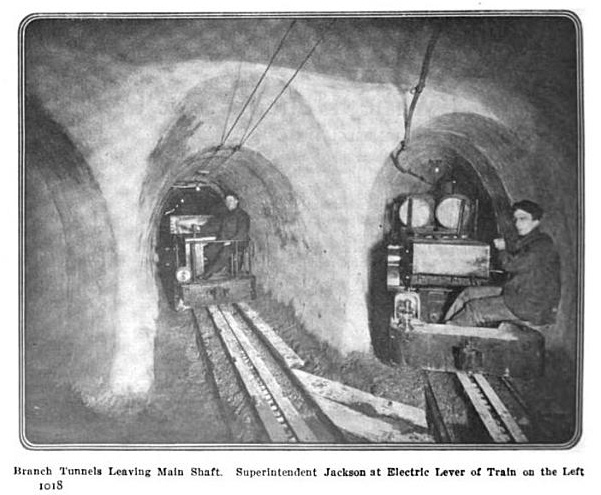
In 1889, the Illinois Tunnel Company began to dig a tunnel from the basement of a saloon near LaSalle and Madison Streets. The tunnel was originally intended to carry telephone and telegraph lines. This was the beginning of a network of tunnels that eventually extended for 60 miles, forty feet below the streets of downtown Chicago. The system included eleven tunnels or "drifts" which passed under the Chicago River to reach North Side and West Side customers. In 1906, the company began to operate two-foot gauge electric freight trains through the tunnels. Its cars delivered goods and raw materials and removed finished goods. They also carried packages and mail. A particularly large part of the business involved delivering coal and removing ashes. In 1912, the financially ailing Illinois Tunnel Company reorganized and became the Chicago Tunnel Company.
Separating freight shipments from the overcrowded city streets seemed like a good idea, but it did not work well in practice. At a surface freight station, a car would be loaded with goods. It would go down an elevator to the tunnel and be added to a train. At the destination, the cars of the train would be sent up another elevator to the surface. This was labor and time intensive.
In 1938, the city began digging the State Street Subway, which displaced the company's connections to many of its best customers. Truck competition stole more customers. Many buildings stopped burning coal and started burning natural gas for heat. The buildings that continued to burn coal mostly switched to truck delivery. Most of the tunnel railroad's remaining business by the early 1950's was ash removal.
Eventually, the company ran out of money to dispose of the ashes and started parking loaded cars in unused tunnels. When the company ran out of empty cars in June, 1959, it went out of business. Scrappers came in and removed trolley wires, signals, and the watertight doors of the eleven drifts under the Chicago River.
Over the years, tunnels under City Hall were made into fallout shelters, and Commonwealth Edison and telecommunications companies used other tunnels to run cables. This returned some of the tunnels to their original use.
In 1992, a company driving wooden piles in the Chicago River drove one too close to one of the drifts, which began to leak. Even though the leak was reported soon after, the city allowed it to continue for several months without taking any action. When the wall of the drift collapsed, the Chicago River poured into the tunnels. Almost all the tunnels and many basements that were still connected to them were flooded. The Loop area was shut down for several days, costing the economy many millions of dollars. This would not have happened if the scrappers had left the water tight doors, or if the city had taken action promptly when the leak was reported.
The Fox River Trolley Museum in South Elgin, Illinois has one ash car that was saved during flood cleanup in 1992. The Illinois Railway Museum in Union, Illinois was able to save a locomotive and a string of ash cars from a tunnel near the Field Museum of Natural History. The IRM web page has a good article about the rescue. All other surviving rolling stock was probably destroyed by the flood.
|
| I have found two interesting articles about the Chicago Tunnel Railway, one from 1904 when it was being built and one from 1913 when it was extended. |
If you want to learn more, you must visit Phil O'Keefe's Chicago Tunnel Company Railroad Home Page. The text and the pictures are wonderful.

|
A junction on the Chicago Tunnel Railway, with a train passing in the background. |
Go to top of page.
Excerpt from The Pit by Frank Norris
Frank Norris' last completed novel, The Pit, was intended to be the second book of a "trilogy of wheat". The first novel, The Octopus, was about growing wheat and the monopoly of land by railroad companies. This book, The Pit, was about trading wheat and cornering the Chicago commodity markets. The intended third novel, The Wolf, was going to be about the consumption of wheat and artificial famines in Europe. In this excerpt, the North Chicago Street Railroad is an important part of the scene.
He and Gretry were in the broker's private room in the offices of Gretry, Converse & Co. They were studying the report of the Government as to the supply of wheat, which had just been published in the editions of the evening papers. It was very late in the afternoon of a lugubrious March day. Long since the gas and electricity had been lighted in the office, while in the streets the lamps at the corners were reflected downward in long shafts of light upon the drenched pavements. From the windows of the room one could see directly up La Salle Street. The cable cars, as they made the turn into or out of the street at the corner of Monroe, threw momentary glares of red and green lights across the mists of rain, and filled the air continually with the jangle of their bells. Further on one caught a glimpse of the Court House rising from the pavement like a rain-washed cliff of black basalt, picked out with winking lights, and beyond that, at the extreme end of the vista, the girders and cables of the La Salle Street bridge.
The sidewalks on either hand were encumbered with the "six o'clock crowd" that poured out incessantly from the street entrances of the office buildings. It was a crowd almost entirely of men, and they moved only in one direction, buttoned to the chin in rain coats, their umbrellas bobbing, their feet scuffling through the little pools of wet in the depressions of the sidewalk. They streamed from out the brokers' offices and commission houses on either side of La Salle Street, continually, unendingly, moving with the dragging sluggishness of the fatigue of a hard day's work. Under that grey sky and blurring veil of rain they lost their individualities, they became conglomerate--a mass, slow-moving, black. All day long the torrent had seethed and thundered through the street--the torrent that swirled out and back from that vast Pit of roaring within the Board of Trade. Now the Pit was stilled, the sluice gates of the torrent locked, and from out the thousands of offices, from out the Board of Trade itself, flowed the black and sluggish lees, the lifeless dregs that filtered back to their level for a few hours, stagnation, till in the morning, the whirlpool revolving once more, should again suck them back into its vortex.
The rain fell uninterruptedly. There was no wind. The cable cars jolted and jostled over the tracks with a strident whir of vibrating window glass. In the street, immediately in front of the entrance to the Board of Trade, a group of pigeons, garnet-eyed, trim, with coral-coloured feet and iridescent breasts, strutted and fluttered, pecking at the handfuls of wheat that a porter threw them from the windows of the floor of the Board.
Frank Norris's The Pit was posthumously published in 1903. The full text is available at On-Line Books.
Go to top of page.
"Memories" by Franklin P Adams

|
A Belding Brothers silk thread ad depicts a red State Street cable train being pulled by its product. October, 2003 Picture of the Month. |
These are the things I used to know:
A book called " Remember the Alamo,"
Written, I think, by Amelia Barr;
And the Cottage Grove cable car --
It was purple, but the State Street car was red
That passed by the bakery of Livingston's bread.
In our yard, by the drying shirts and socks,
I planted nasturtiums and four-o'clocks,
And in winter I often used to glide
On Johnny Cudahy's toboggan slide --
(He had a pair of pants with stripes,
And lived just across from the Conrad Seipps).
And Toots McCormick and Alma Meyer
Yelled when I passed on my Barnes White Flyer;
And a thousand other things I knew
In that sweet Chicago of '92.
Franklin Pierce Adams (FPA), author of The Connning Tower, a popular newspaper column in the New York Tribune, wrote this poem remembering his childhood in 1892 Chicago. His most famous poem was "Tinker to Evers to Chance". To learn more about FPA, see Michael Gilleland's excellent "Biography of Franklin P Adams".
Go to top of page.