|
Where Should I Go from Here?
Visit the Map
If you came to this page from an outside link, you may want to see the Picture of the Month and visit my main page. |
- Hoboken, New Jersey
The need to connect the low-lying lands of central Hoboken with residential areas atop the Pallisades was an excellent application of cable traction.
- Newark, New Jersey
Busy Newark, close to New York City, was a good place to demonstrate an experimental technology.
- Binghamton, New York
The need to link Binghamton with a hilltop sanatarium called for a cable railway.
- Brooklyn, New York (Brooklyn was a separate city until 1898)
Brooklyn was home to the most successful cable railway in the East, and one of the least.
- Brooklyn Cable Company
- Nassau Cable Railway
- Brooklyn and Long Island Elevated Cable Railroad
- Brooklyn Heights Railroad
- New York City, New York
America's biggest city had some of its most heavily-used lines.
- Cable Car Operating Companies
- New York/New Jersey Miscellany
- Cable Car Run Amuck (1893 newspaper article)
- New York Loses Its Last Horse Car (1917 newspaper article)
- The Beach Pneumatic Subway
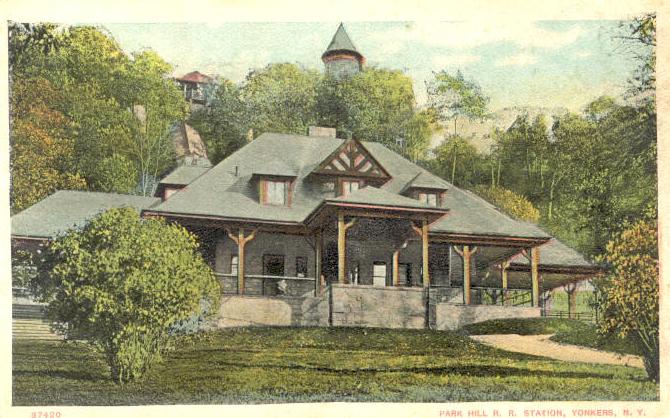
- The Park Hill Incline
- The Orange Mountain Cable Railway
- Magazine Articles
- "Cable Roads in New York"
- "The Great Cost of Cable Laying in New York Streets"
- "The Traffic of the Cable Railway on the New York and Brooklyn Bridge"
- "Prize Offered for a Street Railway System"
- "A Combined Gravity and Cable System for the Operation of Elevated Railways in Cities"
- "Plan of the East River Railway to Connect New York and Brooklyn"
- Rapid Transit for New York City (July, 1874)
- Excerpt from New Buildings in New York City (December, 1872)
- Travel Under Ground and in the Air (May, 1873)
- The Gilbert Elevated Railroad (February, 1874)
- Dummy Locomotives (May, 1875)
- Street Cars Run by Motive Power (May, 1878)
- The Noise on the Elevated Railroad (August, 1878)
- Abatement of the Elevated Railroad Noises (May, 1879)
- Compressed Air Locomotives in New York City (November, 1879)
North Hudson County Railway
A Hoboken cable car on the viaduct next to the earlier funicular. (Source: Image courtesy of Rail-Road Extra). January, 2002 Picture of the Month. opened: 25-Jan-1886. By viaduct from Delaware, Lackawanna & Western ferry to Palisade Avenue.
extended: 1890 to Hudson Courthouse in Jersey City.
powerhouse: at upper terminal
grip: Endres bottom grip
gauge: 4'8 1/2"
cars: double-end, double-truck
terminals: crossovers
crossings: none
notes: Rapid transit operations were rare in the cable railway industry. Only the Hoboken elevated and the Glasgow District Subway were successful.
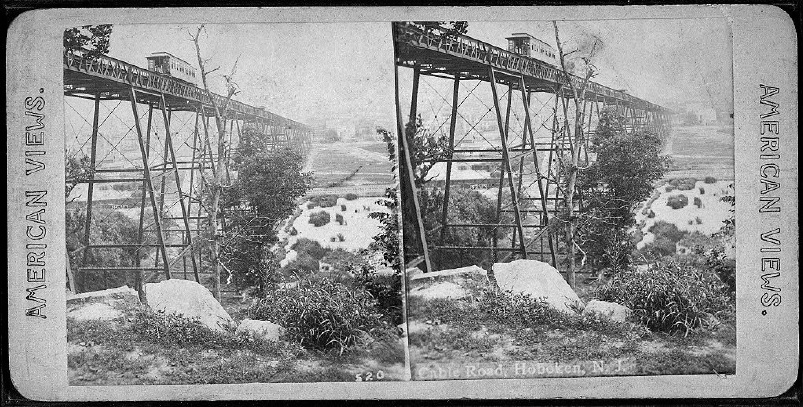
The steep Palisades split the land along the west bank of the Hudson River, across from New York City. The industrial part of Hoboken, low meadowland along the river, had an important ferry connection. Above Hoboken was Jersey City Heights, a residential area. Early attempts to reach the residential area used steam and horse power along indirect routes. According to the 20-Feb-1886 edition of Scientific American (available at Rail-Road Extra), it took a car pulled by four horses twenty minutes to go one mile from the ferry to the top of the hill.
Access to the top of the Palisades improved in 1873, when the North Hudson County Railway built a 400 foot long funicular to haul horse cars 100 feet up the face of the hill. The entire trip from the ferry to the top of the hill took ten minutes. The incline portion took one minute. Counterbalanced funiculars are, by their nature, limited in the amount of traffic they can handle, so the North Hudson County Railway looked for a better solution.
The company chose to build an elevated railroad, with cable traction. This shortened the trip to from the ferry to the top of the hill to five minutes.
The iron towers of the elevated structure sat on bluestone and brick piers, which were supported by clusters of wooden piles. Deep piles were necessary to reach bedrock through the soft meadow land.
Read about test trips on the line:
- Hoboken's Elevated Road (New York Sun, Sunday, December 20, 1885) "The run from the ferry to Jersey City Heights was made in six minutes."
- "The new elevated railway in Hoboken was tested yesterday and it will be formally opened on Thursday of the present week. The line extends from the Hoboken Ferry to Jersey City Heights and is little more than a mile long. The fare will be five cents." (Brooklyn Daily Eagle, Tuesday, January 26, 1886)
from Notes. From The Street Railway Journal, July, 1885. Volume I, Number 9.
Hoboken. -- The large steel cable, intended to operate the cars on the North Hudson County Railway Company's elevated road between the Hoboken Ferry and the brow of the hill, arrived yesterday [June 10th]. It was made by Roebling & Son, is 12,000 feet in length, and exclusive of the wooden drum upon which it is coiled, weighs twentyfour tons. It is said to be the longest cable ever inade. -- New York Tribune.
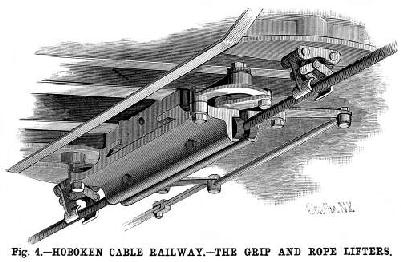
The Endres bottom grip was heavy and powerful, with three foot jaws. Behind and before each grip were a pair of claws, which could be lowered to pick up the cable. This unusual feature probably damaged the cable. The company used the thickest cable in the industry, 1 1/2".
from Notes and Items. From The Street Railway Journal, August, 1885. Volume I, Number 10.
The Hoboken Cable Road will be running, engineer Endris (should be "Endres" -- JT) says, by Aug. 5th.
The cars carried a grip on each truck. The grip was operated by a vertical wheel on the platform. The same wheel operated both the grip and the wheel brakes, depending on the setting of a lever next to the wheel.
from Notes and Items. From The Street Railway Journal, March, 1886. Volume II, Number 5.
Messrs. Poole & Hunt, who, as noted in our last issue, put in the cable machinery plant of the New York Tenth Avenue line, also designed and built the machinery for the Chicago Cable Railway, the Kansas City Cable Railway, and the North Hudson Railway Co., of Hoboken, N. J., the last of which is an elevated structure. They have recently perfected some improved grips, track brakes and rope lifts for the Hoboken road that it is thought will overcome many of the difficulties that have often made trouble on the New York & Brooklyn bridge. Boston, Mass.
Approaching the ferry terminal, cars dropped the cable and coasted into the station, switching from the the down-bound track to the up-bound. The single track in the station was flanked by wide platforms. Arriving passengers used the front door to exit onto one platform; at the same time, departing passengers entered the rear door of the car from the other platform. According to Scientific American, a car could load and unload in one minute. Already on the right track, the gripman could pick up the rope and depart.
Read about problems on the line:
- "Operations on the Hoboken Cable Elevated Railroad, between Hoboken and Jersey City, were suspended yesterday in consequence of the cable slipping from the drum in the engine house on Jersey City Heights. A carload of passengers were compelled to walk along the structure to the Hoboken depot in consequence of the stoppage." (Brooklyn Daily Eagle, Monday, February 8, 1886)
- "Panic in a Hoboken Elevated Car/ The Cable Grip Broke and the Car Rushed Toward the Ferry, But Was Finally Checked" (New-York Tribune, Thursday, February 10, 1887)
The line was electrified in 1892, and the viaduct carried trolley cars until 1949. It was dismantled in 1950.

The Weehawken Viaduct and elevators being demolished (Source: "End of a Big Viaduct" (New York Tribune, Monday, March 5, 1900)). The North Hudson County Railway had another elevated structure to connect the Weehawken ferry terminal with the Pallisades and the Guttenburg racetrack. Three large elevators carried passengers from the ferry terminal up to the viaduct. Blue noses shut down the racktrack. The company abandoned the elevators and the viaduct and replaced them with a snaking trolley line up the Pallisades. Read about the viaduct being demolished in 1900:
John H Bonn, born in 1829 in Norden, East Friesland in what is now Germany, was a firm promoter of Hoboken. He founded the transit companies that merged to become the North Hudson County Railway in 1859. He remained president of the company through the cable era. Read about his life and work in "History of Essex and Hudson Counties, New Jersey" by William H Shaw, available at Accessible Archives Full-Text Databases.
I miss Al Mankoff's site (www.almankoff.com), which had many interesting articles, including chapters from his book Trolley Treasures on Hoboken transit.

The heavy Endres bottom grip used on Hoboken cable cars. Note the cable lifters before and after the grip. (Source: Image courtesy of Rail-Road Extra). January, 2022 Picture of the Month. 
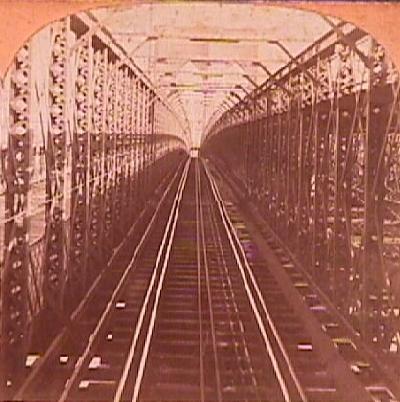
A stereo view of the Hoboken elevated. (Source: Robert Dennis Collection of Stereoscopic Views, Photography Collection, Miriam & Ira D. Wallach Division of Art, Prints & Photographs, The New York Public Library. Image id: NYPG90-F458 005F. Available from American Memory). Smaller version. January, 2012 Picture of the Month. 
A Hoboken electric car ascending to the Pallisades on the former cable line. Hoboken's Elevated Road. From The Street Railway Journal, April, 1885. Volume I, Number 4.
Hoboken is to have an elevated railway; trestles are up, tracks laid, paint on, etc. Everything substantial. North Hudson C. R. R. has the franchise.
Structure all wrought iron, resting on heavy brick piers, built on piles driven ninety feet (in meadows 100 feet). At this point grade very heavy, the highest point ninety-seven feet from ground. Peculiar feature in construction of the iron trestle is the lattice work on every column, beam and girder. It is designed to run cars by traction cable similar to that on the Brooklyn Bridge. Traction plant built by Poole & Hunt, Baltimore; two 500-H.P. engines been built by Watts & Campbell, of Newark. Both ready for use. Building on Palisade Avenue, top of hill, 120 by 80, will contain engines and traction plant; upper part used as terminal depot.
Here the tracks, which are fourteen feet above surface, will pass over driving apparatus and machinery. Large boiler house been built, solid brick, adjoining depot; four steel boilers, 125-horse power each, put in. One end of boiler house occupied by chimney ten feet square at base and 100 feet high.
At Hoboken Ferry the depot is 170 by 40 feet; tower story a massive brick structure, carrying handsome frame superstructure for elevated station above. Ground floor will be used for offices and waiting rooms. Proposed to have three stations between ferry and hill and to run cars every minute. Pullman & Co. are building cars; not yet received. Company hopes to have road open for travel by June. Engineer Endrus (should be "Endres" -- JT) is supervising work, and pushing it as fast as practicability will permit. Although road is not quite a mile and a quarter long, it is estimated to have cost over half a million.
It is said that as soon as road is in operation company will extend to Court House and Union Hill. Intention is to eventually run to Fort Lee, which will afford magnificent view of the Hudson from the Palisades.
from Poor's Directory of Railway Officials, 1887
P. 249
North Hudson County Ry. Co. operates 12.75 miles of horse and 1 1/4 miles of elevated road, double-track, owns 620 horses and 116 cars and also 10 cable-cars. -- John H. Bonn, Pres., F. J. Mallory, Sec., F. Michel, Treas., Nicholas Goelz, Supt.. -- GENERAL OFFICE, Hoboken, N. J.
from History of the North Hudson County Railway, 1898
... Mr. Goelz built the road which then ran from about Nineteenth Street, Weehawken, to the foot of Washington Street, Hoboken. The first rail was laid on or about August 31, 1860, and the railroad completed December 1st, 1860. The cars were started to run on December 15th, 1860, and at the same time the stages were taken off, but continued to run from Union Hill to 19th street, Weehawken, the starting point of the Hoboken and Weehawken Horse Car Railway. It was only a single track road, with turn-outs, but faulty and antiquidated as it would now appear to modern eyes, it made the fortunes of those whose pluck, energy and perseverance carried their idea through to completion. Some idea may be had of the difficulties they had to contend against, when it is known that every car that passed over the road was obliged to pay toll on the old plankroad.
About two years later, 1862, the road was extended up the Boulevard to Lewis St., Union Hill. About seventeen years ago, when the Boulevard was graded, the road was rebuilt with double tracks, and cars were run on ten (10) minute headway at that time. The cars came up the hill on a road of the company's from the foot of the Hill to Palisade and Hoboken Avenues, to where the present elevator is now located at Palisade Avenue and Ferry Street. The drawing of the cars up the Hill required the services of four horses, and was necessarily very slow, but the progressive minds of the late Mr. John H. Bonn and Nicholas Goelz soon devised other means of obviating the difficulty. In 1874 a steam elevator (funicular - JT) was built (the first one in the country) by which the cars (with horses attached) were taken up the hill in one minute. They secured the services of Mr. J. J. Endres, engineer, who made the plans for the elevator as well as superintended its construction. The elevator proved a great success, and was the indirect cause of the building up of old Hudson City so rapidly. The rapidly increating population made it imperative for the company to devise some other means of transportation, as the old elevator's years of usefulness had passed.
In 1884 the officers of the company, therefore, decided to build an elevated road from the Hoboken Ferry to Jersey City Heights, thus dispensing with the inclined plane and stationary engine formerly employed at the head of Ferry Street for elevating cars and horses from the base to the summit of the Heights, the drawing of the plans and the kind of structure to be erected, being again confined to Engineer Endres, and the result was the structure which stands to-day as a model of engineering skill, overcoming the greatest difficulties of building an iron structure ninety-eight (98) feet high, through a marsh where the solid bottom could only be reached in some places, at a depth of eighty (80) feet. The motive power used on the elevated railway was a cable, furnished by John A. Roebling, Sons Company of New York. But the largest part of the operating mechanism was made by Poole and Hunt, Baltimore, Md. Thus the company has the proud distinction of having constructed the first elevated cable railway in the United States.
Go to top of page.
Essex Passenger Railway/Newark and Irvington Street Railway

A later view of the Pennsylvania Railroad station on Market Street in Newark, the terminal of the cable installation. line: Springfield Avenue/Market Street
opened: 06-Mar-1888. Springfield from 10th Avenue to Arlington Street. Market Street to the Pennsyvania Railroad depot.
powerhouse: Springfield Avenue and Bedford Street
grip: Rasmussen "chain pump" non-grip
gauge: 5' 2 1/2"
cars: ?
terminals: ?
crossings: N/A
notes: The United States Cable Railway Company persuaded two horse car operators in Newark, New Jersey, the Newark and Irvington Street Railway and the Essex Passenger Railway, to allow them to make an experimental installation of the Rasmussen non-grip system. This installation followed a brief test on the tracks of the Chicago West Division Railway. The track on Springfield belonged to the Newark and Irvington company and the track on Market to the Essex Company.
An experimental electric railway installation by Professor Leo Daft (no kidding) may have soured Newark on electric operation.
from the Columbus Daily Advocate, 11-June-1886

Perhaps the company wanted to change its motive power because of this 1886 fire which killed 50 of its horses.
The United States Cable Railway Company promoted Charles W Rasmussen's patents for a system which was intended to be inexpensive to install on existing horse car lines. Rasmussen's system used small four-wheeled trucks which were attached to the cable at about 6 foot intervals. The trucks ran on rails formed into the sides of the small conduit. The driving sheave in the powerhouse had slots at suitable intervals for the trucks; this was simpler than the drivers and idlers with multiple wraps needed for regular cable traction. Curves were also simpler. The tracks in the conduit banked around the curves, allowing the trucks to ride around. The rolled iron conduit required an excavation only 8 inches deep. The company claimed it could be laid between the rails of a horse car line.
In Chicago, the non-grip mechanism was a large cog wheel attached under the floor of a horse car. The cog wheel passed through the slot of the conduit and the teeth of the wheel engaged buttons attached to the trucks. A goose neck on the car's platform controlled a brake on the cog wheel. Loosening the brake would allow the wheel to rotate and the car to stop. Tightening the brake would stop the wheel and impart motion to the car.
The cog wheel had not worked well in Chicago, so the US Cable Company tried an arm with four claw-like prongs which were to grab the trucks. The Newark installation was not a success. According to one account, the claws could grip the trucks, but had trouble letting go. Crews had to jump off the cars, find a telephone, call the powerhouse, and ask them to stop the cable.
Other problems included the fact that normal stretching of the cable made the distance between the trucks vary so that the slots on the driving wheel had trouble engaging the trucks and the buttons. The cast iron trucks were brittle and frequently broke. Sometimes the trucks would get off the tracks in the conduit and get jammed.
The installation was eventually taken over by William Heckert, who replaced the claw with a link belt under the car. It didn't work any better.
The Newark line was out of service by December, 1889. If the installation had worked, the next one would have been in Milwaukee.
from MODIFIED CABLE SYSTEMS. From Street Railways: Their Construction, Operation and Maintenance, by CB Fairchild, 1892.
Another system, known as the "Chain Pump Cable" was constructed on an extensive scale in the city of Newark, N. J., but was never put into service. This system employed a wire rope of ordinary size, having a wire core. Attached to this rope, every six or eight inches were metal collars or buttons, about three inches in diameter, securely held in place by being pressed on in halves and the parts riveted together and babbited. This rope thus equipped was mounted in a shallow conduit close to the slot, and was carried upon small two wheel trucks, about ten feet apart, to the axle of which it was securely attached, so that the trucks travelled with the cable, small tracks for the wheels being provided in the bottom of the conduit. The truck wheels were about six inches in diameter, mounted loose on six inch axles. The rope was made to travel slightly to one side of the slot, bringing the side of the button directly under the opening. Power was transmitted to the car by means of a sprocket wheel hung under the car, the arms of which engaged with the buttons through the slot. The car was started by means of a band brake, in about the same manner as described for the ladder cable system. In place of the sprocket wheel a revolving metal belt was afterward substituted. This belt was provided with arms which were designed to engage with the axles of the travelling trucks, the object being to dispense with the buttons and depend only upon the trucks to impart motion to the car. In this system the cable was driven by means of a single horizontal pulley, having chambers or pockets in the face of the rim of sufficient depth to receive the buttons and trucks. Around this driving pulley the cable made but one wrap, being driven by the contact of the buttons against the shoulder of the chamber. The proper tension was maintained by means of a tension carriage placed in a vault at the end of the line, the pulley of which was provided with chambers the same as the driving sheave, and was also mounted upon its car in a horizontal position. The curve pulleys were also provided with pockets. An attempt was also made during this experiment to avoid the use of curve pulleys, by placing the tracks in the conduit in a perpendicular position on the side of the conduit, with spiral approaches, so that the trucks would lead the rope around the curve.
from Milwaukee, Wis. From The Street Railway Journal, October, 1893. Volume IX, Number 10.
In seeking a franchise for this system, the new company proposed to operate by the Rasmussen cable system, or "Chain Pump Cable System," as it was called, in which the rope was provided with buttons every few inches, which were intended to engage with the sprocket wheel on the car, but the project of operating by cable was abandoned after the failure of this system in Newark, N. J., where five miles of line were equipped, but never operated.
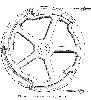
A Rasmussen driving drum with slots for the trucks. It was intended to be expandable to deal with stretching of the cable (Source: The Heckert System of Cable Railroads" From Manufacturer and Builder / Volume 20, Issue 12, December 1888). March, 2002 Picture of the Month. from Poor's Directory of Railway Officials, 1887
P. 249
Essex Pass. Ry. operates 31 miles of road, owns 702 horses and 128 cars. -- S. S. Battin, Pres., F. T. Kirk, Sec. & Treas., H. F. Totten, Supt.. -- GENERAL OFFICE, 786 Broad St., Newark, N. J.
Newark and Irvington RR. Co. operates 3.5 miles of road, owns 132 horses and 20 cars. -- S. S. Battin, Pres., W. L. Mulford, Sec., H. F. Totten, Supt.. -- GENERAL OFFICE, 786 Broad St., Newark, N. J.
Electric traction survives until the present in Newark because of the Newark City Subway, built in the bed of the Morris Canal. Subway service started on 18-Nov-1929. Various streetcar lines fed into the subway to reach downtown. As surface lines were abandoned, all-subway service survived, using former Twin Cities Rapid Transit PCC cars beginning in 1952. The last day of PCC service was 24-Aug-2001. The official last revenue car was number 6, but because of heavy crowds, number 14 carried the last paying passengers. Number 14 went to San Francisco on loan, arriving on 13-Feb-2002. Kinki Sharyo LRVs now serve the subway. Muni purchased 11 of the PCCs in 2004 and tried to put them in service right away to relieve crowding on the F line, but found that the well-used cars needed work. After thorough refurbishment, the cars went into service in 2011-2012.

San Francisco Municipal Railway car 1080, formerly Public Service 9, waits to turn from Steuart Street into Don Chee way on 02-March-2012. It had to wait because a tourist couple had driven their car into the private right-of-way. A kind Muni employee helped them back out. Go to top of page.
Washington Street & State Asylum Railroad

The Perry Building of the Binghamton Asylum. line: Asylum.
opened: 06-Nov-1885. Grounds of State Asylum.
powerhouse: ?
grip: Fairchild dual cable non-grip
gauge: 4' 0"
cars: double truck, single end
terminals: loops
crossings: N/A
notes: Binghamton lies at the junction of the Susquehanna and Chenango Rivers, on the "Southern Tier" of New York State. Binghamton has never been an industrial center -- the town was nicknamed "Parlor City" in the 1870's because of the lack of anything to do but sit in one's parlor -- but the East Side of Binghamton is home to the Binghamton Psychiatric Center.
Doctor J Edward Turner founded the Binghamton Inebriate Asylum in 1854. Doctor Turner was a pioneer in treating alchoholism as a medical condition rather than a sin. In 1858, Doctor Turner and his associates hired architect Isaac Perry to build a castellated Gothic hospital building on the 200 acre site. Construction finished in 1866. Now called the Perry Building, it is closed and in deteriorating condition. In 1999, the National Trust for Historic Preservation added the structure to its list of "America's Eleven Most Endangered Historic Places".
In 1879 the Inebriate Asylum became part of the state's system of mental hospitals. Over the years the Binghamton facility evolved through different names and different missions into the current Binghamton Psychiatric Center. The Center now provides outpatient services and vocational training.
People wanting to visit the facility in the 19th Century could ride a horsecar of the Washington Street and State Asylum Railroad from the riverside or the train station in Binghamton to the Asylum grounds, but then faced a stiff climb to the main building at a 250 foot elevation. The horsecars could not handle the ascent through the grounds of the Asylum, so the company looked for another mode of traction.
from Notes. From The Street Railway Journal, May, 1885. Volume I, Number 7.
The Washington St. & State Asylum, R.R. Co. (Binghamton, N. Y.), will extend its line to the Insane Asylum, a distance of 1 miles, using cable power.
They allowed CB Fairchild, "a teacher in one of the New York public schools", according to the Brooklyn Eagle, and later publisher of the Street Railway Journal, to install a test version of his non-grip twin cable system on the grounds of the asylum in November, 1885.
A Cable Road Without Grips. From The Street Railway Journal, March, 1886. Volume II, Number 5.
A new system of cable railway is being tried at Binghamton, New York, which is of especial interest, because it dispenses altogether with the grip. Two cables are used, one driven in the ordinary manner by a stationary engine, the second, and smaller, cable taking motion from the first. This second cable is led continuously over a loose drum or pulley fixed under the car. While the drum is free to revolve, the cable simply imparts motion to it and the car does not move, but by the application of a brake stopping the motion of the drum, the car is carried forward with the cable.
The Fairchild system used a pair of cables. A heavy endless cable, much like a normal street railway cable, ran along the line on sheaves, and was driven by a stationary engine in a powerhouse. The sheaves turned by the heavy cable shared axles with sheaves which drove a lighter cable. The lighter cable passed over pulleys up into a car and turned a drum. Through a clutch, the drum turned driving gears which could move the car forward at the speed of the cable, forward at twice the speed of the cable, or backwards at half the speed of the cable. The ability to control speeds was an innovation. A major benefit of the system was the lack of wear on the heavier cable.
Records of the installation are scarce, but it was not a success. I can see several potential problems. I'm not sure how well the heavier cable could have driven the lighter one. The Brooklyn Eagle also reported that: "The road is made to show every possible condition of a street car line. There is single track, double track, level road, different grades and every conceivable turn and curve with the cable running above and below the surface." I don't see how the lighter cable could have risen out of the slot of a conduit and back down safely in actual street running. Two lines could not have crossed each other. The Brooklyn Eagle also reported that: "The track is laid in a loop or circle of sixty feet radius at either terminus of the road so that the car can make the circle and continue on the return trip without stopping". The line could not have ended in anything but loops. It would be impossible, I think, to have a switch, and it would be very difficult to take a car out of service.
Despite the optimistic reports in a newspaper story ("Improvement On Cable Roads/A New System in Successful Operation at Binghamton", Brooklyn Daily Eagle, 15-November-1885), the cable system did not last long. It may never have functioned properly. I won't make the obvious comment about building a system like that on the grounds of an insane asylum. It may have been replaced by a funicular. The Center is now served by Broome County buses.
from MODIFIED CABLE SYSTEMS. From Street Railways: Their Construction, Operation and Maintenance, by CB Fairchild, 1892.
The third modification, known as the "Twin Cable System," was tried on a short experimental line in the city of Binghamton, N. Y., and was operated successfully for about two years, the grades on the line being over twelve per cent. By this method two cables are operated side by side, one being a rope of ordinary size, and the other a small rope only one-half inch or less in diameter. The large rope was driven in the ordinary manner, and the small or secondary rope received its motion and power by means of its frictional contact with the same curve and carrying pulleys upon which the main cable travelled. The terminals of the line were necessarily constructed with a loop. Power was transmitted to the car by means of the small rope which was led up through the slot over a loose pulley mounted under the car. Two thin guide pulleys were provided which revolved with one edge through the slot and so protected the cable from chafing against the side of the slot, and also conducted it back to its place in the conduit. The car was started and stopped by means of a band brake on the middle pulley, thus avoiding the wear due to the grip in the ordinary systems. Only a shallow conduit was required.
This system has been further improved by introducing a train of differential gear with friction clutches between the cable pulley and the car axles, by means of which the car can be run twice as fast as the cable, or be run at half speed in the opposite direction. In practice the car is designed to have varying speeds in both directions. It is run at cable speed or double speed, and half speed backwards, at the will of the driver.
from Street Railway News. From The Street Railway Journal, August, 1888. Volume IV, Number 8.
I don't know Binghamton geography, but I assume this was a funicular in another location, not the one that replaced the line on the grounds of the asylum.
Binghamton, N.J.
The Washington Street & State Asylum Railway Company has put in about half a mile of cable on the Ross Park end of the road on the tail rope system, and is running one car, which connects with the electric car at the bridge. It was found that the electric motors were too slow on these grades of six and eight per cent. A 12 H. P. engine furnishes the power, and the rope, one half inch in diameter, is wound up on a drum or windlass, made of wood and about six feet in diameter. The car travels down the grade by gravity and hauls out the rope.
Ivan Furlanis reports that the Sassi-Superga line, near Turin, Italy, was built as a cable-driven cog railway which used a system somewhat resembling Fairchild's. A cable ran along the side of the track and passed into and out of the "grip" cars by pulleys. Through a gear train, the pulleys drove the four cog wheels that propelled the train. There was also a reverse gear. Trains of one to three cars were hauled on the electric interurban line from Turin to Sassi. They were then coupled ahead of the "grip" or Locomotore car and pushed up the hill to Superga. The grip car did not carry passengers. The Sassi-Superga line opened on 27-Apr-1884. On 24-Oct-1934 it was closed and replaced by an electrically driven rack tramway. It was considerably more successful than the Fairchild system. Thanks to Ivan for the details.

A train on the Sassi-Superga line. Note the huge pulleys on the side of the "grip" car (Source: ATM (Azienda Torinese Mobilita S.p.A.). Italian Cable Railway. From Popular Mechanics, December, 1909.

On a mountain cable railway in Northern Italy the ordinary cables are supplemented by a "locomotore," the wheels of which are geared to grooved pulleys. The effect of the cable working on the pulleys on a tangent forms the tractive force, and this, it is said, admits of the employment of a cable not much more than half the size of those required under the ordinary system of cable operation. The grooved pulleys are the large wheels attached to the side of the locomotive shown in the illustration.
The method of working the system is as follows: At the top of the railway, which is 3,400 yd. long and contains gradients of 15 per cent, are placed two vertical power-driven pulleys around which the continuous cable is wound, imparting to the latter the motive power. The cable is then passed over a horizontal drum, then down over the track to the lower end of the railway, over another drum, and then back again to the top of the incline over small grooved pulleys placed along the center of the track. On the way it is wound around the vertical pulleys of the locomotive, to which it imparts motion.
The cable experiment was not the Washington Street & State Asylum Railroad's only pioneering effort. An 1887 list of electric railways in Manufacturer and Builder magazine notes: "Binghamton, N. Y -- Washington Street & State Asylum Electric Railroad; over-head conductor, five and a half miles; Van Depoele system". Charles J. Van Depoele built several pre-Sprague electric systems.
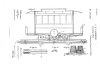
Fairchild's patent 300236. April, 2012 Picture of the Month. from Poor's Directory of Railway Officials, 1887
P. 254
Washington Street and State Asylum R.R. Co. operates 3.5 miles of road, 23 horses and 12 cars. Leased to George W. Stow, and operated by him in connection with the Park Avenue R.R., which he also leases. Directors, George Whitney, R. H. Meagley, F. W. Whitney, Geo. F. Lyon, Warren N. Bennett, Ira J. Meagley, Edward K. Clark, R. Hooper, Isaiah S. Mathews, Allen Perkins, William R. Osborn, Erastus Ross, Frederick E. Ross, Binghamton, N. Y. -- Robert H. Meagley, Pres., Geo. Whitney, Vice Pres., Frederick E. Ross, Treas., I. J. Meagley, Sec., Henry C. Merrick, Eng., Wm. Whitney, Supt. -- GENERAL OFFICE, 216 Front St., Binghamton, N. Y.
Go to top of page.
Brooklyn Cable Company

The Fulton Ferry terminal, next to the East River Bridge, was the intended destination of the Brooklyn Cable Company. line: Park Avenue
opened: 06-Mar-1887. Park Avenue from Grand to Broadway.
powerhouse: Grand Avenue and Park Avenue
grip: Johnson ladder cable non-grip
gauge: 4' 8 1/2"
cars: ?
terminals: ?
crossings: N/A
notes: The Atlantic Avenue Railroad, a horse car operator, allowed the Brooklyn Cable Company to set up an experimental installation of the Tom L Johnson ladder cable system on its Park Avenue tracks. Had the experiment been successful, the cable line would have run from the Fulton Ferry to cemeteries in central Brooklyn.
from The American Railroad-Journal, March, 1884
from Tramway Notes.
WILLIAM RICHARDSON, president of the Atlantic avenue Railroad Company, is about to apply to the Brooklyn Common Council for permission to operate the horse cars of his road, at the Adams street hill, by means of a cable.
from MODIFIED CABLE SYSTEMS. From Street Railways: Their Construction, Operation and Maintenance, by CB Fairchild, 1892.
So far we have confined our description to the standard cable systems which use a vise or roller grip for transmitting power to the car. Other systems, however, have been devised and deserve a brief description. One of these, known as the "Ladder Cable System," was operated for some time in the city of Brooklyn, N. Y., but afterwards abandoned. The distinctive feature of this system was in the construction of the cable and in the car connection. The hauling cable was made of two wire ropes, each about three-fourths of an inch in diameter, and composed of six large wires one-fourth of an inch in diameter without a hemp core. These ropes were placed side by side, about an inch apart, and connected together every six or eight inches by steel or bronze clips, forming a ladder. This cable was mounted to run on split pulleys in a shallow conduit directly under the slot.
Underneath the car a sprocket wheel was hung, having suitable teeth, which, when lowered through the slot, engaged with the clips of the cable, and caused the wheel to revolve. To start the car a band brake was applied to the sprocket wheel, which checked its motion and caused the car to move with the cable. At the terminals and cable crossings the sprocket wheel could be readily lifted from the slot. The cable was driven in the ordinary manner, by solid drums having grooves or channels wide enough to receive the flat side of the cable.
from Notes and Items. From The Street Railway Journal, August, 1885. Volume I, Number 10.
Thomas L. Johnson, President of the Cleveland St. Railway Co., and inventor of the new cable system, has examined the plant of the Brooklyn City Railroad Co. with a view to the use of his system on its road. He will prepare a minute estimate of the expense of putting his system on Fulton street from the Ferry to East New York. The estimate will cover every item pertaining to the road from the cost of laying conduits and establishing the driving plants with their big boilers and giant engines to the wear and tear on the grip, so that the exact cost of building and maintenance may be ascertained beyond question. No system yet shown Mr. Hazzard and his associates has appeared to possess so many advantages as this of Mr. Johnson.
from Notes and Items. From The Street Railway Journal, August, 1885. Volume I, Number 10.
The new cable road on Atlantic avenue, Brooklyn, N. Y., has been commenced.
Read Brooklyn Eagle articles about the line being planned:
"WANTS TO USE THE CABLE"
"CABLE ROAD/The Aldermen Inspect the New York Variety" (Brooklyn Eagle, 14-Apr-1886.)
"MR. RICHARDSON'S CABLE ROAD"
"TO ADOPT JOHNSON'S SYSTEM/The Cleveland Cable to be Put on Richardson's Road."Read about the line being built:
"CABLE ROADS/Universal Interest Excited by the Brooklyn Experiment"
"BUILDING THE CABLE ROAD"
"The Cable System Authorized on Park Avenue/To be Abandoned Altogether if it Does Not Prove Successful on that Thoroughfare..."
"THE PARK AVENUE CABLE ROAD"Read about the lease arrangement which allowed the promoters to use the facilities of the Atlantic Avenue Railroad:
"LEASED THE CABLE ROAD"
Milton Wheaton's patent 192314. The "griper." May, 2012 Picture of the Month. 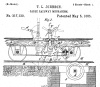
Tom L Johson's patent 317,139 proposed replacing the "griper" with a cog wheel. The Johnson ladder cable system was developed by Milton A Wheaton, but was promoted by Cleveland politician and traction magnate Tom L Johnson. Like other non-grip and shallow conduit systems, it was intended to allow quick, cheap conversion of horse car lines to cable. It used not one but two thin cables, running in parallel and connected by metal "rungs" every 6 inches. I have trouble picturing how the dual cable could have gone around a curve. In the original plan, the transit car's grip would be a prong which would reach down and grab a rung. Later, the developers attempted to use a large cog wheel. Unequal stretching of the two cables must have caused problems. The system had been tested briefly in Cleveland and Cincinnati.

Wheaton's patent 192314. The ladder cable. No thumbnail. 
Tom L Johson's patent 317,139 used a different method to form the ladder. 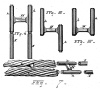

Wheaton's patent 192314. The cable wraps around a terminal sheave. A view from above. Read a Brooklyn Eagle article about the early tests:
"A GOOD START". This article mentions that the ladder cable system was installed on a small portion of the line. Horses hauled the cars over the rest of the line the Fulton Ferry. "With the grip arrangement (the cars) weigh much more than those on other roads and ordinary car horses could not move them. President Johnson has been compelled to select special horses, and as a result he has one hundred of the finest ever seen in the city." A later article, "HORSES DYING", describes the effect of this work on the animals.Despite the claims of articles like "EXTENDING THE CABLE ROAD", the ladder cable system did not work and the entire line reverted to horse power.
Before the company gave up on cable traction, it was faced with some of the typical problems faced by cable traction companies. "WERE THEY BROUGHT FROM CHICAGO?", describes horses losing their shoes by catching them in the slots. "A CABLE CAR ACCIDENT" describes a pedestrian who was injured when his foot got caught in the slot. "THE FIRST VICTIM" describes the sad death of a three year old who fell beneath the wheels of a car. "THE CABLE ROAD CASUALTY/Nobody to Blame for the Death of Seth Low Fisher" describes the results of the inquest. The jury's verdict: "We, the undersigned, do find that Seth Low Fisher came to his death by being accidentally run over by car 23 of the Park avenue Cable Railroad. We also find that no blame attaches to the brakeman and conductor of said car." "ITS FIRST SMASH/A Mishap on the Park Avenue Cable Road" says "The cable road on Park avenue yesterday encountered its first serious mishap since it was put in operation, four months ago." Apparently the death of Seth Low Fisher was not a "mishap."
from Notes and Items. From The Street Railway Journal, April, 1887. Volume III, Number 6.
Brooklyn Cable R. R. Co. The line began making regular trips March 6. The power was supplied by a 250 H. P. engine at Grand and Park avenues. The route is from Broadway, E. D., through Park to Washington avenue, thence to Yanderbilt avenue and Fulton Ferry. The tracks of the De Kalb avenue line are used as far as Washington and Concord streets, thence they are continued to Navy street, and running into Park avenue extend to Broadway. At present the cable portion of the road begins at Grand avenue, though the cable traction will shortly be extended all the way to the ferry in one direction and a mile and a half along Central avenue to Evergreen Cemetery in the other. The company derive their rights from an eighty-nine year lease of a franchise secured from Deacon William Richardson. Its promoters and almost exclusive owners are Thomas L. Johnson, his brother, A. L. Johnson, of Cleveland, and A. J. du Pont. The most important difference between the Johnson system, in use by this company, and those commonly in use, is in the construction of the cable itself. This consists of two three-quarter inch cold wire ropes with a cotton core, laid side by side at a distance of an inch apart, and connected together at every six inches by steel bands, or lugs, and presenting somewhat the appearance of an elongated and extremely narrow rope ladder. It is by means of these lugs and not by any grip of the cable that the cars are propelled. They are the only portion of the cable visible through the iron slit, or slot, at the top of the conduit through which the cable travels. Underneath the center of the car is a wheel with twelve peculiarly shaped spokes, and when the car is ready to start this wheel is let down until its spokes are caught and turned by the lugs, and in this manner the propelling force for the vehicle is furnished. The rate of speed obtained at present is seven miles an hour, and will ultimately be increased to nine miles. The company will soon have enough cars to dispatch them under three minutes' headway.
IT PULLS OFF HORSES' SHOES/ An Effort to Have the Park Avenue Cable Pronounced a Nuisance discusses common complaints about cable traction: "The principal complaint against the cable is that the slot in which it is worked is just narrow enough to hold the cog of a horse's shoe and wrench it from the foot. The cable men say if they make the slow wide boys will tie tin cans to the cable and thereby make a dangerous nuisance." Attaching tin cans to the cable was a popular trick in San Francisco many years ago.
The Rope Broke talks about a breakage of the ladder cable, requiring horses to pull cars over the whole route.
DISSATISFACTION ON THE CABLE ROAD talks about how pioneering labor union the Knights of Labor fought unfair conditions on the road.
WON’T BE RASH/Mr. Richardson Will Examine the Facts talks about how Richardson got rooked by the cable people. It proves that the cable system was abandoned before 20-July-1887.
from Electricity, Steam, Cable, or Horse Power? From Western Electrician, November 12, 1887.
"I have omitted stating that in Brooklyn there is on trial a new kind of cable. It is composed of two cables about three-fourths of an inch apart with short bars across about every eight to twelve inches like a rope ladder. Thus far the builders have attempted to run on straight lines only. The system is in an experimental state as yet. It will cost more than the Rasmussen system.
Tom L Johnson, a political follower of Henry George, invented a farebox for transit use in 1880. He founded the Johnson Farebox Company. He began to develop a registering fare box, which led, after his death, to the famous Type D. Johnson-type fareboxes and belt changers are still produced by Lynde-Ordway.
When Johnson was mayor of Cleveland from 1903 to 1910, Peter Witt was city clerk.
Read about the death of William Richardson:
"The Passing of Richardson"from Poor's Directory of Railway Officials, 1887
P. 249
Atlantic Avenue R.R. Co. operates 7 miles of road, having an aggregate mileage of 33.08 miles, the main line of which is on Atlantic Avenue. Of the mileage owned, 9.75 miles, from Flatbush Avenue, Brookly, to Jamaica, L. I., is leased to the Long Island R.R. Co. I also owns 938 horses, 251 cars and 39 other vehicles. Directors, William Richardson, Frederick A. Schroeder, Newberry H. Frost, Wm. A. Read, James S. Suydam, Benjamin F. Tracy, Samuel W. Bowne, James H. Kirby, Henry Meyer, William F. Redmond, Augustus Storrs, John Q. Jenkins, W. J. Richardson, Brooklyn, N. Y. -- Wm. Richardson, Pres., Wm. J. Richardson, Sec., N. H. Frost, Treas. -- GENERAL OFFICE, Atlantic and Third Aves., Brooklyn, N. Y.
Go to top of page.
Nassau Cable Railway
Cable Railway Notes. From The Street Railway Journal, May, 1885. Volume I, Number 7.
In Brooklyn, a cable railway company has been reorganized and a commission appointed. The Nassau Cable Railway Company is the company's name. The commission reported that a cable road was not needed. This report has not yet been acted upon by the Court.
Go to top of page.
Brooklyn and Long Island Elevated Cable Railroad
from The American Railroad-Journal, March, 1884
from Tramway Notes.
A NEW plan of rapid transit in Brooklyn, is projected. The company having the project in hand is to be known as the Brooklyn and Long Island Cable Railway Company. The incorporators are Austin Corbin, William Richardson, J. Rogers Maxwell, Newberry H. Frost, Frederick A. Schroeder, Henry W. Maxwell, Charles Storrs, William B. Kendall and Samuel W. Bowne of Brooklyn, and Henry Graves, of Orange, New Jersey. The capital stock of the company is $1,000,000, with the privilege of increasing the same to $5,000,000. The new company is the result of a combination between the Long lsland Railroad and the Atlantic Avenue Railroad men. The proposed routes of the company will be a scheme of rapid transit meeting the needs of the city in an even and approximately perfect manner. Work on the new road will be begun just as soon as the consent of the mayor and common council can be obtained. William Richardson, president of the Atlantic Avenue Railroad Company, says that it will not be necessary for the company to have a commission appointed as under the act of 1875, because it intends to proceed under the cable act of 1866. If the mayor and aldermen grant consent, and no unforeseen legal dilliculties obstruct the progress, the company expects to have the entire road completed within a year. It is claimed that by means of the stationary engine and cable system a speed of thirty miles an hour, if necessary, can be attained on the proposed elevated road.
from Notes and Items. From The Street Railway Journal, August, 1885. Volume I, Number 10.
J. R. Maxwell, president of the Brooklyn & Long Island Elevated Cable Railroad Company, says: -- You can depend on it that if any people can make the cable road a thorough success we can and will. We are going to build a structure strong enough to bear a Pullman car, and that is about equal to a thirty-five ton locomotive.
Go to top of page.
Brooklyn Heights Railroad

Postcard showing Brooklyn Heights cable cars on Montague Street. line: Montague Street
opened: 20-Jul-1891. Montague Street from Court Street to the Wall Street Ferry landing.
powerhouse: State and Hicks. The cable reached Montague by a long blind conduit on Hicks. "The Montague street cable line, consisting of about one-half mile of track, operating from Wall Street ferry to City Hall in Brooklyn, is operated by the cable power house on State street, where a 225-horse-power tandem compound engine supplies the necessary power. The steep grade near the Wall Street ferry, together with the fact that cars coming down the grade, retaining grip on the cable, assist in pulling cars up the grade, make it desirable from a commercial point of view to continue the operation of this line as a cable road, rather than to substitute electric traction." (Source: The New York Electrical Handbook, 1904).
grip: Gillham double-jaw side.
gauge: 4' 8 1/2"
cars: Single truck double-end closed and open bench.
terminals: crossovers
crossings: N/A
notes: The most successful street-running cable line in the East climbed a fairly steep hill on Montague Street in Brooklyn, connecting the Wall Street Ferry with the City (later Borough) Hall area. The promoters considered using a Bentley-Knight conduit electrification, but the limited power of early electric cars helped them decide to use cable propulsion.
Robert Gillham, who had built some of the most important lines in Kansas City, designed the installation. He used the same double-jaw side grip he had created for the Kansas City Cable Railway, but adapted it to work with a horizontal wheel rather than a lever. Wheel and track brakes operated off of one lever. In 1895, the company experimented with air brakes. The company initially used a locked-coil rope, which could not be spliced, only welded. They gave up after some time and switched to a conventional rope.
from ELECTRIC RAILWAYS. From The Electrical Review, 21-May-1898.
BROOKLYN, N. Y. -- President Rossiter, of the Brooklyn Heights Railroad, says that the Montague Street cable road will not be changed to an underground electric road till next fall.
Property values forced the powerhouse to be located on another street. The line was tested on 15-Jul-1891 and opened on 20-Jul-1891. It was a great success, although Sunday and holiday service stopped in 1898. On 25-Sep-1909, it was converted to electricity. The heavy single-truck cars were suitable for conversion, and continued to run on the line. The Wall Street Ferry stopped running in 1912, but the line continued until 18-May-1924.
Read an 1891 Brooklyn Eagle article about the line being planned:
"TO RUN IN MAY/Cable Cars Will Traverse Montague Street"Read an 1891 Brooklyn Eagle article about the line's first cable being threaded:
"IN THE CONDUIT/Final Preperations for the Montague Street Line"Read an 1891 Brooklyn Eagle article about the line being demonstrated:
"THE FIRST CAR/Travels Over the Montague Street Road/The Directors and the Officers of the Company Inspect the Machinery and Admire the New Vehicles for Travel"Read Brooklyn Eagle articles about accidents along the line:
"DOWN THE HILL/A Cable Car Breaks Away on Montague Street"
"THROWN THROUGH A WINDOW/Singular accident on the Montague Street Railroad"
"BATH OF RED PAINT/Basis of a Damage Suit for $1,700 Instituted by Miss May Against W. J. Cockle"from ELECTRIC RAILWAYS. From The Electrical Review, 14-August-1909.
BROOKLYN, N. Y. -- Permission has been received from the Public Service Commission to change the motive power to electricity on the Montague Street cable line, and the Brooklyn Rapid Transit Company will lose no time in remodeling the line. The decision was given on condition that the company submit plans for approval, and consent of property owners and local authorities be obtained.

Brooklyn Heights Railroad Montague Street cable cars at the Wall Street Ferry terminal, from the 18-July-1897 New York Tribune. June, 2012 Picture of the Month. The Brooklyn Heights Railroad was one of the precursors of the BMT.

The square in front of City (later Borough) Hall was the destination of the Brooklyn Heights Railroad. I think those are two cable cars under the El. 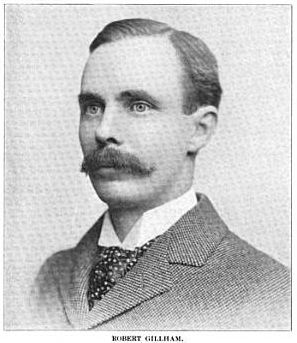
Engineer Robert Gillham designed and built the Brooklyn Heights Railroad in 1891. From the 30-July-1897 Railway Age and Northwestern Railroader. from Brooklyn and Queens Boroughs Street Railroads. From The World Almanac and Encyclopedia, 1899.
Notice. -- Numbers following tbe names of the different routes Indicate the railroad company operating the line, viz.: (1) Brooklyn City R. R. Co. (leased by Brooklyn Heights R. R.); office, cor. Montague and Clinton Sts.
Montague Street Cable Line (1). -- Runs from City Hall to Wall St. Ferry, through Montague St. Does not run Sundays. Transfers with all Brooklyn Heights Railroad lines.
Go to top of page.
West Side and Yonkers Patent Railway
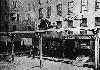
Charles T Harvey making a test run on his West Side and Yonkers Patent Railway in 1867 or 1868. July, 2002 Picture of the Month. line: Greenwich
opened: 01-Jul-1868. Greenwich Street from Cortlandt Street to Battery Place.
extended: ??-Apr-1870. Ninth Avenue to 30th Street.
powerhouse: see below
grip: see below
gauge: 4'10"
cars: double truck closed cars
terminals: ? Cars probably double-ended
crossings: none
notes: Charles T Harvey, a civil engineer, designed and built the West Side and Yonkers Patent Railway, the first elevated rapid transit line.

Proposal for a cable-driven elevated railway. (Source: Exposé of the Facts Concerning the Proposed Elevated Patent Railway. 1866. July, 2012 Picture of the Month. The single track ran above the street on a row of single columns, so the line was called the "one-legged railroad". There were stations at the terminii and at Dey Street. The cables were powered by a series of stationary steam engines in vaults under the street. Fueling and tending the engines must have been labor intensive.
The line did not use a Hallidie-type grip. Harvey's patent 66330 calls for small trucks which would run along a narrow set of rails, each truck carrying "a vertical spur or projection ... that extends upward above the level of the top of the cable-guide..." The "spur can engage or come against the cable-clutch or arm ... of the car." Different reports put the line's operating speed between 10 and 15 mph.
Read contemporary articles from the Brooklyn Eagle about the on-and-off efforts to get the line to run:
Thursday, October 10, 1867 - "The experimental elevated railway on Greenwich street, New York, will soon be in operation."
Saturday, October 19, 1867 - "...the work on the line in Greenwich street, which appeared to have been abandoned has been resumed..."
Monday, October 21, 1867 - "The first mile of the elevated railway in Greenwich street, New York, will be completed in three weeks, or about a month..."
Saturday, November 16, 1867 - "The result was not wholly satisfactory."
Saturday, December 7, 1867 - workers discover a relic
Saturday, December 28, 1867 - "The elevated railroad in Greenwich street will soon be ready for another trial."
Thursday, May 7, 1868 - "A practical test of the work has been again and again promised the last year or two and as often postponed."
Friday, June 26, 1868 - "The time for a trial trip on the elevated street railway in Greenwich street is again fixed."
Wednesday, July 1, 1868 - "The long deferred trial of the elevated road on Greenwich street was made the other day..."
Tuesday, July 14, 1868 - "It is expected to be finished as far as Thirtieth street by September next"
Wednesday, August 25, 1868 - "...there seems to be no prospect of its ever being finished..."
Wednesday, September 29, 1868 - "...regarded by the New York Common Council as a public nuisance..."
Sunday, October 2, 1868 - "The general conclusion, hower, is that if the elevated railway is practicable, the delay in its construction is inexplicable..."
Wednesday, December 8, 1868 - "...evidently a failure..."
Wednesday, May 12, 1869 - "The road, from its origin, has been a mystery of management and a phenomenon of delay."
Monday, July 26, 1869 - "The mysterious delay which attends this elevated enterprise..."
Saturday, December 18, 1869 - "The Elevated Railway Purchased by Commodore Vanderbilt"
Friday, February 11, 1870 - "While the elevated railway on Greenwich street is making its way patiently and cautiously from the Battery to Courtlandt street..."
Tuesday, May 17, 1870 - "Two experimental cars on the Elevated Railroad, in Greenwich street, New York ... smashed through the track, and fell to the pavement..."
Wednesday, May 18, 1870 - "The Elevated Railroad has met the fate of Humpty Dumpty..."
Wednesday, June 15, 1870 - "... this dizzy and dangerous road ..."
Wednesday, July 16, 1872 - "...the tranmission of power by wire ropes, as illustrated in the elevated railway in Greenwich street, has proved a mediocre and insufficient method of propulsion..."
Wednesday, July 26, 1872 - "...estimated the cost of several miles of double track, at $300,000 per mile..."
Friday, April 4, 1873 - "So much to the disturbance, otherwise, of weak nerves belonging to frequenters of Greenwich street..."
Sunday, September 7, 1884 - "The first elevated railroad charter was that of the (New York) West Side Elevated Patent Railway Company in 1868..."
Sunday, February 26, 1899 - "The first cars run over the Greenwich street, New York, elevated railroad, were on July 3, 1869..."An article from the New York Times reports successful testing and gives techinical details, along with lists of investors and officers of the company:
The Elevated Railway; Successful Trial Trips of the West Side Railroad in Greenwich-Street (New York Times, Tuesday, September 7, 1869)The system broke down frequently and stopped running some time in 1870. A contemporary magazine article says "The Greenwich Elevated Railway, which at first was a total failure as long as several stationary engines were used, moving the cars by means of a wire rope, has become a decided success since the employment of small locomotives, each pulling two or three quite long cars."
Another article describes the technology and its problems in more detail: "...the main trouble by which the first management lost considerable money, (and probably the cause of the breaking of the company financially,) were the costly experimental contrivances intended for the propulsion of the trains. They consisted in an endless wire rope of about a mile long, and of which one-half moved over pulleys between the rails, while the returning half moved through a small tunnel underground, along the base of the columns. This however was soon abandoned as utterly impracticable, and both portions of the rope were made to pass between the track, while at the end of each section it passed through one of the hollow columns underground in the celler (sic - JT) of one of the adjoining buildings, which had been hired to place the stationary engine in, the engineer of which started it at a given signal when a train approached his section. As there were several such stationary engines placed from distance to distance, each requiring attendants, the wastefulness of this plan is evident, and it is surprising that this was not seen at the outset, before this great expense was indulged in. Experience soon showed another very objectionable feature, namely, when a train passed from one section to another, the pull of the wire rope, when this moved faster than the train, often caused such a jerk at the moment it became attached, as to throw the passengers from their seats. We ourselves experienced this on a trial trip to which the editors of the various New York papers were invited, and as the seats are placed lengthwise, the whole editorial corps were thrown in a heap to the rear end of the car. However no one was injured."
A magazine article about another proposed cable-driven system concluded "If this inventor were acquainted with the drawbacks connected with the system of drawing trains by endless ropes, and had seen how it has been gradually abandoned in every case where it was possible to apply the motive power in another way, he would not think of applying it in a case like this. Does he not know that this was the plan upon which the Greenwich street elevated railroad was first worked; that it was given a fair trial, and that after so many thousands of dollars had been spent in experimenting as to bankrupt the whole concern, it was finally abandoned as valueless for the purpose?" ("An Absurd Rapid Transit Plan", [Manufacturer and Builder, Volume 11, Issue 5, May 1879)
The New York Elevated Railroad bought the property at auction and ran the line with steam locomotives. The Ninth Avenue Elevated eventually was triple-tracked and extended to 155th Street, near the Polo Grounds. After hosting a series of tests, the line was electrified in 1903. The New York Elevated leased its lines to the Interborough Rapd Transit in 1903. When the city took over the bankrupt IRT, the Ninth Avenue El closed on 12-Jun-1940.

A Ninth Avenue El train after conversion to steam. Visit Joe Brennan's site to read a web-published book about the Beach Pneumatic Subway and other contemporary developments in transit, including Harvey's line. I learned many things from this item and saw many photos of Harvey's line that I had not seen before.
Go to top of page.
New York and Brooklyn Bridge Railway
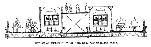
An early cross sectional view of the Brooklyn Bridge deck. The outer "carriage" lanes later carried trolley tracks (source: "The Brooklyn Bridge", Harper's New Monthly Magazine, Volume 66, Issue 396, May 1883). September, 2002 Picture of the Month. 
Another cross sectional view of the Brooklyn Bridge deck. (source: A Complete History of the New York and Brooklyn Bridge, Samuel W Green, 1883).
line: Brooklyn Bridge
A New York bound three car train approaches the Brooklyn cable pick up point. Note the trolley cars in the road lanes. opened: 24-Sep-1883. Manhattan to Brooklyn on Brooklyn Bridge.
revised:
powerhouse: Brooklyn terminal
grip: Paine roller grip, revised as Paine bottom grip
gauge: 4'8 1/2"
cars: double-ended, double-truck rapid transit-type cars
terminals: crossovers
crossings: N/A
THE RAILWAY and THE RAILWAY SERVICE. From A Complete History of the New York and Brooklyn Bridge, Samuel W Green, 1883.
THE RAILWAY. Next (to - JT) the promenade, on either side, is a section for the cars run under the Bridge management, from end to end by an endless wire rope. These cars will be commodious, run rapidly and frequenty, and be propelled by an engine erected near the Brooklyn terminus. As the grade of the Bridge descends its 3 1/4 feet to 100 toward either terminus, the railway keeps an elevation that brings it out on a level above that of the footway and of the driveway, passengers reaching and leaving it by means of stairs. But the railway future of the Bridge is yet to be developed. Probably the boldest of us would gasp if he could see the traffice which the year 1903 will witness upon it.
THE RAILWAY SERVICE. So as to the railway service. At either end, the cars are upstairs, and do not now connect with anything. In New York, the City Hall station of the Third Avenue Railroad is close by, and the change made by merely going down one flight of stairs and up another. In Brooklyn, not even that. This will not prevent an immense travel back and forth on the cars. The little Manhattan Beach Marine Railway, Coney Island, carried last season 879,327 passengers with net earning of more than $16,500. And the season there is about four months. Is it too much to expect that the average travel over the Bridge Railway will be much greater than over the Marine, and that it will last uniterruptedly the year round?
notes: John and Washington Roebling broke ground for the Brooklyn Bridge on 03-Jan-1870. It opened to traffic on 24-May-1883. The Roeblings designed the bridge to include a railway, but felt that steam locomotives could not haul loaded trains up the slopes of a suspension bridge, so they planned to use cable traction. The tracks ran on a raised private right of way in the center of the bridge, on either side of the pedestrian walkway, and inside of the carriage roadways.
Colonel William H Paine designed a roller grip which should not have infringed Hallidie's patents. Paine exhibited "a large model of the apparatus to be employed in the traction of cars on the East River Bridge" at the 1879 American Institute Fair in New York ("Miscellaneous and Advertising" Manufacturer and Builder, Volume 11, Issue 11, November 1879). In practice, Paine found that the roller grip could not grip the cable well enough to start a train from a standing stop. Because the grip was weak and because the cable did not extend into the terminals at each end of the bridge, the company used tank engines to push the trains from the terminals to the pickup points and get the trains up to speed. In 1885, Paine added short jaws to the grip, making it a bottom grip; the cable railway trust sued for patent infringement.
The line used a very thick cable, 1 1/2" in diameter.
The original Brooklyn powerhouse, under the bridge approach, had two sets of engines, either of which could drive the cable. The new Brooklyn powerhouse, north of the approach, had three sets of engines of different sizes, to handle different traffic loads.
The railway which opened on 24-Sep-1883 was one of the most successful in the cable traction industry. By 1885, trains were running at a 1 1/2 minute headway during rush hour. According to the article The Traffic of the Cable Railway on the New York and Brooklyn Bridge from the November, 1889 issue of Manufacturer and Builder: "In November (1888), on one day during the hour, 12,160 passengers were carried. Looking at the vast increase in October of 1883 and 1884, 477,700 passengers were carried, and in October of 1887 and 1888, 2,635,617. The total of 1883 and 1884 was 7,955,200; the total of 1886 and 1887 was 27,377,930. Looking over the totals for the seven months of 1887-88, the increase is notable, jumping up by the thousands."
To deal with increased traffic, gauntlet tracks and duplicate cables were installed in 1893.
Steam locomotives were used for switching until 30-Nov-1896, when the railway started adding a Pullman motor car, running off of a third rail, to each train. The motor car switched the trains in the terminals, but cable still powered the trains across the bridge.
When New York absorbed Brooklyn on 01-Jan-1898, the Brooklyn Elevated took control of the bridge railway. The Elevated built a physical connection and began running its own cars across the bridge into Manhattan, hauled by electric bridge motors. Through service stopped from 16-Jul-1899, except for summer trains to Brighton Beach. Bridge trains began running by electricity except during rush hour. Through service began again on 01-Oct-1901. Bridge local trains ran only during the afternoon rush. Local trains and cable traction stopped completely on 27-Jan-1908.
Elevated trains ran on the bridge until 1944. Trolleys stopped crossing the bridge in 1954.

A view along the tracks from a Keystone stereoview. The dual cables and gauntlet tracks are clearly visible. 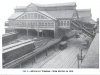
A view of the Brooklyn Terminal from a detailed article in the February, 1897 Street Railway Journal: "The Bridge Transportation System Between New York and Brooklyn". September, 2012 Picture of the Month. The Library of Congress' American Memory site has an 1899 Edison film, "Brooklyn to New York via Brooklyn Bridge".

A postcard view of the Manhattan terminal. Go to top of page.
New York Cable Railway
I had to throw this in because of its name. There were two entities that went by this name, the New York Cable Railway, a proposed comprehensive system in Manhattan and the New York Cable Railway Company, which built cable lines as a representative of the Patent Trust.
The Patent Trust formed the New York Cable Railway in 1883 with a plan to build a system of 29 lines. This system would have included three major uptown lines running on embankments. The mayor vetoed its franchise in 1885. The company continued to push until 1890, but without success.
from The American Railroad-Journal, March, 1884
Proposed Rapid Transit Arrangements in New York
On the ninth of February the Rapid Transit Commissioners, New York, completed the first part of their work, namely the "location" of routes. Their first meeting was held in the mayor's office, December 12, 1883,and their labors began on the following day, when a meeting was held at which addresses were delivered by prominent citizens and by William P. Shinn, president of the National Cable Railway Company. The next day another meeting was held at which resolutions were offered dcclaring that there existed a necessity in the city for additional steam railways for transportation of passengers, mails or freight. These were passed ten days later. Numerous meetings were held during the intervening period and after, in which many men of local reputation took part, and suggestions almost innumerable on the subject of the proposed improvements. were received from property owners in the city. On the ninth of January the commissioners started on a trip to Chicago, where they inspected the operations of the cable system After their return, five days subsequently, meetings with the Commissioners were resumed, and their time otherwise occupied with the examination of various competing systems of transit, until, on the ninth ult., the first stage of their laborious undertakings was ended in their proposal of twenty-nine new routes of rapid travel. As described by one of the Commission, their scheme involves three roads running lengthwise of the city and the balance cross roads.
To decide upon the kind of superstructure and the mechanical construction of the means of rapid transit, was the second of their duties undertaken by the Commission. On February 15, they passed a resolution declaring that at present they considered the cable system of construction upon the new routes the most desirable, whether wholly or in part upon the surface. Ten days afterwards the Commissioners decided that the company to be formed for the purpose of constructing, maintaining, and operating the lines of surface and elevated railways should be named "The New York Cable Railway Company," and fixed the fare of one person for a continuous trip between two pomts on any two connecting or intersecting routes at five cents between four in the morning and midnight, and six cents the remaining four hours of the twenty-four. At the present writing they are seeking from the State legislature, an extension of the time originally given them for their work. The outlook is obstructive litigation on the part of corporations interested in present franchises. the interests of which would be possibly temporarily injured were the plans of the Commission executed, and from individual owners of property; and a hard fight at Albany over the proposal to remove by legislation what stands in the way of the Commissioners' scheme being carried out.
There is unquestionably very much room for improvement in the matter of street travel in New York city. Already an outcry is heard that the National Cable Railway Company has been unduly favored by the Commissioners, seeing that it claims to own all the patents which have been successfully applied to street railways, and to have the exclusive right to their use east of the Rocky Mountains; and that, therefore, the New York Cable Railway Company will be virtually the National under a new name. The Commissioners, as it appears to us, are not fairly dealt with when this is urged against them ; the presumption, on the contrary, is that their work so far, has been done consistently with the obligation laid upon them to do their duty as honorable citizens representing not a company, but the entire population of the greatest city on this continent. Surely public virtue ought to be presumed of public servants, and that citizen does not deserve well of his country who finds a grievance in the fact that those who provide a great public convenience largely profit by it. To this cause all public improvements on a great scale must be referred. In the present instance. the corporation taking franchises from the Commissioners, incurs the obligation to pay their salaries and expenses, and to accept the probable difficulties in the way of litigation and testing the constitutionality of such legislative enactments as at present obstruct the work to be undertaken. While the interests of certain horse-car companies seem to be threatened by the proposed improvement in rapid transit, we cannot but believe that the expansion of means augmenting the desirableness of New York as a place of residence, will, in the long run, promote the gain of all who are engaged in the transport of its freight, mails, and teeming population.
Go to top of page.
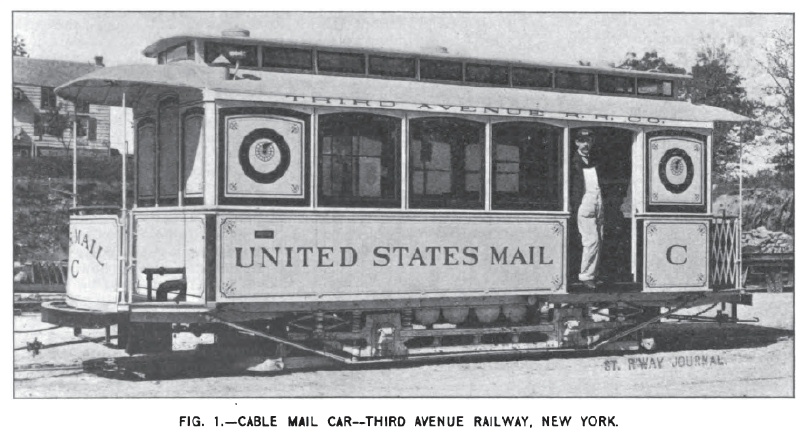
Third Avenue Railroad

Open parlor car E served the 125th Street and Amsterdam Avenue line in Harlem. Passengers paid a premium fare, $0.25. October, 2002 Picture of the Month. line: 125th Street
opened: 01-Dec-1886, 125th Street from the East River to Amsterdam (10th) Avenue to 187th Street, with a branch continuing on 125th Street to the Hudson River.
powerhouse: 128th Street and Amsterdam (10th) Avenue
grip: Lever-operated Jonson double-jaw side
gauge: 4' 8 1/2"
cars: Heavy single-truck double-end open and closed cars.
terminals: crossovers
crossings:
Intersection Company Status 125th Street/Third Avenue TARS superior 
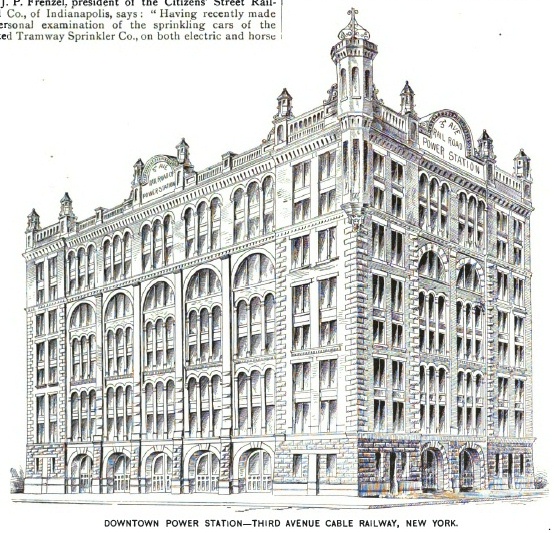
The downtown power station on the Bowery, at the corner of Bayard Street. (Source: "Downtown Power Station of the Third Avenue Road, New York.", The Street Railway Journal, February, 1892). line: Third Avenue
opened: 04-Dec-1893, Third Avenue from Sixth Street to 130th Street.
extended: 11-Feb-1894, Park Row from loop at Broadway to Bowery to Third Avenue.
powerhouse: Bowery and Bayard
powerhouse: Third Avenue and 65th Street
grip: Wheel-operated Jonson double-jaw side.
gauge: 4' 8 1/2"
cars: Heavy single-truck double-end open and closed cars, sometimes trailers.
terminals: loop, crossovers
crossings:
Intersection Company Status 125th Street/Third Avenue TARS inferior notes: Cable traction came rather late to the streets of Manhattan.
The Patent Trust formed the New York Cable Railway in 1883 with a plan to build a system of 29 lines. This system would have included three major uptown lines running on embankments. The mayor vetoed its franchise in 1885. The company continued to push until 1890, but without success.

DJ Miller invented the duplicate cable system used by the Third Avenue Railroad. From the May, 1895 Street Railway Journal The Third Avenue Railroad, a horsecar operator since 1858, built its first cable line, the first street-running cable line on Manhattan, in Harlem, on 125th Street. Cable traction was so expensive to implement that cross-town lines were almost unheard of. The line used D J Miller's duplicate cable system, which required two cables under each slot, either of which could operate at any time. This very expensive option allowed the system to operate cars 22 hours a day. Miller's system was not covered by the trust's patents, which led to long and costly lawsuits.

The vertical wheel grip used on the Third Avenue Railroad starting in 1895. (Source: "Vertical Wheel For Cable Grips", The Street Railway Journal, December, 1895). The grip was attached under the center of the car. The gripman stood on the front platform and operated the grip using a lever attached to grip by extension rods. The Jonson grip used a mobile lower jaw, unlike most side grips in the industry. Later, the Third Avenue line used a wheel instead of a lever.
Read about a tour of this line by Brooklyn aldermen:
"CABLE ROAD/The Aldermen Inspect the New York Variety" (Brooklyn Eagle, 14-Apr-1886.)The seven-year gap between opening of the the cross-town line and the main line on Third Avenue and the Bowery was caused by legal problems and the difficulty of building the second-longest American cable car line, almost eight miles. The city wanted the company to build an electric line. The company had to go to court to get permission to begin construction. Building the Third Avenue line was reported to cost $250,000 per mile.
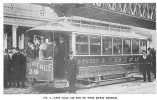
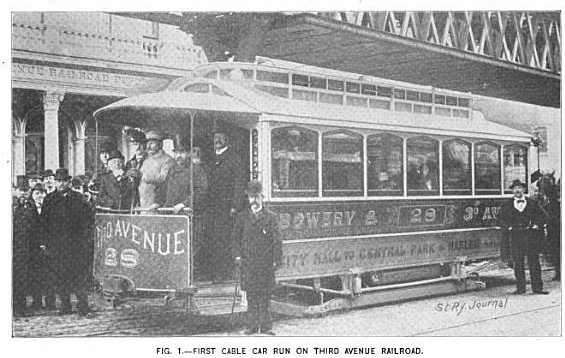
The first cable car on the Third Avenue line on 05-December-1893. (Source: "Starting the Cable Cars on Third Avenue, New York.", The Street Railway Journal, January, 1894). October, 2012 Picture of the Month. The Third Avenue company used an internal combustion fired locomotive as a yard goat, a switcher, in the car house at Third Avenue and 65th Street.

A Connelly internal combustion-powered locomotive, like the one used as a switcher by the Third Avenue Railroad. (Street Railways: Their Construction, Operation and Maintenance by Charles Bryant Fairchild, 1892). Thomas Edison was quoted as saying "Edward Lauterbach was connected with the Third Avenue Railroad in New York--as counsel--and I told him he was making a horrible mistake putting in the cable. I told him to let the cable stand still and send electricity through it, and he would not have to move hundreds of tons of metal all the time. He would rue the day when he put the cable in." It cannot be denied that the prophecy was fulfilled, for the cable was the beginning of the frightful financial collapse of the system, and was torn out in a few years to make way for the triumphant 'trolley in the slot'." (Source: Edison His Life and Inventions by Frank Lewis Dyer and Thomas Commerford Martin, New York, Harper Brothers, 1929)
The Third Avenue Railroad experimented with conduit electrification on Amsterdam Avenue in 1895. When the system was perfected, it began to convert its cable and horse lines. The 125th Street line was converted on 28-Sep-1899 and the Third Avenue line later in the year.
The Metropolitan Street Railway leased the Third Avenue Railroad in 1898. In 1910 the Third Avenue Railway Company took over the property. It continued to operate streetcars until 1947.
Many of the company's cars were converted to electric operation. Car 20, built by Laclede in 1892, converted to conduit electric car 220 in 1899, converted to slot scraper 33 in 1908, and is preserved as car 220 at the Shore Line Trolley Museum in East Haven, CT.

Third Avenue Railroad cars run between the elevated structures through the Bowery. from Poor's Directory of Railway Officials, 1887
P. 254
Third Avenue R.R. operates 14 miles of road, owns 2,190 horses and 360 cars. Directors, Wm. Remsen, Henry Hart, Lewis Lyon, Robert G. Remsen, John E. Parsons, M. G. Lane, Edward Lauternach, Wm. M Prichard, Samuel Hall, Sylvanus S. Riker, Robert W. Tailor, Sol. Mehrback, New York, N. Y. -- Lewis Lyon, Pres., Henry Hart, Vice Pres., Alfred Lazarus, Sec., John Beaver, Treas., John H. Robertson, Supt. -- GENERAL OFFICE, 1,119 Third Ave., New York, N. Y.

Third Avenue Railroad open and closed cars, built by the Laclede Car Company of Saint Louis. (Source: "Third Avenue Cable Cars.", The Street Railway Journal, March, 1892). 

A cable mail car. (Source: "New Cable Mail Cars for Third Avenue.", The Street Railway Journal, November, 1895). Go to top of page.
Metropolitan Street Railway
Broadway cable car 2. July, 2004 Picture of the Month. line: Broadway
opened: 01-May-1893, Battery Place from Whitehall Street to Broadway. Broadway to Seventh Avenue. Seventh Avenue to 59th Street.
powerhouse: Broadway and Houston. ( "The Houston Street Station of the Broadway, New York Cable Railway." The Street Railway Journal, April, 1893) This building is still standing in 2002.
grip: Earl double-jaw side
gauge: 4' 8 1/2"
cars: Heavy single-truck double-end open and closed cars
terminals: crossovers
crossings:
Intersection Company Status 51st Street/Seventh Avenue MSR superior line: Columbus Avenue
opened: 06-Dec-1894, Battery Place from Whitehall Street to Broadway. Broadway to 51st Street. 51st to Columbus, Columbus to 109th Street.
powerhouse: 50th Street and Seventh Avenue. ( "Broadway Cable Railway, New York -- Uptown Power Station." The Street Railway Journal, January, 1893)
grip: Earl double-jaw side
gauge: 4' 8 1/2"
cars: Heavy single-truck double-end open and closed cars
terminals: crossovers
crossings:
Intersection Company Status 51st Street/Seventh Avenue MSR inferior line: Lexington Avenue
opened: 14-Oct-1895, Battery Place from Whitehall Street to Broadway. Broadway to 23rd Street. 23rd to Lexington, Lexington to 105th Street.
powerhouse: 25th Street near Lexington Avenue. This building presently (2002) houses the William & Anita Newman Library at Baruch College, CUNY
grip: Earl double-jaw side
gauge: 4' 8 1/2"
cars: Heavy single-truck double-end open and closed cars
terminals: crossovers
crossings:

Broadway cable cars at Herald Square in 1893. 
A Broadway cable car posed at John Stephenson's car building shop. This is an excellent book, full of builder's photos. 
The John Stephenson Company built this cable car for Manhattan's Metropolitan Street Railroad (Source: "Notes on the Broadway, New York, Cable Railway", The Street Railway Journal, July, 1893). November, 2012 Picture of the Month. notes:Jacob Sharp, owner of the Broadway and Seventh Avenue Railroad, a horsecar line, had worked for many years to get a franchise for lower Broadway from the state legislature. Sharp had almost succeeded in 1883 when Thomas F Ryan and William C Whitney entered the scene. Sharp's lobbyist secured the passage of supporting laws with $200,000 in bribes. Back in the city, Sharp offerred the Board of Aldermen $500,000. The Whitney and Ryan group, with the help of Philadelphia capitalists, fought back, offerring the Alderman $750,000, but making a strategic error; only half of their bid was in cash. The rest would be in company bonds. The aldermen went for the ready money. Whitney and company pushed for an investigation of Sharp and the aldermen for bribery (!). Sharp and most of the alderman went to prison. He was forced to sell his traction interests to Whitney's group, which formed the Metropolitan Traction Company, a holding company.
Read about the beginning of the Broadway cables:
- "The Broadway Railroad Cable" (Brooklyn Eagle, 05-Apr-1893.) "The cable on the Broadway line between Thirtieth and Houston streets, New York, was put in early this morning..."
- "Cable Cars in Broadway/A Trial Trip to Be Made To-morrow Night". (Brooklyn Eagle, 09-May-1893.) "By to-morrow night a single car will be drawn over the downtown division as a test of the machinery and cables."
- "First Cable Car on Lower Broadway". (Brooklyn Eagle, 10-May-1893.) "A cable car ran down Broadway from Fiftieth street to Houston and back last night."
- "The Opening of the Broadway Cable Railway.", (The Street Railway Journal, July, 1893). "The Opening of the Broadway Cable Railway is an event upon which the owners of that road, the engineers and the contractors are greatly to be congratulated."
- "Notes on the Broadway, New York, Cable Railway", (The Street Railway Journal, July, 1893). "The new cars are very popular, and for the first few days every cable car was uncomfortably crowded."
- "Broadway Cable Railway Notes.", (The Street Railway Journal, August, 1893). "The Broadway road has been unfortunate in the matter of stoppages."
- "Newspaper Criticism.", (The Street Railway Journal, August, 1893). "several stoppages which have occurred in the service of the cars"
The Metropolitan's cable lines came late and didn't last for long. A reverse pull curve at Broadway and 14th Street became known as Dead Man's Curve because the cable cars had to run it at full speed. In 1895, the company put in a slower auxilliary cable, but cars, running every 15 seconds in rush hour, got backed up, and it was removed. Later, the company added clips to the grip to allow it to go through the curve in partial release.
Another safety hazard was at 53rd Street and Ninth Avenue, where gripmen going around a tight pull curve at full speed had their view impaired by an elevated structure.
Read Cable Car Run Amuck, an 1893 newspaper article about a runaway cable car on Broadway. Also read "Surface Transit in Cities (Excerpt)", an early article comparing the safety of Broadway cable cars with trolleys in Brooklyn.
The Broadway line was reported to cost $1 million per mile to build. When the company extended the Columbus Avenue line via 110th Street and Lennox Avenue, it chose to use conduit electrification. The rest of the Columbus Avenue line was converted by 11-May-1901, and the Lexington Avenue line by 19-Jun-1901. The last Broadway cars ran on 25-May-1902.
Read about the last cable cars on Broadway and the plans to convert the line to conduit electrification:
- "The Trolley On Broadway/To Be Operated in Manhattan in a Week" (Brooklyn Daily Eagle, Sunday, May 19, 1901)
- "No Cars On Broadway/Work of Removing the Cable Began at 8:30 Last Night -- Traffic Stops Until Tuesday" (Brooklyn Daily Eagle, Sunday, May 26, 1901)
A Metropolitan horsecar, Number 3, built by Stephenson in 1893, is preserved at the Shore Line Trolley Museum in East Haven, CT.

A beautiful print of the Broadway and Houston powerhouse, courtesy of Randall. Visit his Lost New York City. Randall lived in the building for a while and found the print there. 
Conduit laying on Broadway. The abundance of buried pipes and other obstructions raised the price of construction to $1 million per mile. 
Broadway cable cars near the Post Office. The Third Avenue Railroad's terminal loop is visible at the right. 
The John Stephenson Company won an award for this car displayed at the 1893 World's Columbian Exposition in Chicago. (Source: "Street Railway Exhibits at the World's Fair.", The Street Railway Journal, July, 1893). 
The Peckham Motor Truck and Wheel Company displayed this cable car truck at the 1893 Columbian Exposition in Chicago. "Fig. 4 is ... (was) built by the Peckham Company for the Broadway cable railway. It is similar to the standard 6A truck, but equipped with grip attachments." (Source: "The Exhibit of the Peckham Motor Truck and Wheel Company.", The Street Railway Journal, November, 1893). 
"In the wake of a cable car." This cartoon, from an 1895 issue of Life, describes the public's fear of operations around the Metropolitan Street Railway's Dead Man's Curve. November, 2002 Picture of the Month. 
"A sure sign." This cartoon, from an 1895 issue of Harper's New Monthly Magazine, indirectly refers to the public's fear of operations around Dead Man's Curve. from Poor's Directory of Railway Officials, 1887
P. 250
Broadway and Seventh Avenue R.R. owns 8.32 miles and leases the Broadway Surface R.R., 2.51 miles -- total miles operated, 10.83; owns 2,242 horses and 227 cars. Directors, John H. Murphy, John J. Bradley, Chas. Banks, Wm. B. Dinsmore, Bernard M. Ewing, Chas. F. Frothingham, Sol. Mehrback, Thos. J. O'Donohue, W. H. Rockwell, Thos. F. Ryan, Henry Thompson, New York, , N. Y. Wm. L. Elkins, Peter A. B. Widener, Philadelphia, Pa. -- Henry Thompson, Pres., Thos. F. Ryan, Sec. & Treas., Henry A. Newell, Supt. -- GENERAL OFFICE, 761 Seventh Ave. New York, N. Y.
Go to top of page.
The Beach Subway

The Beach Pneumatic Subway (Source: "Rapid Transit in New York" by William Rideing. Appleton's Journal, Vol 4, Issue 5, May, 1878 ). This is not a cable railway, but it is another form of obsolete transit which has become an urban legend.
In 1867, Alfred Ely Beach, editor of Scientific American and inventor, demonstrated a pneumatic railway at the American Institute Fair in the Fourteenth Street Armory in New York. He had patented a pneumatic transit system for mail and passengers in 1865. At the fair, he used compressed air to push and pull a cylindrical car through a tube.
Scientific American reported that "The most novel and attractive feature of the exhibition is by general consent conceded to be the Pneumatic Railway, erected by Mr. A. E. Beach, of the SCIENTIFIC AMERICAN, and every one visiting the Fair seems to consider himself specially called upon to visit, and, after actual experience, to pronounce his verdict upon this mode of traveling. Having accomplished this feat, descending from the mouth of the tube to the main floor, the visitor immediately enters the Department of Intercommunication, a brief glance at the articles exhibited in which shall be the subject of this notice." (Volume 17, Issue 16, Oct 19, 1867).
When Beach proposed to build a full-scale subway in Manhattan, he met opposition from the corrupt politicians of the day, led by William Marcy "Boss" Tweed. Tweed had proposed a system of elevated railways on stone arcades that would provide transit, kickbacks, and profits from real estate schemes.
The New York Sun reported that "We learn that the Governor has approved of the act to facilitate the transmission of letters and merchandise by means of the Pneumatic Dispatch, and that our citizens now have the promise of soon enjoying the most improved and rapid means of intercommunication. The act authorizes the laying down of the pneumatic tubes under the streets of New York and Brooklyn, and also under the waters of the North and East rivers.
"The present enterprise contemplates the connection of the Brooklyn, Jersey City, and all our sub-post offices, with the general post office, and also the erection of pneumatic letter-boxes in place of the present lamp-post boxes, so that letters and parcels will be both collected and delivered by air pressure acting on cars, which will fly along at the rate of thirty miles an hour. The mails will go back and forth between the New York and Brooklyn and Jersey City post offices in from three to five minutes. Letters deposited in any of the street letter-boxes on the pneumatic line below Forty-second street will be carried to the general post office, or to any intermediate station, in from three to six minutes. Our citizens can easily understand the great benefit that will accrue to business transactions from this arrangement.
"The introduction of the Pneumatic Dispatch is due to the efforts of our enterprising neighbor, Mr. Alfred E. Beach, of the SCIENTIFIC AMERICAN, and we congratulate him upon his success before the Legislature. The Pneumatic Dispatch was first put into practical operatien last October, at the American Institute Fair, and a full account of its construction and operations was then given in our columns. We understand that it is the intention of the grantees to put a short line of the Pneumatic Dispatch into operation within the next ninety days. The exact route has not yet been determined, but it will probably extend from the post office, corner of Nassau and Liberty streets, to the City Hall Park. If this short line is found to operate as well as is expected, the pneumatic tubes will then be laid down extensively in many different directions. -- New York Sun." (Reprinted in Scientific American, Volume 18, Issue 26, June 27, 1868).
Beach avoided conflict with Tweed by applying for a franchise to drill a pneumatic mail tube under Broadway.
Beach then made the tunnel 9 feet in diameter, large enough to handle passengers. In 1868, crews began to dig from the basement of Devlin's Clothing Store at the corner of Broadway and Warren, using a pioneering cylindrical shield developed by Beach. The tunnel ran from under Warren Street near the corner of Broadway, then under Broadway to Murray Street, about 300 feet.
For demonstration purposes, Beach built a station at Warren Street, decorated in high Victorian style with candelabras, chandeliers, a grand piano, and a fountain with goldfish. He fitted the tunnel with two tracks and installed a huge Roots Patent Force Blast Blower, nicknamed the "Western Tornado". Roots Blowers & Compressors, a division of Dresser, Inc, is still in business, and has a page on their website about the Beach Subway. Many Diesel-electric locomotives have used Roots blowers.
A cylindrical car which could seat 22 passengers on padded benches, was blown from the station to the end of track near Murray Street, and then sucked back by a partial vacuum. Beach charged $0.25 per ride, which he donated to charity.
The ride, which opened to the public on 26-February-1870, was a popular novelty for a time. Faced with a fait accompli, Tweed could not order Beach to stop. However, Beach was not able to get a franchise or financing to build a full-scale subway system before he was wiped out by the Panic of 1873.
Some time in 1873, or perhaps a little earlier, the subway stopped running. The tunnel was used for various purposes, including storage. Beach's subway was generally forgotten.
In 1912, workers excavating for the Brooklyn Rapid Transit subway in Manhattan broke into the tunnel. The contractor was aware of the Beach Subway and went in to inspect the tunnel. Reports indicate that they found the shield, left in place when digging stopped, and the remains of the car. Legends say that they also found the station with piano, fountain, and goldfish skeletons, but no contemporary reports of the rediscovery mention the station. Photographs of the tunnel and the car still exist. The shield was removed and presented to Cornell University by Beach's son Frederick; Cornell has no idea what happened to it. The tunnel was destroyed to make room for the new subway. Romantics wonder if there are any traces of the station under Warren Street, but it was probably removed by later occupants of the site.
THE BROADWAY TUNNEL, an article from the 15-March-1870 Brooklyn Eagle reports that the "... Beach Pneumatic Tunnel under Broadway is still open for exhibition for the benefit of the Soldiers' and Sailors' Orphans."
Beach's subway lives on in legend, reinforced by Klaatu's song "Sub Rosa Subway" and an appearance in the movie Ghostbusters II. Don't believe most of the stories you read.
Learn more about the Beach subway and other vanished lines in Frederic Delaitre's Lost Subways, on his Railway Pages. He has some excellent illustrations both from the time the subway was built and from its rediscovery in 1912.
Joe Brennan's Abandoned Subway Stations has a web-published book about the facts behind the myth. These two items were the sources for most of my statements.

The circular Beach shield being used to dig the tunnel under Broadway (Source: "The New-York Method of Tunneling Applied in Austria, and not in Baltimore" From Manufacturer and Builder / Volume 4, Issue 8, August 1872). Go to top of page.
The Park Hill Incline

The lower entrance of the Park Hill Elevator. Thanks to the research efforts of Rich Fill, I can now present more information about the Park Hill Elevator.
The Park Hill section of Yonkers was developed in 1888 by the American Real Estate Company. Park Hill was the second-to-last station on the Getty Square Branch of the New York Central's Putnam Division. The branch ended at Getty Square, near City Hall and the commercial center of Yonkers. Many Yonkers policitians and money men rode the train to their homes in Park Hill.
The Park Hill Elevator in Yonkers opened in 1894. The single track, hydraulic-powered incline, built by the Otis Company, climbed from the east side of Park Hill Terrace, by the train station, up to Alta Avenue. The stations at the top and bottom have been converted to homes. The lower station, known as the "Elevator House" was almost completely rebuilt after a fire in 1992. The driving machinery was located at the top. The entire track was enclosed. The single car carried 10 passengers. The track, set at a 40 degree angle, climbed 107 feet.
The incline closed in 1937. JW Thomas reports that he remembers seeing remnants a few years later. More recent visitors don't report seeing any traces of the right of way.
Drummer Gene Krupa lived in Park Hill. Actresses Joan and Constance Bennett grew up in the neighborhood.

Park Hill station with the Elevator climbing the hill in the background. 
The upper entrance of the Park Hill Elevator. Go to top of page.
The Orange Mountain Cable Railway
The Orange Mountain Cable Railway was a funicular giving people access to the top of scenic Orange, New Jersey. The line opened for service on 29-April-1893. It was never financially successful, and stopped running by 1902.From The Street Railway Journal, January, 1893. Volume IX, Number 1.
The top of Orange Mountain, located in the well known and beautiful town of Orange, N. J., twelve miles from New York City, will soon be accessible by means of a cable incline railway. This incline, which is now being installed by the John A. Roebling's Sons Company, of 117 Liberty St., New York, will connect at its lower terminus with the Delaware, Lakawanna & Western Railroad at Highland Avenue, and with the Orange & Newark Electric Railway, and will bring the top of Orange Mountain within sixty-five minutes of Wall Street, New York City.
The incline is 3,700 ft. in length, and has an average width of thirty-four feet. The minimum grade is 8 per cent., and the maximum grade 14 per cent., the average being 11 per cent. The gauge of each of the tracks is eight feet. The roadbed consists of broken trap rock to a depth of eighteen inches, upon which rest the ties which are twelve feet in length, and spaced thirty inches between centers. T rails are used, weighing sixty pounds to the yard, breaking joints alternately; the rails are spiked directly to the ties and the joints are connected by six-bolt angle fishplates. The tracks for the greater part of the line are eighteen feet between centers, but converge slightly at the foot. Considerable grading had to be done, and as the railway employs no trestles the construction of the road necessitated at one point a rock cut 60 ft. deep and 400 ft. in length.

The power station (see Fig. 1) is located at the top of the incline, is 36 X 97 ft., outside measurement, is of trap rock with brick finish, and is very substantial in appearance. The engine room is 60 X 33 ft. inside measurement. The arrangement of the machinery is shown in Fig. 2. Two cables are used; one as a main cable and the other, of the same size, as a safety cable. They are of the Roebling standard type, with hemp center, and one and a half inches in diameter. At the power station, as will be seen in Fig. 2, the main rope is carried around the quadrant of a horizontal sheave 8 ft. in diameter, then about the two vertical main driving drums about which it is given three wraps. It is then carried around the quadrant of a second horizontal sheave of the same size as that first mentioned, and thence passes over the carrying pulleys to the second track. The course of the safety cable is about the quadrants of two horizontal drums, similar to the main driving drums, 8 ft in diameter, as shown. The driving drums are solid, and are each keyed to a hammered steel shaft 8 15/16 ins. in diameter in the swell, and 7 5/8 ins. diameter in the bearings. Also keyed to these shafts are two spur wheels 95 7/8 ins. pitch diameter, geared to a common steel pinion 24 1/2 ins. pitch diameter, mounted on a 7 in., hammered steel shaft. The gear wheels have 86 teeth each, with a 3 1/2 in. pitch and 10 in. face. The pinion has 22 teeth and a 10 1/2 in. face, and is driven by a pair of engines with cylinder dimensions 16 X 24 ins. The engines are arranged with reversing link and cut-off at 7/8 full stroke. The speed of the engine is 124 revolutions and that of the driving drums 31 revolutions per minute.

Each of the driving drums is provided with a brake flange, 8 inches wide, and faced by hard wood blocks, three inches thick. The brake bands are operated by a Westinghouse air brake cylinder, which sets the brake simultaneously on both driving drums. The air cylinder dimensions are 8x12 ins., and it can be worked under an air pressure of from 15 to 100 lbs. A large margin of safety is provided in this brake, since a pressure of fifteen pounds in this cylinder is sufficient to stall the engines. The air cylinder is mounted on the bedplate of the drums, and its connections are shown clearly in Fig. 3, but are not given in Fig. 2.


FIG. 3. -- ELEVATION AND PLAN OF ENGINE AND DRIVING MACHINERY -- ORANGE MOUNTAIN CABLE RAILWAY.
The safety drums are also provided with an air brake as shown in Fig. 2. The brake flanges on these drums are ten inches wide, and are faced with hard wood blocks, as in the case of the driving drums. The Westinghouse air cylinder is of the same size as that of the driving drums, and is located between the sheaves, as shown. Air for both cylinders is drawn from a 26 1/2 X 41 in. reservoir, into which air is pumped by an eight inch pump, operated by steam from the boiler. The diameter of the steam piping, from boiler to air pump, is three-quarters of an inch, from pump to reservoir, three-quarters of an inch, and from reservoir to cylinders, one inch. The supply to each brake cylinder is controlled by separate valves, located in the operating room.
The latter is directly above the engine room, and contains a large bay window from which the operator can command a complete view of every portion of the line. There are four operating levers, one for the throttle, one for reversing the engines, and one (the air pipe valve) for setting each of the brake drums.
The second story contains, besides the operating room, which is, of course, in front, the office of the company and the superintendent's room. The roof is of slate, supported on iron girders. The cables enter the power station through masonry conduits.
The boiler room, which adjoins the engine room, is thirty-three feet square. It contains at present a 150 H. P., Hallett-Hazleton tripod boiler, and space is provided for a second, should it at any time be deemed necessary to increase the boiler equipment. The stack is of brick, forty five feet in height, with flue three feet in diameter at the top.

FIG. 4. -- SIDE VIEW AND END ELEVATION OF CAR-ORANGE MOUNTAIN CABLE RAILWAY.
The style of car used is shown in Fig. 4, and, as will be seen, it is quite novel in character and appearance. The platform is 44 X 16 ft. over all, and carries on one side a cabin for passengers, 6 x 23 ft. over all and 8 ft 3 ins. in height. The interior of this cabin is finished in white oak with bent wood, white oak ceiling. Perforated wood seats are provided on one side of the car, and interior illumination is provided by three center lamps. The seating capacity of the car is fifteen; but standing room in the cabin is also furnished for about twenty-five additional passengers. On the portion of the platform intended for teams, the car can accommodate easily two loaded teams. The open sides of the platform are protected by handsome brass railings, except for a short distance at the ends on the team side, where lattice telescoping gates are provided. Lattice gates are also located at each end of the car. The car frame is composed of seven 9 in., steel, I beams, Carnegie section, covered with 3 in. plank and connected at the center by two 6 in. I beams and at each end by two 15 in. I beams, those at the forward end acting as pedestals.
The two trucks are of novel design, and have four wheels each. To keep the car as nearly level as possible on all grades, a truss is interposed between the platform and the truck at the lower end. This consists of four longitudinal, fifteen inch, I beams, supporting the two similar beams referred to above as forming part of the truck frame and themselves resting on the bolster of the truck. The diameter of the four lower wheels of each truck is three feet five inches, and that of the upper wheels two feet five inches. The total weight of the car, empty, is about fifteen tons, and it will carry about the same weight as a load. The exterior of the cabin is painted a Valentine C C carmine color.
The cables are attached to the car by clamps at the forward body bolster, and are then carried under the car and fastened to two eyebolts, eleven feet five inches in length, passing through the rear body bolster, and provided with a long thread and nut for taking up any slack.
The carrying pulleys are double grooved, and have a diameter of twelve inches at the bottom of the tread and eighteen inches at the rim. They are mounted on wrought iron shafts which are carried in cast iron bearings, and are placed every twenty feet. One of the special features of the line is that at one point the road crosses a highway. Provision had to be made at this point for preventing any interference with passing vehicles by the cables, and the latter are, therefore, sunk below the level of the street through a slot. The time required for a single trip is five minutes, and the fare for passengers will be five cents. The railway will be put in operation during the early part of the coming spring.
The entire railway including the station, as has been already mentioned, was contracted for and installed by John A. Roebling's Sons Company. The designing and installing engineer is S. A. Cooney, to whom all credit should be given for the various novel features contained in the plant, and to whom we are indebted for the plans from which the accompanying engravings were made.
The officers of the Orange Mountain Cable Company are Allison Z. Mason, president; A. W. Kissam, secretary and treasurer, and F. W. Child, general manager.
Go to top of page.