|
Where Should I Go from Here?
Visit the Map
If you came to this page from an outside link, you may want to see the Picture of the Month and visit my main page. |
- Los Angeles
The desire to develop land on and beyond the steep hills near the central plaza inspired Los Angeles to build cable car lines in imitation of San Francisco.
- Los Angeles Cable Car Operating Companies
- Los Angeles Miscellany
- Oakland
Oakland's cable car lines connected downtown with outlying residential and business sections.
- Oakland Cable Car Operating Companies
- Oakland Miscellany
- San Diego
San Diego's only cable car line was one of the shortest lived.
Second Street Cable Railway
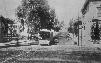
Los Angeles Second Street cable train at Fort (now Broadway) in 1893-1895, photographed by C.C. Pierce (Source: [group 1:12], William C. Barry Collection of Los Angeles Area Photographs, BANC PIC 1964.056--PIC, The Bancroft Library, University of California, Berkeley). Thank you to Don Young for correcting the date. Jan, 1999 Picture of the Month. line: Second Street from Spring Street to Diamond Street (now Beverly Boulevard)
opened: 08-October-1885
powerhouse: Second & Boyleston
grip: Single-jaw side grip.
gauge: 3'6"
cars: single-ended dummy & trailer trains.
turntables: single track
crossings:
Intersection Company Status Second/Fort LAC superior notes: Like most Spanish and Mexican colonial cities, Los Angeles grew up around a central plaza. Bunker Hill, like Nob Hill in San Francisco, impeded development northwest of the Plaza.
Real estate promoters, seeing the success of the cable car lines in San Francisco, projected a line to climb Bunker Hill on Second Street. Their job was made more complicated by the fact that Second Street was not graded far past Fort Street (now Broadway). The work required deep cuts in Bunker Hill. The line climbed another hill beyond Bunker Hill. The powerhouse was in the valley in the middle.

A real estate ad offers "Free Ride on the Second Street Cable Road." (Source: Los Angeles Herald, 22-December-1885).
Two articles from the Los Angeles Times describe how the line was expected to raise property values, so property owners were expected to contribute to the line's financing: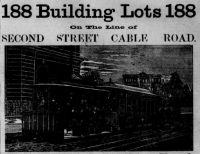
A detail from the real estate ad offering lots along the Second Street Cable Railway. (Source: Los Angeles Herald, 22-December-1885) January, 2019 Picture of the Month. - Second Street Cable Railway Seeks Subscriptions/1 (Los Angeles Times, Tuesday, February 3, 1885): "It is simply a business proposition that those who own the property along the line of road can be afford to pay liberally to carry the enterprise through. A cable road up over the hills will treble in value property in that section as soon as the first car starts. It will also more than double the value of all property on Main, Spring and Fort streets, between First and Third. Every property owner and every merchant in that section ought to subscribe to the fund as a business proposition."
- Second Street Cable Railway Seeks Subscriptions/2 (Los Angeles Times, Saturday, February 7, 1885): "There should be no difficulty about raising the remaining $5000 for the prosecution of a work so manifestly advantageous to residents and property owners along the line..."
In an effort to save money, the line was built with a single track. Passing sidings were arranged so that downbound cars could drop the rope and coast through. The arrangement was not successful. The line was designed by J M Thompson, an engineer who worked for the patent trust's Pacific Cable Construction Company.
The line was tested on 08-October-1885. "The road is evidently a success and will open up a delightful portion of the city which is in full view of the ocean. Since the road has become assured, there has been a considerable rise in values on South Spring street, where a new business center is rapidly forming. Rents have nearly doubled, and, in some cases, contributors to the cable road fund report that they have already been repaid tenfold for their investments." (Second Street Cable Railway Tested (Los Angeles Times, Friday, October 9, 1885))
The line contained the single steepest cable gradient in North America, 27.7% between Hope Street and Bunker Hill Avenue.
The company was short of cash throughout its life and it was especially hurt whenever it rained, because the water would run down the poorly drained conduit, damaging the cables and the pulleys. The line was shut down from late February to early March 1888 because a replacement cable could not get through the mud from the train station to the powerhouse. The line shut down on 13-Oct-1889 when the cable broke and the company could not afford a replacement. A terrible storm on 24-Dec-1889 ruined the property beyond repair.
Two newspaper articles talked about the sad fate of the line:
- Second Street Cable Railway -- Unpaid Cable Bill (Los Angeles Times, Saturday, October 26, 1889): "The rains of this week have choked up the conduits, but they have not been cleaned out, and the road at present may be termed "dead horse," as far as the public is concerned."
- Second Street Cable Railway -- Conduit Blocked (Los Angeles Times, Thursday, December 5, 1889): "One or two workmen were busy yesterday in patching up the holes in the Second-street cable conduit; but whether it was with a view to starting up the road or not, could not be ascertained."
The Second Street Cable Railway became the first operational cable car line to be abandoned.
The company connected with a steam line, the Cahuenga Valley Railroad, which ran to Hollywood. The steam line was later forced to cut back to the city limits, which hurt the Second Street company.

Looking up Second Street, photographed by I.W. Taber (?) (Source: [group 3:3], Riverside and Los Angeles Area Views, ca. 1880-1889, by I.W. Taber and Others, BANC PIC 1905.06211--PIC, The Bancroft Library, University of California, Berkeley). 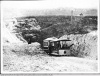
A train of the Second Street Cable Railway in Los Angeles passes through the line's deep cut in Bunker Hill. This CC Pierce photograph shows the lightly populated area which the line's promoters hoped would grow and provide riders. Digitally reproduced by the USC Digital Archive (c) 2004, California Historical Society: TICOT/Pierce, CHS-2867. All rights reserved. January, 2009 Picture of the Month. 
The powerhouse of the Second Street Cable Railway. Crewmen pose with a dummy and a side grip. Digitally reproduced by the USC Digital Archive (c) 2004, California Historical Society: TICOT/Pierce, CHS-M12634. All rights reserved. Thank you to Bob Davis for the story of what happened to the Second Street powerhouse after the cable line ceased operations in late 1889. A predecessor of Southern California Edison bought the property around 1896 and used the steam engines to drive dynamos. There may have been an oil well on the property, which would have been a nice source of fuel. Another well provided water for the boilers. The plant was in use for less than 10 years before it was supplanted by more powerful generating stations. The site is still used by the Los Angeles Deptartment of Water and Power.

Second & Boyleston powerhouse and carhouse in 1888. (Source: Sanborn Fire Insurance Maps, Los Angeles, 1888, Vol 1, Sheet 40b). from Poor's Directory of Railway Officials, 1887
P. 233
Second Street Cable R.R. Co. operates 1.6 miles of road, owns 6 dummies and 6 cars. Directors, W. S. Newhall, San Francisco, Cal; Jas. McLaughlin, Jesse Yarnell, H. C. Witmer, Edward A. Hall, Los Angeles, Cal. -- Edward A. Hall, Pres., Jas. McLaughlin, Vice-Pres., H. C. Witmer, Sec., Jesse Yarnell, Treas., Edward A. Hall, Supt., F. F. Field, Pur. Agt.. -- GENERAL OFFICE, 33 South Spring St., Los Angeles, Cal.
P. 378 Revised statement
Second Street Cable R.R. Co. operates 1.6 miles of road, owns 6 dummies and 6 cars. Directors, Jas. McLaughlin, A. I. Hall, D. W. Field, Chas. McLaughlin, Los Angeles, Cal. -- Jas. McLaughlin, Pres., H. W. Davis, Sec., Treas., & Supt., E. H. Hutchinson, Asst. Supt. -- GENERAL OFFICE, Second and Figueroa Sts., Los Angeles, Cal.
Go to top of page.
Temple Street Cable Railway

Temple Street cable train (detail of a large photograph taken from the tower of the county court house) (Source: [group 7:66], William C. Barry Collection of Los Angeles Area Photographs, BANC PIC 1964.056--PIC, The Bancroft Library, University of California, Berkeley). February, 1999 Picture of the Month line: Temple Street from Main to Edgeware Road
opened: 14-Jul-1886
extended: 30-Apr-1889 Temple Street to Hoover Street
powerhouse: Temple & Edgeware
grip: Single-jaw side grip.
gauge: 3'6"
cars: double-ended dummy & trailer trains.
turntables: crossovers
crossings:
notes: The Temple Street Cable Railway was the most successful cable car line in Los Angeles. It was built by real estate promoters, and it succeeded in raising the value of property along the road. The line climbed through the draw between Fort Moore (Mormon) Hill and Pound Cake Hill.
Like the Second Street Railway, the line was originally single-tracked. In 1889, the line from Main to Union was double-tracked.
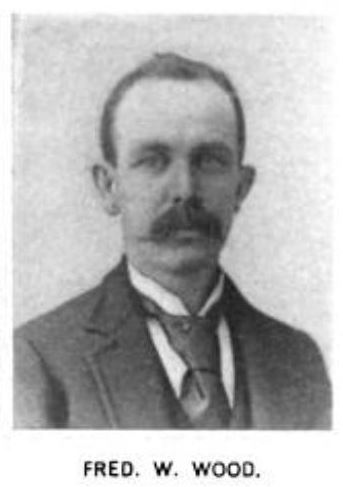
Fred W Wood was president of the Temple Street Cable Railway. (Source: The Street Railway Journal May, 1895). The Temple Street line connected with the Cahuenga Valley Railroad, a steam line to Hollywood.
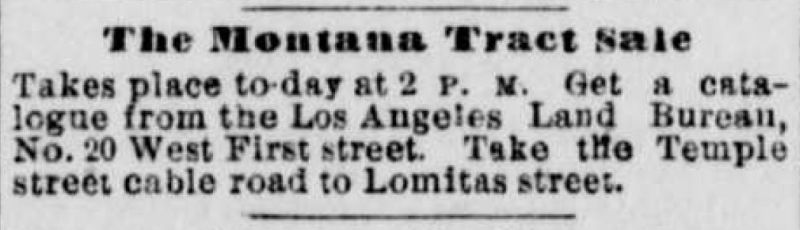
A real estate says people should "Take the Temple street cable road" to a sale of lots in the Montana Tract, a subdivision next to Echo Park. (Source: Los Angeles Herald, 15-January-1887). The company was sold under foreclosure on 28-Feb-1898. Henry E Huntingtion acquired it in 1902 and included it in the Pacific Electric Railway. It was converted to electricity on 02-Oct-1902. The line was transferred to the Los Angeles Railway in 1910. In the 1930's, the A line, which ran on Temple Street, was one of the first in Los Angeles to be converted to buses.
The Los Angeles Times ran a detailed article about the completion of the line:
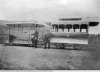
A train of the Temple Street Cable Railway in Los Angeles near Temple and Hoover Streets in 1889. Digitally reproduced by the USC Digital Archive (c) 2004, California Historical Society: TICOT/Pierce, CHS-7070. All rights reserved. February, 2019 Picture of the Month. 
Cahuenga Valley Railroad steam train which connected the Temple Street Cable Railway with Hollywood (Source: [group 3:23], William C. Barry Collection of Los Angeles Area Photographs, BANC PIC 1964.056--PIC, The Bancroft Library, University of California, Berkeley). 
Temple & Edgeware powerhouse and carhouse in 1888. (Source: Sanborn Fire Insurance Maps, Los Angeles, 1888, Vol 1, Sheet 40a). from Poor's Directory of Railway Officials, 1887
P. 234
Temple Street Cable Ry. (in progress.) Length of road, 3 miles, owns 6 dummy engines and 6 cars. Directors, Walter S. Maxwell, Victory Beaudry, Prudent Beaudry, Julius Lyons, Thomas Stovell, Ralph Rogers, E. A. Hall, Octavius Morgan, John Milner. -- Walter S. Maxwell, Pres., P. Beaudry, Vice-Pres., Octavius Morgan, Sec., John Milner, Treas., O. Morgan, Supt., Pur. Agt, etc., Los Angeles, Cal. -- PRINCIPAL OFFICE, Los Angeles, Cal.
P. 378 Revised statement
Temple Street Cable Ry. operates 1.75 miles of road, owns 6 dummy engines and 6 cars. Directors, W. S. Maxwell, Victory Beaudry, Prudent Beaudry, Julius Lyons, Thomas Stovell, Ralph Rogers, E. A. Hall, Octavius Morgan, John Milner. -- P. Beaudry, Pres., O. Morgan, Vice-Pres., F. W. Wood, Sec. & Man., John Millner, Treas., Los Angeles, Cal. -- PRINCIPAL OFFICE, Los Angeles, Cal.
Go to top of page.
Los Angeles Cable Railway/Pacific Cable Railway

The Los Angeles Cable Railway used the "Cape Horn" viaduct to cross the Southern Pacific Railway yards near the Los Angeles River. 1889 photograph. The viaduct was carried on a single row of columns for over 1 KM (Source: [group 3:21], William C. Barry Collection of Los Angeles Area Photographs, BANC PIC 1964.056--PIC, The Bancroft Library, University of California, Berkeley). Mar, 1999 Picture of the Month. 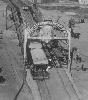
A detail of the preceeding photograph. The steep approach and open tracks kept other vehicles off of the viaduct. The sign reads "Los Angeles Cable Railway Co/Caution, No Thoroughfare" (Source: [group 3:21], William C. Barry Collection of Los Angeles Area Photographs, BANC PIC 1964.056--PIC, The Bancroft Library, University of California, Berkeley). line: East LA/West LA
opened: 08-Jun-1889. Fort (now Broadway) from the Plaza to Seventh, Seventh to Grand.
extended: 14-Sep-1889. Grand from Seventh to Jefferson.
extended: 02-Nov-1889. North Spring to Downey (now North Broadway), Downey to Pritchard (now Lincoln Park).
powerhouse: Seventh and Grand.
powerhouse: Downey and Workman.
grip: Eppelsheimer bottom grip.
gauge: 3'6"
cars: single-ended dummy & trailer trains.
turntables: ?
crossings:
Intersection Company Status Second/Fort 2ST inferior line: Westlake Park/Boyle Heights
opened: 03-Aug-1889. East First from Spring to Chicago.
opened: 28-Sep-1889. East First from Chicago to Evergreen.
extended: 02-Nov-1889. North Spring to Downey (now North Broadway), Downey to Pritchard (now Lincoln Park).
extended: 07-Dec-1889. West Seventh from Alvarado to Grand.
powerhouse: Seventh and Grand.
powerhouse: East First and Chicago.
grip: Eppelsheimer bottom grip.
gauge: 3'6"
cars: single-ended dummy & trailer trains.
turntables: ?
crossings:
Intersection Company Status Second/Fort 2ST inferior notes: The Los Angeles Cable Railway, later known as the Pacific Railway, operated ten miles of cable and 25 miles of horse lines.
The promoters of the Los Angeles Cable Railway, Isais W Hellman and James F Crank, studied the first electric line in Los Angeles, the Los Angeles Electric Railway, which used the pioneering system of Professor Leo Daft (no kidding). The Pico Street line was entirely unsuccessful, so Hellman and Crank chose to use cable even though their system covered very few hills.
Frank Van Vleck was the Chief Engineer of the Los Angeles Cable Railway.

Two trains of the unsuccessful Los Angeles Electric Railway. The poor performance of this line convinced the promoters of the Los Angeles Cable Railway to use cable as their source of motive power (Source: [group 3:24], William C. Barry Collection of Los Angeles Area Photographs, BANC PIC 1964.056--PIC, The Bancroft Library, University of California, Berkeley). 
Charles B Holmes (Source: The Street Railway Journal December, 1891). Hellman and Crank ran short of money and sold three quarters of the company to C B Holmes, promoter of the Chicago City Railway. Holmes reorganized the company as the Pacific Railway. Augustine W Wright of Chicago designed the system using patents controlled by the industry trust.
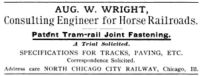
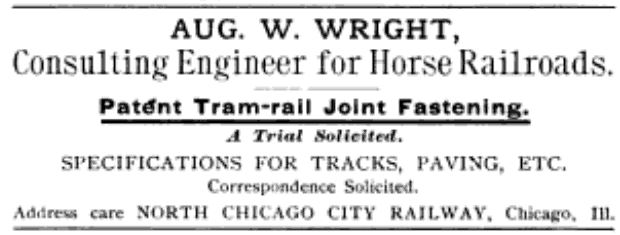
An ad for AW Wright "Consulting Engineer for Horse Railroads". He also worked on cable railroads, including the Los Angeles Cable Railway/Pacific Cable Railway. Note that he is to be contacted care of the North Chicago City Railway, where he was superintendant of track and construction. From the April, 1885 Anerican Railroad Journal. The system had several difficult features, including complicated pull curves around the Plaza, and three long viaducts used to cross rivers and railroad yards.
The storm of 24-Dec-1889, which destroyed the Second Street Cable Railway, also caused damage to this company. General Manager James Clifton Robinson was allegedly fired after a huge rainstorm on 24-December-1889 obstructed the conduits with debris. Robinson, having bet a cigar that he could get the system going again, ordered the cables started the next day and caused severe damage to the cables and machinery, which were full of gravel and sand.
An 1891 interview with Colonel Robinson.
Robinson's comments from "A Year's Progress of Cable Motive Power": The provision of an efficient system of drainage is deserving of the greatest attention, as without adequate drainage of the conduits there can be no sustained and satisfactory operation of the cable road. Having a vivid recollection of our experience in this direction at Los Angeles, I cannot emphasize too strongly the importance of this point. There, in a practically newly-founded city, hurriedly built up as Los Angeles was, and developed in a period brief beyond precedent, the city possessed no commensurate system of storm drains or sewers, consequently the cable roads for many miles of their extent were constructed without any drainage facilities whatever. In the rain storms which periodically visited us, we found our roads literally swamped with storm water, which had no means of escape other than through the cable conduits and thence into the terminal pits and power-houses, which had been located with their foundations 30 ft. below the level of the tracks. How, and to what extent, those power-houses were flooded, and with what danger, expense and difficulty the roads were maintained in continuous operation, are matters of Pacific Coast history.
The Pacific Railway went bankrupt on 21-Jan-1891 because of storm damage and competition from Sprague electric cars of the Consolidated Electric Railway. The Consolidated Electric Railway purchased the company for a tiny fraction of its capital value on 13-Jun-1893. The Los Angeles Railway purchased the Consolidated on 13-Oct-1893.
The Los Angeles Railway, run by Frederick W Wood, the former general manager of the Temple Street Cable Railway, strung wires over the former LA Cable tracks. On 01-Feb-1896, West Seventh and Fort were shut down. The Grand Avenue cable stopped on 12-Feb-1896. Service to Boyle Heights was converted on 13-Mar-1896. Downey Avenue was converted on 18-Mar-1896.
The electric lines which replaced the Los Angeles Cable Railway were among the last in Los Angeles before the new era of light rail. They were converted, along with the Pico Street line, on 31-Mar-1963.
The Los Angeles Cable Railway/Pacific Railway lost money for all concerned. Hellman continued to be a successful bank executive. He was also president of Wells Fargo Bank. Crank was bitter about the Consolidated's efforts to ruin the company. Holmes, one of the pioneers who spread cable cars beyond San Francisco, was ruined.
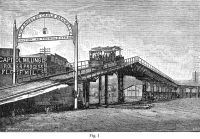
Scientific American Supplement described the Los Angeles Cable Railway in an article in its 10-Oct-1891 issue. March, 2019 Picture of the Month. General Manager James Clifton Robinson wrote and delivered at the Tenth Annual Meeting of the American Street-Railway Association, held at the Monongahela House, Pittsburgh, Pennsylvania on October 21 and 22, 1891, "A Year's Progress of Cable Motive Power", a paper about cable traction developments.
from The Street Railway Journal December, 1891
Amusing incidents often occur in street railway practice which vary the ordinary monotonous routine. One of these, which is worth relating, occurred recently on the Los Angeles cable line. A cable car entered a curve at the usual speed and a passenger slightly intoxicated, sitting on the front seat was thrown on the cobble stones below and landed fairly on the top of his head. He was assisted to arise by an inspector of the road and was helped to the curb where he sat down awaiting the arrival of a hack. Of course, the usual curious crowd gathered around. The man after recovering a little from his dazed condition, looked up with the blood streaming down over his face and said: "Well boys, I am just from Texas and this is my first ride on a cable car. I have ridden Texas bronchos and mules, but I never struck anything that could throw me as that car did."

Los Angeles Cable Railway cable train on Fort (now Broadway) near Second in 1889, photographed by C.C. Pierce (Source: [group 1:14], William C. Barry Collection of Los Angeles Area Photographs, BANC PIC 1964.056--PIC, The Bancroft Library, University of California, Berkeley). 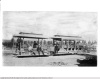
A Boyle Heights train of the Los Angeles Cable Railway in Los Angeles near First Street and Cemetery around 1890. Digitally reproduced by the USC Digital Archive (c) 2004, California Historical Society: TICOT/Pierce, CHS-8471. All rights reserved. March, 2009 Picture of the Month. 
Downey & South Workman powerhouse in 1894. (Source: Sanborn Fire Insurance Maps, Los Angeles, 1894, Vol 1, Sheet 35b). 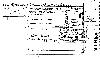
East First & Chicago powerhouse and carhouse in 1888. (Source: Sanborn Fire Insurance Maps, Los Angeles, 1888, Vol 2, Sheet 69b). 
Seventh & Grand powerhouse in 1894-1900. (Source: Sanborn Fire Insurance Maps, Los Angeles, 1894-1900, Vol 2, Sheet 56a). 
Tension run at the Seventh and Grand powerhouse of the Los Angeles Cable Railway. The closest sheave is on a movable tension carriage. The drivers and idlers are in the background (Source: [group 2:20], William C. Barry Collection of Los Angeles Area Photographs, BANC PIC 1964.056--PIC, The Bancroft Library, University of California, Berkeley.). 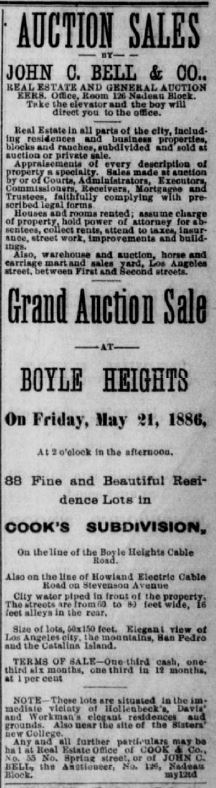
A real estate ad says this property is "On the line of the Boyle Heights Cable Road." (Source: Los Angeles Herald, 12-May-1886). Go to top of page.
Cable Cars at Knott's Berry Farm

A postcard showing former O'Farrell/Jones/Hyde cable car 59 at Knott's Berry Farm. April, 2009 Picture of the Month. In 1955, the San Franisco Municipal Railway sold former California St Cable Railroad cars 6, 17, 20, 43, 49, and 59 to Knott's Berry Farm in Buena Park, Orange County. They ran under battery power, hauling visitors from the parking lot. The cars operated at Knott's until 1979.
Car 17 is preserved at the Poway Midland Railroad in Poway, California. The Poway museum hopes to restore the car to operate it.
Car 43 is preserved at the Orange Empire Railway Museum in Perris, California.

California Street Cable Railroad car 43 was used at Knott's Berry Farm. Bob Murphy took this photo at the Orange Empire Railway Museum. All rights reserved. 
Another view of car 43. Bob Murphy took this photo at the Orange Empire Railway Museum. All rights reserved. Two sources say the other cars were returned to Muni in 1981, but they must have been used for parts, because they aren't on Muni's roster. One car, number 59, was spotted in Auburn in late 2017 or early 2018.
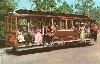
A postcard showing a former Cal Cable car at Knott's Berry Farm, with costumed characters from the Ghost Town. 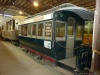
Sutter Street Railway trailer 77 was used as a snack stand at Knott's Berry Farm. Bob Murphy took this photo at the Orange Empire Railway Museum. All rights reserved. 
A map of Knott's Berry Farm shows the two loops of track used by the cable cars, and the location of the carhouse. Big image. 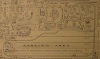
A detail of the map of Knott's Berry Farm shows the larger of two loops of track used by the cable cars. 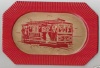
This Knott's paper plate shows car 59. Go to top of page.
Cable Car Murals at Disney California Adventure

An animated mural in the Ghirardelli Soda Fountain and Chocolate Shop features a California Street cable car passing Ghirardelli Square on North Point. California Street cable cars have never run on North Point. July, 2012. Disney California Adventure (it lost its apostrophe s in 2011-2012) is an amusement park that was built in the former parking lot of Disneyland. When it opened in 2001, one of the attractions was a tortilla factory in the Cannery Row section. When the park was renovated in 2011-2012, the tortilla factory was replaced by a Ghirardelli Soda Fountain and Chocolate Shop.
Behind the counters are two animated murals of San Francisco scenes.
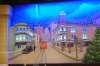
Another animated mural in the Ghirardelli Soda Fountain and Chocolate Shop features a California Street cable car approaching the corner of Haight and Ashbury with Coit Tower in the background. Psychedelic. July, 2012. 
In the same mural, the scene has changed to night. July, 2012. Go to top of page.
Oakland Cable Railway
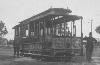
Oakland Cable Railway Car One at San Pablo and Park Avenues in Emeryville, the outer terminal. This car was struck by a steam train in December, 1894. (Source: [group 3:29], Frank B. Rodolph Photograph Collection, BANC PIC 1905.17146-17161--PIC, The Bancroft Library, University of California, Berkeley). April, 1999 Picture of the Month. line: Broadway/San Pablo Avenue
opened: 19-Nov-1886. Broadway from Seventh Street to San Pablo. San Pablo Avenue to Park Avenue in Emeryville.
extended: 1889. Broadway from Seventh Street to the ferry terminal at Water Street.
powerhouse: Twentieth and San Pablo.
grip: Root single-jaw side grip.
gauge: 3'6"
cars: single-ended California cars.
turntables: double track
crossings:
Intersection Company Status Broadway/San Pablo ConPed superior The Oakland Railroad was founded in 1869. It built a 5 foot gauge horse car line on Broadway and Telegraph Avenue.
Senator James G Fair, a Comstock millionaire who also built the South Pacific Coast narrow gauge railroad, purchased the company and promoted the Oakland Cable Railway.
The cable car line had few grades and only one mild curve. The Southern Pacific bought both the SPC and the Oakland Railroad with its cable subsidiary from Fair in 1887.
The line used the same Root single-jaw side grip as the Market Street Cable Railway, under license from the Patents Trust.
The line used nice-looking single-ended California type cars that were similar to the original Ferries & Cliff House Railway cars.
The line crossed steam railroads near both terminii. This was difficult because it required a very strong conduit to support the weight of the steam locomotives. There was at least one fatal accident when a Seventh Street local train hit Car One at Broadway: Cable Car Struck by Steam Train -- a series of articles. "A frightful accident occurred last night at Seventh street and Broadway, in Oakland, where two streetcar lines (one a cable and the other an electric) cross the broad-gauge local train track, on which trains run every half hour in the day and hourly after 7 p.m., and at a point at which just such an accident has been long expected."
The horse-drawn Broadway/Telegraph Avenue line was electrified on 04-Jan-1893. The Telegraph Avenue cars shared the cable car tracks on Broadway to the Ferries. The Broadway/San Pablo Avenue cable line was converted to electricity on 21-May-1899.
Some contemporary newspaper articles:
- "The ship Seminole, discharging at Vallejo street wharf, has landed three larye cables. One of these, 12,000 feet long, is for the Oakland cable road, another, 11,800 feet in length, is for the Sutter-street road, and the third, weighing seventeen tons, is for the Geary-street road." (Sacramento Daily Record-Union, July 30, 1886)
- "It is again rumored in San Francisco that Senator Fair has sold to the Southern Pacific company, for $6,0OO,000, the Santa Cruz steam road and the Oakland cable system." (Phillipsburg, Kansas Herald, March 26, 1887)
- New Cable (San Francisco Morning Call, Sunday, April 12, 1891). "The putting in of the new cable of tbe Oakland Cable Company was not completed until about noon yesterday."
- The Lorings to Resign (San Francisco Morning Call, Tuesday, May 29, 1894). "They have been connected with the roads (cable and electric - JT) since the cable was built and are perfectly conversant with every detail of the business. It is rumored that their resignations were requested."
- Martin Succeeds Lorings (San Francisco Morning Call, Friday, June 1, 1894). "Mr. Martin of San Francisco, an experienced railroad man, will succeed the Lorings..."
- Battle Over Assessments (San Francisco Morning Call, Thursday, July 15, 1897). Southern Pacific's attorney battled to get assessments reduced: "2.35 miles of cable on San Pablo avenue, from $83,225 to $47,000; franchise on the same, from $71,000 to $10,000; .35 of a mile of cable-road near Park avenue, from 11,750 to $3500...It was stated that the Telegraph-avenue electric road was paying a little, but the San Pablo cable road is operated at a loss."
- Only Broad Tracks Now/The Unpopular Narrow Gauge Torn Up (San Francisco Morning Call, Sunday, September 4, 1898). An article about the beginning of the process to convert the former South Pacific Coast line to standard gauge mentions that "The railroad company has also contracted for the material for changing the San Pablo cable road into an electric system, the contract being contingent on the permission of the City Council to make the change."
from Poor's Directory of Railway Officials, 1887
P. 233
Oakland R.R. Co. owns 100 horses, 2 dummies and 25 cars. -- J. S. Emery, Pres., A. Doble, Vice-Pres. & Pur. Agt., H. H. Towns, Sec., First National Bank, Treas. G. Y. Loring, Supt. -- GENERAL OFFICE, 921 Broadway, Oakland, Cal.
from Poor's Directory of Railway Officials, 1890
P. 1186
Oakland Cable Ry. Co. Main line, 5 miles; gauge, 3 ft.; rail (iron), 40 lbs.; owns 10 cars. -- J. G. Blair, Pres., C. S. Neal, Sec., G. Y. Loring, Supt. -- GENERAL OFFICE, 21st and Jones Sts., Oakland, Cal.
Go to top of page.
Consolidated Piedmont Cable Company

Consolidated Cable Company crews building the conduit and track on Oakland Avenue (Source: [group 5:60], Frank B. Rodolph Photograph Collection, BANC PIC 1905.17146-17161--PIC, The Bancroft Library, University of California, Berkeley). line: Broadway/Oakland Avenue
opened: 01-Aug-1890. 8th Street from Clay to Washington. Washington from 8th to 14th. 14th to Broadway. Broadway to 24th. 24th to Oakland Avenue. Oakland to Highland Avenue. Inbound only: 14th to Clay. Clay to 8th.
powerhouse: 24th and Harrison.
grip: McClelle bottom grip.
gauge: 3'6"
cars: single-ended California cars.
turntables: double track turntables. Loop at inner terminal.
crossings:
Intersection Company Status Broadway/San Pablo OakCab inferior line: Broadway/Piedmont Avenue
opened: 02-Aug-1892. 8th Street from Clay to Washington. Washington from 8th to 14th. 14th to Broadway. Broadway to Piedmont. Piedmont to Mountain View Cemetery. Inbound only: 14th to Clay. Clay to 8th.
powerhouse: 24th and Harrison.
grip: McClelle bottom grip.
gauge: 3'6"
cars: single-ended California cars.
turntables: double track turntables. Loop at inner terminal.
crossings:
Intersection Company Status Broadway/San Pablo OakCab inferior notes: The lines of this company were longer and more complicated than those of the Oakland Cable Railway; the company's corporate history was also complicated.
The company was at some point known as the Piedmont Cable Company. It was taken over by the Consolidated Piedmont Cable Company. I have also seen it referred to as the Consolidated Cable Company.
The company's lines started in the business district, where I used to work, and continued on Broadway after the Oakland Cable Railway's line turned off. The Oakland Avenue line made a steep climb into the East Oakland Hills. The area was projected as a highly desirable residential area.

An advertisement for Linda Vista Terrace. "LINDA VISTA TERRACE is only ten minutes, by a charming ride, from the center of Oakland and only forty minutes from San Francisco. The cars of the cable-line reach both the broad and narrow gauge ferry depots, thus affording fifteen minute communication between the Terrace and San Francisco. Cars run every five minutes and connect with the last boat from the city." From the San Francisco Call, Sunday, 04-January-1891. An advertisement for the Flint Tract. "THE CABLE ROAD IS NOW BUILT PAST THE PROPERTY." From the San Francisco Call, Monday, 09-May-1891. 

A William J. Dingee advertisement for an auction of new Piedmont homes. "Take Piedmont cable-cars at Eighth and Washington streets." Would you want to live in a Dingee (dingy) home? From the San Francisco Call, Monday, 09-May-1891. At the outer turntable, cars could return on Oakland Avenue or hoist their grips and run along another route by gravity, rejoining the main line around Highland and Oakland. The "gravity loop" must have been a neat trip. I have collected some newspaper articles about the gravity loop.

A cable car pauses on the gravity loop at the entrance to Blair Park. From "Picturesque Piedmont," an 1891 San Francisco Call article. See this and other newspaper articles about the gravity loop. May, 2009 Picture of the Month. The Piedmont Avenue line climbed the hills to Mountain View Cemetery.
To generate traffic, the company built the Piedmont Baths and the Piedmont baseball grounds near the powerhouse.
The company considered converting its Fourteenth Street horse car line to cable. It began to lay conduit on the street, but converted the flat line to electric instead.
The Panic of 1893 put the company into receivership. "Oaklanders were treated to a genuine surprise yesterday when the rumor was spread about the streets that the big concern known as the Piedmont Cable Company was in the hands of a receiver." PIEDMONT ROAD/It Is Placed in the Hands of a Receiver. (San Francisco Morning Call, Thursday, November 02, 1893).
Ira Bishop of the San Francisco Tool Company, which had built the system, was appointed Receiver. The reorganized Piedmont and Mountain View Railway converted the Piedmont Avenue line on 10-Jun-1893. Oakland Avenue was too steep, so the line ran under electricity on weekdays and under cable on weekends when people rode to the hills for recreation.
On 19-March-1895, the line was sold at auction for $82,000. Receiver Ira Bishop was the auctioneer and the purchaser, and only bidder, was Charles R. Bishop. Ira's brother? My favorite line from the newspaper account: "Ever since the road began going down hill..." AN OAKLAND ROAD SOLD AT AUCTION/The Consolidated Piedmont Is Bought In by Banker Bishop. (San Francisco Morning Call, Wednesday, March 20, 1895).
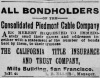
A notice from the California Trust Company requests all Consolidated Piedmont bondholders to contact them immediately. This is usually not a good sign. From the San Francisco Call, Thursday, 31-January-1895. In December, 1896, the line was completely electrified.

Receiver Ira Bishop. "Ira Bishop Ends Life In The Park" (San Francisco Morning Call, Thursday, February 23, 1905). Receiver Bishop had a difficult job. "... Ira Bishop will be compelled to appease the wrath of Mrs. Phoebe Blair, who is after him with a sharp stick." He Wants to See the Books. (San Francisco Morning Call, Saturday, January 05, 1895). Various disputes in court persisted into the new century. After sufferring a stroke, Bishop shot himself in Golden Gate Park in 1905.
The line was the only one in California to use a non-trust grip, using a bottom grip designed by R A McLelle (or McLellan). The company was sued by the trust.
The company's powerhouse and car barn still stands. It was a Cadillac dealership for many years and then was vacant for many years. Clay Burrell, a famous local architect, remodeled it for Cox Cadillac. A Whole Foods store opened there in 2007. As part of the store's first anniversary celebration, on 28-September-2008, The The Friends of the Cable Car Museum dedicated a plaque at the store. Board member Don Holmgren, the leading authority on Oakland's cable car lines, spoke on the company's history.

Former Consolidated Piedmont powerhouse at 27th and Harrison Streets in Oakland. March 2003. Photo by Joe Thompson. 
The former Consolidated Piedmont powerhouse at 27th and Harrison Streets in Oakland is now a Whole Paycheck Market. Google Maps Streetview Image updated February 2019. Copyright 2019 Google. May, 2019 Picture of the Month. Some contemporary newspaper articles:
- First Cable Arrives (San Francisco Morning Call, Friday, May 09, 1890). "The two flat-cars that arrived with the wire cable for the Piedmont cable road are ... low set heavy structures, weighing nineteen tons each, supported by two double trucks, a total of eight pairs of wheels on each, which is twice the number on an ordinary flat..."
- Consolidated Piedmont Nearly Ready for Testing (San Francisco Morning Call, Sunday, May 25, 1890). "The experimental car for trial on the Consolidated Oakland and Piedmont Cable Company's line ... will shortly be tried on the section between Piedmont and the cable-house before the contract for the rolling stock is let."
- Consolidated Piedmont Real Estate News (San Francisco Morning Call, Monday, January 05, 1891). "The cable system has greatly increased the value of suburban property, bringing land on the outskirts nearer to the center of the city, and opening up tracts which formerly seemed inaccessible."
- Consolidated Piedmont Real Estate News/2 (San Francisco Morning Call, Thursday, January 29, 1891). "E. A. Heron is offering many inducements in the way of pretty home sites in Linda Vista, on the Piedmont cable road."
- New Transit Lines in Oakland (San Francisco Morning Call, Sunday, March 29, 1891). "It will do as much for its section as the Piedmont cable has done for Piedmont."
- Consolidated Piedmont Receivership (San Francisco Morning Call, Thursday, November 02, 1893). "Oaklanders were treated to a genuine surprise yesterday when the rumor was spread about the streets that the big concern known as the Piedmont Cable Company was in the hands of a receiver."
- Consolidated Piedmont Hard Feelings (San Francisco Morning Call, Tuesday, December 11, 1894). "Mr. Bishop scowled at Mr. Garthwaite and Mr. Garthwaite scowled at Mr. Bishop, and the matter was ended."
- Consolidated Piedmont Hard Feelings/2 (San Francisco Morning Call, Saturday, January 05, 1895). "... Ira Bishop will be compelled to appease the wrath of Mrs. Phoebe Blair, who is after him with a sharp stick."
- Baseball Field Unprofitable (San Francisco Morning Call, Saturday, January 05, 1895). "Yesterday the Piedmont Railway Company began demolishing this fence and taking down the grand stand ... the grounds do not pay."
- Consolidated Piedmont Foreclosed (San Francisco Morning Call, Sunday, January 13, 1895). "... a considerable barrier of prior liens is piling up between the bondholders and their security ..."
- Consolidated Piedmont Sold at Auction (San Francisco Morning Call, Wednesday, March 20, 1895). "Ever since the road began going down hill..." (lol - JT)
- Consolidated Piedmont Assessment (San Francisco Morning Call, Thursday, May 16, 1895). "Mr. Dalton says he will not accept these figures and will place a valuation of his own on the road."
- Consolidated Piedmont Sale Contested (San Francisco Morning Call, Wednesday, July 10, 1895). "... holders of ten bonds of the Consolidated Piedmont Cable Company, have sued the stockholders of that company ... They allege that when the sale of the road was made on the 19th day of March, 1895, all of the proceeds went for the payment of the receiver's indebtedness, leaving no part for the payment of the bonds."
- Consolidated Piedmont -- Bitter Feelings (San Francisco Morning Call, Wednesday, August 14, 1895). "Mr. Garthwaite accused Mr. Bishop of peculiar tricks with reference to a franchise which had been obtained from the Council for a few blocks down Washington street."
- Consolidated Piedmont Fraud Alleged (San Francisco Morning Call, Sunday, April 05, 1903). "This suit will open up some of the history of this bankrupt cable road."
- Consolidated Piedmont -- Revenge of Mrs Blair (San Francisco Morning Call, Sunday, May 17, 1903). "It is said C. R. Bishop and J. R. Spring have made good their proportion of the amount, which aggregated $2268 20."
- Consolidated Piedmont -- Attempted Suicide of Receiver Bishop (New-York Tribune, Sunday, November 06, 1904). "..while suffering from depression, due to ill health."
- Consolidated Piedmont -- Death of Receiver Bishop (San Francisco Morning Call, Thursday, February 23, 1905). "He was at one time proprietor of the Piedmont Baths in Oakland, and was manager of the Oakland street railway system at the time of its sale to the Oakland Transit Company."
In January, 2004, workers digging near Mountain View Cemetery may have uncovered the turntable or the base of the turntable under the asphalt.
from Poor's Directory of Railway Officials, 1887
P. 231
Broadway and Piedmont R.R. Co. -- Walter Blair, Pres., Samuel Howe, Sec., Montgomery Howe, Supt. -- GENERAL OFFICE, Oakland, Cal.
Go to top of page.
H Casebolt's Elevated Railroad

Henry Casebolt stands at the controls of his overhead cable car. Photograph courtesy of the Museum of the City of San Francisco. July, 1999 Picture of the Month. In 1887, Henry Casebolt, builder of the Sutter Street Railway built an experimental line in Piedmont's Blair Park to demonstrate an overhead cable system. He hoped to sell it to the management of the Consolidated Piedmont Cable Company. They were not interested.
Casebolt's idea was that not having to lay an expensive conduit under the street would save money. In this system, the cable would run on pulleys attached to cross arms on poles along the line. In the accompanying photograph, the grip sits atop the ornate metal structure, which reminds me of the legs under my grandmother's sewing machine. One of the poles is dimly visible in the background. In larger and clearer copies of the photograph, one can read the legend "H Casebolt's Elevated Railroad" on the dash panel of the car. The grip is essentially a single-jaw side grip.
According to historian Roy Graves, the cable and pulleys dripped lubricant on the passengers.
I am still trying to determine how long the track was, what gauge the track was, and how the cable was powered.
I found some contemporary newspaper references:
- "The Casebolt Overhead Cable Road, in operation at Blair's Park, is returning good results ... It is estimated that the Casebolt cable road can be built at one eighth the outlay for an underground cable, or at a saving of 87 1/2 per cent in the cost of construction, while the cost of operation is considerably less. It is claimed that this system is practicable, to the best advantage in small towns or suburban localities, where the expense of an underground cable would not be warranted." -- This article answered the question of where the line had been located (Daily Alta California, Monday, September 26, 1887)
- "Mr. Casebolt is at present figuring upon placing the cable in operation upon a road to be built from the end of the East Berkeley local line up the foothills." (Daily Alta California, Saturday, October 15, 1887)
- "On Saturday, August 4th, the people of San Mateo county will meet at Germania Hall, Redwood City, and there discuss with Henry Casebolt of this city the building of an elevated cable street-railway between Menlo Park and Redwood City." (Daily Alta California, Saturday, May 19, 1888)
- "Patents for
Califonians -- Henry Caseboldt (sic - JT),, elevated cable and car propeller"
(Daily Alta California,
Thursday, June 7, 1888)
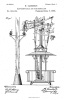
Henry Casebolt's patent drawing for Patent 384,124, "ELEVATED CABLE AND CAR-PROPELLER." July, 2009 Picture of the Month. G T Beauregard (General P G T Beauregard, CSA) had tried to build a similar system in New Orleans, Lousiana in 1869 or 1870. In Beauregard's experimental installation, the cable was powered by a steam locomotive at each end of the line. Casebolt's grip was similar to Beauregard's; Casebolt appears to have infringed upon Beauregard's patents, but as far as I know was never sued for it.

General Beauregard's patent drawing for Patent R7,669 (reissue of patent 97,343), "IMPROVEMENT IN MACHINERY FOR PROPELLING CARS." James Clifton Robinson visited New Orleans while Beauregard was making his experiment. Here are Robinson's comments from "A Year's Progress of Cable Motive Power": In the following years a number of inventions were put forward for the operation of railways by overhead or underground cables, but no solid progress falls to be recorded until 1869-70, when, at a time when I happened to be in New Orleans, General Beauregard put forward an important invention in which the principles of the modern cable grip were first distinctly set forth. Although the plan with which this invention was connected was one for the use of an overhead cable, this does not detract from the value of his suggestion, furnishing as it did the groundwork of all further development in the line of a side grip apparatus, with mechanically moving jaws.

A side view of the car in General Beauregard's patent drawing for Patent R7,669. 
A front view of the car in General Beauregard's patent drawing for Patent R7,669. Go to top of page.
BART to OAK Connector
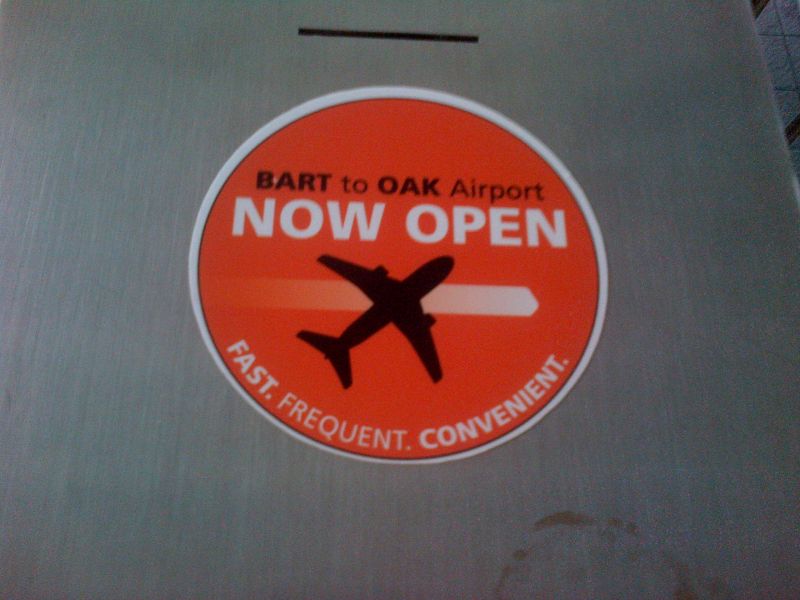
BART to OAK sticker on a fare gate at Colma BART Station. November, 2014. BART to OAK is a 3.2 mile cable-driven Automated People Mover (APM) which shuttles passengers from the Coliseum/Oakland Airport BART Station to the Oakland Airport (OAK) which opened for service on 22-November-2014.
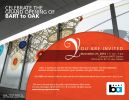
An invitation to the 21-November-2014 preview of the BART to OAK cable-driven automated people mover. The APM uses Doppelmayr's CABLE Liner Shuttle system. The CABLE Liner Shuttle uses an endless cable and an automatic grip in each car which allows the cars to stop and start at the stations. The Dolittle Maintenance Facility by the edge of the airport houses the powerhouse, which drives one cable to the Coliseum BART station and one to the airport station.
The $6 one-way fare, coincidentally, was the same fare paid on San Francisco cable cars; this was controversial.

A BART alert about a service interruption on BART to OAK. On 30-December-2024, service was interrupted by a power outage.
Go to top of page.
San Diego Cable Railway

A San Diego Cable Railway combination car, Las Penasquitas. From Charles B Fairchild's book Street Railways: Their Construction, Operation and Maintenance/A Practical Handbook for Street Railway Men. June, 2009 Picture of the Month. 
Former San Diego Cable Railway car converted to electricity. This picture was taken between 1896 and 1898. Photograph used with the kind permission of the San Diego Historical Society. June, 1999 Picture of the Month. line: Main
opened: 07-Jun-1890. Sixth Avenue from L to C Street. C to Fourth Avenue. Fourth to Spruce.
extended: late July 1892. Fourth from Spruce to University. University to Normal Street. Normal to Park Boulevard. Park to Adams Avenue.
powerhouse: Fourth and Spruce.
grip: Van Vleck bottom grip.
gauge: 3'6"
cars: single-ended California cars and open cars.
turntables: Single track at terminals.
crossings:
notes: The San Diego Cable Railway was one of the least successful lines in the industry.
The San Diego Cable Railway was incorporated on 22-Jul-1889. It took over the franchise of an unsuccessful electric line. The line was intended to connect downtown with elevated residential areas.
Frank Van Vleck, who had been associated with the Los Angeles Cable Railway, designed the system, which was single-tracked to save money. He made a variation of the Eppelsheimer bottom grip suitable for single track operation. Van Vleck presented a paper on the subject of Light Cable Road Construction in which he described the San Diego line in detail.
The company used combination cars and open cars similar to those used on the Ferries and Cliff House Railway in San Francisco.
The first cars ran on 07-Jun-1890. On 09-Sep-1890, the company opened Mission Cliffs Gardens. The cable company went into receivership during the widespread economic downturn in early 1892 and the last cable cars ran on 15-Oct-1892.
Many people expected the system would be back in business after reorganization, but the system lay idle until 1896. The Citizens Traction Company took over the property and began running the old cable cars converted to electrics on 28-Jul-1896. Converting cable cars to electricity was not common because cable equipment was usually too light. The San Diego Electric Railway took over the Citizens company and converted the line to standard gauge some time after 23-Mar-1898.
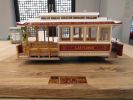
Eleanor Catalina Stevens created this wonderful model of San Diego cable car Las Flores as part of her studies in model making. She has a talent. Learn more on the Cable Car Models page. All rights reserved. 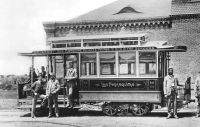
San Diego Cable Railway car "Las Peñasquitas" poses in front of the powerhouse. Photograph used with the kind permission of the San Diego Historical Society. June, 2019 Picture of the Month. San Diego Electric Railway Car 54 is preserved at the Poway Midland Railroad in Poway, California. The double-ended electric streetcar is believed to have been assembled from the remains of two San Diego cable cars.
Visit the San Diego Historical Society, which has a wonderful collection of old San Diego photographs, including several more pictures of the cable railway. They also have an interesting article from The Journal of San Diego History, January 1956, Volume 2, Number 1: "Those Fabulous Cable-Cars" by William C. Enneking.
Go to top of page.