If you came to this page from an outside link, you may want to see the Picture of the Month and visit my main page.
I get a lot of questions about model cable cars. I don't know a lot about model cable cars, but here are some photos people have shared with me over the years. Thank you to the many people who let me use photos of their models. I welcome contributions of other photos. Click on each thumbnail to see a larger version. Use your browser's "Back" button to return.
- Walter Rice's Collection
- The Handiwork of Val Lupiz
- The Handiwork of Jonathan Milne
- The Handiwork of Eleanor Catalina Stevens
- The Hawk Model
- The National Hobby-Craft Sales Model
- Lego Models
- Lefton Models
- The OcCre Model
- The Wurlington Bros Model
- The Metal Earth Model
- Powell Street Car 16
- Trainz Cable Car Simulation
- Garden Scale Cable Cars
- 1948 Tournament of Roses Parade
Walter Rice's Collection
Transit historian Walter Rice had a wonderful collection of transit models. Here are a few examples.
|
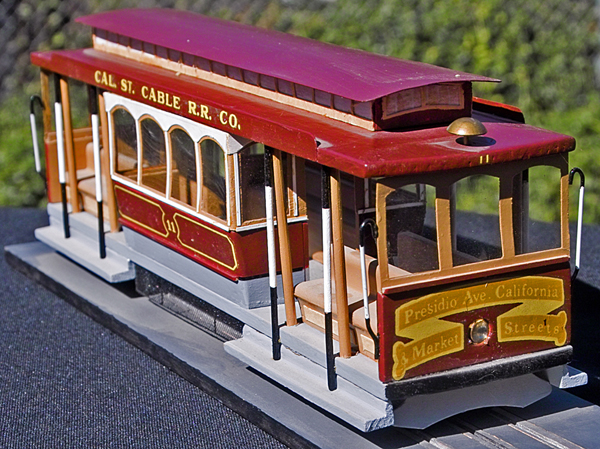
Walter Rice owned this wooden model of California Street Cable Railroad car 11. He said "The kit was a post WWII kit that I spotted at WinterRail several years ago. I remember pushing my past lots of folks as I dashed across the room to get to the table that had it for sale." Walter Rice collection. All rights reserved. |

|
A broadside view of Walter Rice's wooden Cal Cable Model. Walter Rice collection. All rights reserved. |

|
Walter was a big fan of Saint Petersburg Tram models. Here is a Pullman Standard PCC painted to represent the Market Street Railway's never-realized 1939 proposal, signed for the 7-Haight & Ocean. Walter Rice collection. All rights reserved. |
Go to top of page.
The Handiwork of Val Lupiz
Gripman Val Lupiz has made a series of fascinating paper models.

|
Val Lupiz created a paper model of United Railroads cable car 511. 511 is still in service as Powell Street car 11. The model is about one foot long. Electric car 1131 behind 511 is built to the same scale. Val Lupiz collection. All rights reserved. |

|
A front view of the paper model 511. Val Lupiz collection. All rights reserved. |

|
Val Lupiz created a paper model of early Market Street Railway electric car 1213, which had been rebuilt from an Omnibus Railroad & Cable Company. The model, built on a larger scale than 511 and 1131, is over three feet long. Val Lupiz collection. All rights reserved. |

|
Val Lupiz shows a work in progress, a paper model of early Market Street Railway electric car 1131. Val Lupiz collection. All rights reserved. |

|
Sacramento/Jackson cable car 455, was destroyed by the falling chimney
of the Washington/Mason powerhouse on the morning of
18-April-1906. Val Lupiz made this model of the car for Walter Rice. In
October, 2007, Walter reported that "It was on display in my room during my
recent hospital stay at John Muir hospital, Walnut Creek. Medical staff often
were more interested the model in me than. Unfortunately, too many (one is too
many) called 455 a 'train.' They were promptly corrected." Both images
Walter Rice collection. All rights reserved.
==> April, 2008 Picture of the Month ==>. |

|
Go to top of page.
The Handiwork of Jonathan Milne

|
Jonathan Milne writes that this is his "Melbourne Cable Tram set...It’s a 7mm 1.43 scale O gauge model made from mostly card stock with wood, wire and wood putty as required..it is motorised but non operational...the photo is taken as it sits on my small shelf electric streetcar layout named Moorabool street which is modeled on the old 1950 Geelong Australia system. I do not have a cable layout (as yet?)." All rights reserved. April, 2014 Picture of the Month. |
I recently heard from Jonathan Milne, who grew up in Melbourne and just remembers the cable trams before World War II, but now lives in Canada. I'm very grateful to him for sharing his talent.

|
This is "an HO Bachmann San Fran Powell Street model which I kit bashed into what it may have looked like in Melbourne if they had purchased these cars...of course we know that they did not, choosing to remain with the Sutter style set throughout the system’s 55 year history...no turntables needed." All rights reserved. |

|
This is a "1.24 scale effort of a Melbourne Dummy... it is motorised and I had every intention of building the eight window car to complete the set but never did so...It now sits along side the O gauge Melbourne set and the kit bashed HO model on a bookshelf." All rights reserved. |
Go to top of page.
The Handiwork of Eleanor Catalina Stevens

|
A broadside view of San Diego cable car Las Flores. Photo by Eleanor Catalina Stevens. All rights reserved. |
I recently heard from Eleanor Catalina Stevens, who was working on a BA (Hons) in Modelmaking. For a project, she chose to build a 1:30 model of a San Diego Cable Railway cable car. I asked her why she picked a project to make a model of a car from a short-lived system a long way from where she lives. She said she picked it because it was the prettiest. Her tutors thought it would be a tricky one. I was able to help her figure out some of the signs on the car. She did a beautiful job. I'm grateful to her for sharing these photos of her work.

|
A head-on view of San Diego cable car Las Flores. Photo by Eleanor Catalina Stevens. All rights reserved. |
Go to top of page.
The Hawk Model

|
The instructions for the Hawk model. Joe Lacey collection. All rights reserved. |
Cable Car Division veteran Joe Lacey called the model produced by Hawk in the 1960's "the most accurate cable model I have ever seen." When he assembled the model, he "went to the MUNI paint shop with some jars and got the real deal, and painted the model and several other Muni models as accurate as possible."

|
Joe Lacey annotated his copy of the instructions for the Hawk model with the proper colors. Joe Lacey collection. All rights reserved. |
Gripman Val Lupiz has "three different boxes (Hawk 1950's-60's, Testor's 1970's, and Testor's 1980's) which are all the exact same kit, in different packaging...Same product, different wrapper..."
A friend bashed together the closed ends of two kits and produced a reasonable facsimile of a United Railroads 100-series electric car.
Go to top of page.
The National Hobby-Craft Sales Model

|
National Hobby-Craft Sales of San Francisco offered an "authentic 1873 San Francisco cable car" model in the July, 1947 issue of Popular Mechanics. Of course, it looks more like an 1891 or later California Street cable car. I'd still like to have one. |
Go to top of page.
Lego Models
Lego(R) bricks and cable cars have always been associated in my mind. I built a small working cable car system using parts of my Lego railroad. I wish I had taken a picture.

|
Walter Rice took this photo of car 27 and a tiny Buena Vista Cafe at Legoland in Southern California. Walter Rice collection. All rights reserved. |

|
Russell Clark, President and Co-Founder of the San Francisco Bay Area LEGO(R) Users' Group and Train Club, built this model of cable car 13 using Lego bricks on the Lego Monorail system. Visit the group's site to see their wonderful model of the San Francisco waterfront. Russell Clark collection. All rights reserved. |
Go to top of page.
Lefton Models
Lefton produced a series of streetcar models, including several cable cars. I don't own any of these, but they look nice.

|
Lefton model of a Baltimore Union Passenger Railway grip car. The gripman stood on the round front platform. |

|
Lefton model of a North Chicago Street Railroad grip car. Note the text about traction "Barren" Charles T Yerkes. |

|
Lefton model of a Cleveland City Cable Railway Payne Avenue grip car. |

|
Another view of the Lefton model of a Cleveland City Cable Railway Payne Avenue grip car. January, 2011 Picture of Month. |

|
Lefton model of a San Francisco Omnibus Railroad & Cable Company Post Street combination cable car. |

|
Lefton model of a Sioux City Cable Railway grip car. |
Go to top of page.
The OcCre Model

|
California Street car 60 by OcCre. All rights reserved. |
OcCre (Ocio Creativo) is a Spanish company that makes fine models. They have a variety of trams, locomotives, and ships.

|
A broadside view of California Street car 60 by OcCre. Thank you to Michael Lampen for pointing out that the signboard says "Market St., Chinatown, Mob Hill and Van Ness Ave. via California St." I checked with OcCre and they said that they noticed this before the car went into production and fixed it. All rights reserved. |

|
Another view of California Street car 60 by OcCre. All rights reserved. |

|
An end view of California Street car 60 by OcCre. All rights reserved. |

|
Another view of California Street car 60 by OcCre. All rights reserved. |

|
A construction view of the closed section of California Street car 60 by OcCre. All rights reserved. |

|
A construction view of the open section of California Street car 60 by OcCre. All rights reserved. |

|
California Street car 60 by OcCre mounted for display. All rights reserved. |

|
Scale reference for California Street car 60 by OcCre. All rights reserved. |
Go to top of page.
The Wurlington Bros Model

|
California Street car 60 by Wurlington Bros. All rights reserved. |
The Wurlington Bros Press produces a series of postcards which can be cut and folded to produce models of landmarks and vehicles. One of their models represents California Street cable car 60. Another is a BART car. Their site is worth a visit.
Go to top of page.
The Metal Earth Model

|
Powell Street car model by Metal Earth. All rights reserved. |
Metal Earth produces a series of DIY metal models which includes a Powell Street cable car. The cable car's degree of difficulty is rated as Easy. Their site is worth a visit.
Go to top of page.
Powell Street Car 16
In August, 2008, the Cable Car Museum received the generous gift of a large wooden model of Powell Street Car 16. A modeller in upper New York State had built it. It was on display for some time at the Herbert Hoover Presidential Library and Museum in Iowa City, Iowa. The museum decided at some point that the model did not fit in with the theme of their collection, so they returned it to the artist. When the modeller died recently, his family donated the model to the Cable Car Museum.
Val Lupiz wrote about the car's arrival in a recent edition of his Tales From the Grip, "Rookie Bites".

|
Model of Powell Street car 16 on display at the Cable Car Museum. |

|
A front view of the model of Powell Street car 16 on display at the Cable Car Museum. |

|
A rear view of the model of Powell Street car 16 on display at the Cable Car Museum. |
Go to top of page.
Trainz Cable Car Simulation
A virtual simulation is another form of model.
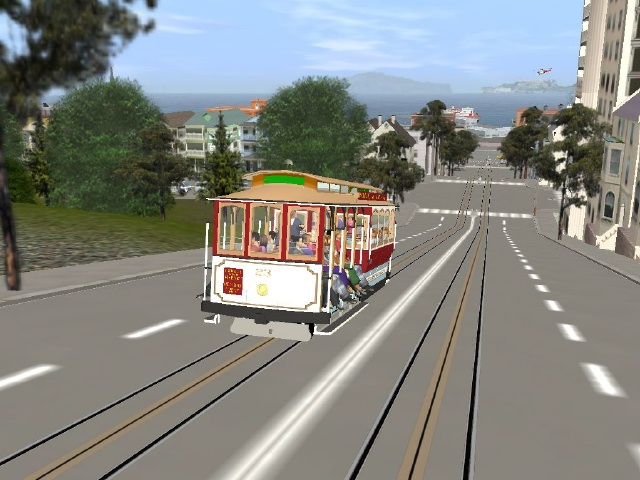
Norm Phythian, working from Australia, has created a Trainz simulation, referred to as a map, representing San Francisco's cable car lines. Sel Churchward has created representations the tracks and of cable cars to run on the lines. They both do nice work.
You can learn more on the Trainz discussion forum:
http://forums.auran.com/trainz/index.php
(search for "cable car")
You can see screen captures from the cable car lines and many other interesting-looking
simulations on Norm's website:
http://members.optusnet.com.au/norm_phythian
|
| A screen capture looking down Hyde Street from Norm Pythian's map. Car 23 by Sel Churchward. All rights reserved. |

|
| Sel Churchward produced this version of Cal Cable 57. All rights reserved. |
Thank you to Norm for the following comments on Trainz vocabulary and the features of different versions of the software:
Go to top of page.
Garden Scale Cable Cars
I have seen some nice Garden Scale cable cars, but I don't know who made them.

|
Powell Street cable car 26 runs by the airport on the Bay Area Garden Railways Association's G-gauge layout at Ardenwood Farm. September, 2006. |
On Labor Day Weekend every year, the Society for the Preservation of Carter Railroad Resources holds the Washington Township Railroad Fair at Ardenwood Historic Farm, just across the Dumbarton Bridge in Fremont. The Bay Area Garden Railways Association always brings a nice layout. Read more about it on my Park Trains and Tourist Trains site.

|
Cable car 23 on the garden-scale layout. Note the sign advertising the 22nd Annual National Garden Railway Convention. September, 2007. |

|
A static diorama at the 2011 Garden Scale layout has a California Street cable car on a hill next to some nice Victorians made from cereal boxes. September, 2011. |

|
Powell/Hyde cable car 3, part of the Golden Gate Express Railway layout, runs down the Hyde Street Hill between Lombard Street and a row of Victorian houses. Coit Tower looms above. January, 2010. |
The Bay Area Garden Railway Society has taken over the special exhibit room in the Conservatory of Flowers in Golden Gate Park to set up the Golden Gate Express Railway, a garden scale layout with famous San Francisco structures made from recycled materials. In 2010, it featured a cable car running down the Hyde Street Hill. Unfortunately, it climbed the hill backwards. I couldn't bring myself to take a picture of that. Read more about it on my Park Trains and Tourist Trains site.

|
Powell/Hyde cable car 3 waits at the end of the line after a downhill run. January, 2010. |
| A video combines several scenes of the operation, including the cable car. January, 2010. (Adobe Flash is required. Some browsers will require two clicks to start the video.) |

|
Powell/Hyde cable car 3 lays over at the end of its run. The freight train speeds by on a trestle in the background. January, 2010. |
Go to top of page.
1948 Tournament of Roses Parade

|
A 3/4 scale cable car decorated the City and County of San Francisco's entry in the 1948 Tournament of Roses Parade, along with bathing beauties in Gay 90s costumes. Frankly, the ladies in the photo appear to be in 1940s clothing. (Source: San Francisco Examiner, 02-January-1948). |
The Tournament of Roses Parade has been held in Pasadena, generally on New Year's Day, since 1890. In 1948, the City and County of San Francisco was represented by a float carrying a 3/4 scale cable car, numbered 1948. "Girls clad in Gay 90s costume rode the ca, and at one end of the float was a realistic reproduction of the Market street turntable (Source: Los Angeles Citizen-News, 01-January-1948)."
On the night before the parade, "In one tent stood San Francisco's fascinating "Cable Car," with 50,000 blooms of desert holly, chrysanthemums and seven other floral charms of California origin. Directing the three-ton venture was a bundle of nerves named Pete Matrala. From La Canada came Nancy Northrup and from San Franciso came Lois Bricker to help (Source: San Mateo Times, 01-January-1948)."

|
Another view of flowered cable car 1948. (Source: Long Beach Press-Telegram, 01-January-1948). |
San Francisco's entry won the Sweepstakes Award for the most beautifully decorated float.
Go to top of page.
Return to San Francisco Miscellany.
Go to top of page.