- Saint Louis Companies
- Saint Louis Miscellany
- Western Cable Railway
- The Volk Cable Grip and Carriage and Other Appliances (The Street Railway Journal, December, 1889)
- The City of St. Louis (New England Magazine, January, 1890)
- New St. Louis (New England Magazine, September, 1893)
- from Rippey's Index Map and Business Guide of St. Louis, Mo., Joseph Rippey, 1888
- from The Street Railway System of Saint Louis (The Street Railway Journal, June, 1895)
- The St. Louis Railroad Co.'s Cable Plant (The Street Railway Journal, June, 1891)
- The Delmar Loop Trolley
Saint Louis Cable and Western Railway

|
The original cable driving equipment of the Saint Louis Cable and Western Railway, offered in the Street Railway Journal. February, 1889. |
line: main
opened: 15-April-1886. North Sixth Street and Locust Street on Locust to North 13th Street. North 13th Street to Lucas Avenue. Lucas Avenue to North 14th Street. North 13th Street to Wash (now Cole) Street. Wash Street to Franklin Avenue. Franklin Avenue to Morgan (now Enright) Avenue. Morgan Avenue to just past North Vandeventer Avenue.
powerhouse: Franklin Avenue and Channing Avenue
grip: Snelson and Judge double-jaw side, converted to Root single-jaw side
gauge: 4' 10"
cars: open grip and trailer trains, double-ended (?), Brownell and Wight
Terminals: crossovers (?)
crossings:
| Intersection | Company | Status |
|---|---|---|
| 14th/Morgan (now Delmar) | CRC | superior |
| 14th/Franklin | CRC | superior |
| Easton/Washington | CRC | superior |
| Franklin/Garrison | CRC | superior |

|
| A group of investors incorporated the Saint Louis Cable and Western Railway on 12-September-1884. "Colonel Fred Colburn's Dream of Rapid Transit About to Be Realized." (source: Decater Daily Republican, 13-September-1884.) |
notes: The Saint Louis Cable and Western Railway took over the West End Narrow Gauge Railroad, a steam-powered suburban line to Florissant (Western) and connected it to the central business district with a cable traction line (Cable). The cable line was poorly designed because most of the streets between the suburban line's terminal and the central business district were already occupied by horse car lines. The Cable and Western had to operate on various streets which required a high level of curvature, and it tried to operate the whole line with a single cable. The company was plagued with cable problems including short life, extreme stretching and unstranding.

|
| "Beginning the Work in Earnest" on the Saint Louis Cable and Western Railway. (source: Indianapolis Journal, 02-February-1885.) |
|

|
| "A Smart Missouri Dog" at work on one of the railway's steam locomotives. "In his zeal to be up and doing, he will sometimes catch the whistle rope in his teeth and make the signal for the crossings." I lost count of the number of newspapers that reprinted this item. (source: Witchita Beacon, 22-February-1885.) |
|
The riveted iron conduit was susceptible to slot closure when the ground froze during winter.
|
The cable of over 34,000 feet was unusually long.
In 1889, the company built a new powerhouse next to the original one. The new powerhouse was set up to issue two cables, which was more in line with industry practice.

|
The Saint Louis Cable and Western Railway helped sell real estate in new neighborhoods like Chamberlain Park. (source: Saint Louis Post-Dispatch, 01-October-1887.) |

|
A detail from the image above. (source: Saint Louis Post-Dispatch, 01-October-1887.) January, 2025 Picture of the Month. |
The new cable line was popular with riders, who moved over from parallel horse car lines. Unfortunately for the Saint Louis Cable and Western, the parallel horse car lines soon converted to cable technology on their routes, which were more direct. Passengers soon moved back to those lines.
The company went bankrupt in 1889 and in 1890 reorganized as the Saint Louis and Suburban Railway. This company converted the steam line to electric traction and then the cable line, which stopped running on 27-October-1891.
According to cable car historian George W Hilton, there are no known photographs of the Saint Louis Cable and Western Railway. If anyone knows of one, I'd be happy to hear about it.

|
| The Saint Louis Cable and Western Railway suffered a severe blow when a newly installed cable damaged one of the driving drums. (source: Saint Louis Post-Dispatch, 01-October-1887.) |
|
|
From St. Louis, the Fourth City, 1764-1909,
by Walter Barlow Stevens, 1911.
St. Louis companies went into cable railroad construction with courage and energy worthy of better results. The St. Louis, Cable and Western, as it was called, began operation in 1886. Within five years it had fallen into such uncertain ways that advantage was taken of the permit to turn it into an electric road. The franchise obtained by the Indianapolis company granted the right to build from Sixth and Locust to Vandeventer. The power house was located on Franklin and Channing. Beyond Vandeventer, connection was made with the former narrow gauge steam railroad built by Erastus Wells to Florissant. For two or three years the cable road did a great deal of summer business. Kensington Garden was established at Union avenue. Spectacular and pyrotechnic exhibitions were given. The pleasure travel was enormous during two or three summers. From the patrons of the horse cars arose importunate demand for rapid transit. Although the first cable road proved anything but reliable, other companies, in 1887 and 1888, let contracts for cabling their lines. About the time the Locust street cable began to show signs of wearing out, the other cable lines were starting. The Franklin avenue cable was built from Fourth street to King’s Highway and from Easton avenue to the Fair Grounds. Cable cars began running in November, 1887. The operation was so irregular and unsatisfactory that in January following the horse cars were put back into service. During the winter and well into the spring the overhauling of the Easton avenue line went on. Not until May were the cable cars tried again. |

|
| An 1887 train schedule. (source: Saint Louis Post-Dispatch, 05-January-1887.) |

|
This want ad offers "a nice block of well-located building lots" near the line of the Saint Louis Cable and Western Railway. (source: Saint Louis Post-Dispatch, 01-October-1887.) |
Go to top of page.
Citizens Railway
line: main
opened: 23-November-1887. North Fourth Street and Franklin Street (now Dr Martin Luther King Drive) on Franklin to Easton Avenue (now Dr Martin Luther King Drive). Easton to Prairie Avenue at powerhouse. Return on Garrison Street to Morgan Street to Fourth
extended: 23-May-1888. From Easton Avenue and Prairie Avenue on Easton to North King's Highway Boulevard. King's Highway to Wells Avenue (?)
branch: 26-May-1888. From Easton Avenue and Grand Boulevard on Grand to Natural Bridge Avenue at the Fairgrounds
powerhouse: Easton Avenue and Prairie Avenue
grip: Eppelsheimer bottom grip, converted to Volk bottom grip, 1889
gauge: 4' 10"
cars: open grip and trailer trains, double-ended (?), Brownell and Wight
Terminals: crossovers (?)
crossings:
| Intersection | Company | Status |
|---|---|---|
| Washington/Broadway | STLRR | superior |
| Morgan/Broadway | STLRR | superior |
| 14th/Morgan (now Delmar) | STLCW | inferior |
| 14th/Franklin | STLCW | inferior |
| Easton/Washington | STLCW | inferior |
| Franklin/Garrison | STLCW | inferior |
notes: The Citizens' Railway built its first horse car line in 1859. When the Saint Louis Cable and Western Railway opened its parallel cable traction line in 1886, the Citizens' Railway lost business.
In 1887, the Citizens' Railway began converting to cable traction. The conduit was poorly designed, so it frequently got clogged and by January, the slot was getting squeezed shut by the surrounding frozen ground. 1888 was a very bad winter. On 22-january-1888, the company suspended cable operation and started running horse cars again. The company made changes to the conduit and restored cable operation on 17-April-1888.
The Grand Avenue branch served the fairgrounds and Sportsman's Park, home of the American Association (then a major league) Saint Louis Brown Stockings. Both places generated good weekend and non-rush hour traffic. Sportsman's Park was at Grand Avenue and Dodier Street.

|
Jacob Volk's bottom grip. (Source: "The Volk Cable Grip and Carriage and Other Appliances", The Street Railway Journal, December, 1889.) February, 2015 Picture of the Month. |
The company initially used the Eppelsheimer bottom grip created for San Francisco's Geary Street Park and Ocean Railway and still used by the surviving lines of the Municipal Railway. Difficulties with crossings, especially the one at 14th and Franklin, caused the company operational problems.
Master mechanic Jacob Volk developed a bottom grip and an automatic cable lifter for crossings.
In 1888, C B Holmes, promoter of the Chicago City Railway, took over the Citizens Railway. Holmes merged it with the Saint Louis Railroad and others to form the National Railway Company.

|
This item mentions the main line of the Citizens Railway being converted from cable to electric traction. (source: Saint Charles Cosmos-Moitor, 05-December-1894.) |
The Grand Avenue branch was converted to electric traction in 1893. One source said the main cable was stopped on 26-December-1894, but the newspaper item above contradicts that.
|
|

|
This real estate ad offers lots for auction in Rappahannock Heights. "Only 3 Blocks to the Grand Avenue Cable Railroad." (source: Saint Louis Globe-Democrat, 30-April-1893.) February 2025 Picture of the Month. |

|
This want ad offers 3636 Evans Avenue, a 7-room house with a grape arbor. It was within "half block of (the) Citizens' cable line. (source: Saint Louis Globe-Democrat, 15-September-1889.) |

|
This want ad offers three arpents (an archaic French unit of measurement) of land with several substantial buildings, for only $15,000. $15,000 was a good chunk of money in 1890. The property was only two blocks from the Citizens' cable line. (source: Saint Louis Globe-Democrat, 30-March-1890.) |
Go to top of page.
Missouri Railroad

|
A typical three-car train of the Missouri Railroad. The open grip car is on the left. It is towing two enclosed trailers. (Source: "The Street Railway System of Saint Louis", The Street Railway Journal, June, 1895.) March, 2015 Picture of the Month. |
line: main
opened: 31-March-1888. North Fourth Street and Olive Street on Olive to North Sarah Street.
extended: 01-June-1889. From Olive Street and North Sarah Street on Olive to North Boyle Avenue. Boyle to Maryland Avenue. Maryland to North King's Highway Boulevard near Forest Park. King's Highway to Wells Avenue (?)
powerhouse: Olive Street and Channing Avenue (now Josephine Baker Boulevard)
grip: Root single-jaw side grip, converted to Jonson double-jaw side grip, 1896
gauge: 4' 10"
cars: open grip and trailer trains, double-ended (?). Often two single-truck trailers. Later used single double-truck trailers.
Terminals: crossovers (?)
crossings:
| Intersection | Company | Status |
|---|---|---|
| Olive/Broadway | STLRR | superior |
notes: The Missouri Railroad ran a horse car line on Olive Street, a long, straight street with lots of potential for generating traffic. The company converted it to cable traction and had a great success. When it was extended to Forest Park, it did even better.
Unlike most companies in the industry, it usually ran three-car trains, with one grip car and two single-truck trailers. In 1896, it replaced all of its equipment with closed grip cars and double-truck trailers, so the line could run with two-car trains. At the same time, the company switched to the Jonson grip used by Manhattan's Third Avenue Railroad. This may have been an attempt to make smoother starts with the company's heavy equipment.
|
From The Great Cyclone at St. Louis and East St. Louis, May 27, 1896,
compiled and edited by Juiian Curzon, 1896.
The Olive street line was stopped by a perfect network of wires at Nineteenth street, which stretched across the entire open space at the corners. Owing to the prompt action of an employe in running to the City Hall for assistance the wires were cut away and the Olive street line resumed operation in about 20 minutes. (Page 117) The Olive street line, when it resumed operations after its 20-minute stop, was so crowded with humanity that movement within the cars was an impossibility. People got on cars as far west as Twelfth street in order to obtain standing room even when the car returned on its west-bound trip. The Olive street line did a tremendous business. The electric lines operated by the same company, on the other hand, fared badly. The power house from which they were operated was partically demolished and it was several days before traffic on them was resumed. (Page 122) From the West End residence portion of the town they came by the Lindell on all of its branches, the Suburban and the Olive street cable, invading thence the section laid waste though every street affording progress. (Page 268) The Olive street cable line was the only dependence for those who live in western part of the city. (Page 411) |
In 1897, the Lindell Railway, a company that used electric traction, took over the Missouri Railroad. Both companies were merged into the United Railways in 1899. The Olive Street cable was stopped on 14-March-1901.

|
A two-car train of the Missouri Railroad with one of the double truck trailers. (Source: "The Street Railway System of Saint Louis", The Street Railway Journal, June, 1895.) March, 2015 Picture of the Month. |

|
(source: Saint Louis Globe-Democrat, 09-November-1952.) |

|
Many cities that once had cable traction have found relics under the street, like this yoke from the Missouri Railroad's Olive Street line which turned up in 1952. (source: Saint Louis Post-Dispatch, 14-May-1952.) |
|

|
This real estate ad offers a space for a store and residential flats at "4068 Olive St. Terminus Olive St. Cable." The Missouri Railroad's Olive Street line started operating the month before. Note that Heath and Company's telephone number is 417. (source: Saint Louis Post-Dispatch, 08-April-1888.) March, 2025 Picture of the Month. |
Go to top of page.
Peoples' Railway
|
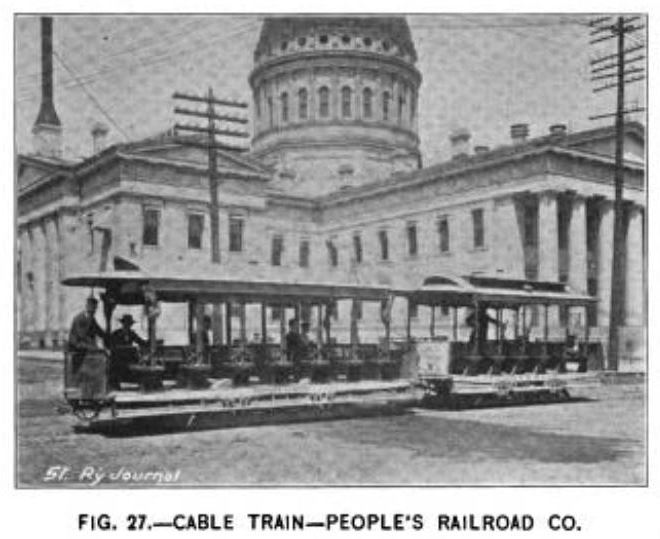
A train of the Peoples' Railway (Source: "The Street Railway System of Saint Louis", The Street Railway Journal, June, 1895.) May, 2015 Picture of the Month. |
line: main
opened: 31-March-1888. Morgan Street and North Fourth Street on North Fourth to Choteau Avenue. Choteau Avenue to South 18th Street. South 18th to Park Avenue. Park Avenue to Mississippi Avenue. Mississippi Avenue to Lafayette Avenue. Lafayette to South Grand Boulevard. South Grand to Halliday Avenue at Tower Grove Park. Return Park Avenue to Saint Ange Avenue to Choteau.
powerhouse: Park Avenue and South 18th Street.
grip: Root single-jaw side grip
gauge: 4' 10"
cars: open or closed grip and trailer trains, double-ended (?). Built by John Stephenson.
Terminals: crossovers (?)
crossings:
| Intersection | Company | Status |
|---|---|---|
| Choteau/Broadway | STLRR | superior |
notes: The Peoples' Railway began operation as a horse car line in 1859. The company converted to cable operation on 10-April-1890. The line had too much curvature, which put a lot of wear on the cables.

|
The Peoples' Railway powerhouse after the cyclone. (Source: The Great Cyclone at St. Louis and East St. Louis, May 27, 1896,
compiled and edited by Juiian Curzon, 1896)
The Saint Louis area was struck by a powerful tornado on 16-May-2025. Five people died. This likes a good time use the photo for Picture of the Month. June, 2025 Picture of the Month. |
On 27-May-1896, a tornado tore the roof off of the powerhouse. The company was able to run by cable the next day.
|
From The Great Cyclone at St. Louis and East St. Louis, May 27, 1896,
compiled and edited by Juiian Curzon, 1896.
The power house of the Peoples' Cable railway was also badly wrecked. Hundreds of cars were injured and several destroyed. The machinery escaped, but the entire second floor was wrecked, and when operations were resumed, the immense wheels revolved in mid air. (Page 117) The Fourth street cable was stopped by an immense number of telegraph poles which were blown down on Choteau avenue from Fourth street west. The poles were piled across the car tracks in all directions. The cable was shut off until they could be cleared away. (page 182) Probably the most remarkable case in point is the destruction of the power house of the Peoples' Railroad, (Fourth street cable), at 1801 Park avenue, alreay referred to. It was a massive structure, only three stories in its tallest part, and built of pressed brick and stone. The walls ranged from 20 to 30 inches in thickness, yet they were crushed as though they were built of paper. The entire top story of the main office building was thrown into the street, and the engine room was unroofed and wrecked. The damage was $100,000, to say nothing of the loss that accrued from the suspension of traffic on the road. When the roof was lifted off great stones and a perfect storm of massive timbers were rained down into the engine room. The big steam pipe leading to the engine on the west side was broken and every car on the road stoppped almost instantly. The roar of escaping steam added to the confusion and for a tie it was thought everybody in the place would be killed. The engineer, D. G. McCarron, was in the engine room and had a narrow escape from death. The car sheds on the block to the south were unroofed and partially demolished, and a number of cars smashed into kindling wood. Manager Mahoney put a force of 100 men, mostly employees of the raod, to work cleaning away the debris and getting in shape to rebuild the power house. (Page 129) The only thing that broke the stillness of the night was the whirr of the machinery in the wreck of the cable power-house as it ran in the open air. (Page 277) One of the strangest sights witnessed in Saint Louis as the result of the tornado's depredation was the power house of the Peoples' Cable railway at the corner of Eighteenth and Park avenue. The magnificent building was completely dismanted and the exprense machinery of the cable road was exposed to the elements. It was a strange sight to see a big plant like that running while the building inclosing it was in ruins. Thousands and thousands of people went to the place on cars, in carriages and on foot, attracted by the novelty of the sight. Operating, as it was, under the most adverse conditions that could be imagined, it is safe to say that never in the history of the road has it carried as many passengers as it did when it resumed running. The threatening aspecy of the dull, murky clouds that hung overhead did not deter the crowds from flocking to the devastated disctrict, and even when the rain began to pour down there was no perceptible dimunition in the vast throng that crowded every foot of the ruins. At the corner of Eighteenth and Park avenue especially, the sight of the cable plant running almost in th street, with its stacks down and without even a roof over it, wa so unusual and evidence of the irresistable force of the elements so plainly demonstrated that the sighseers seemed dazed, and the combined efforts of a dozen policemen were necessary to prevent them from standing on the tracks where the trains were sailing around the curve at a dangerous rate of speed every half minute. Any number of people were brushed from the side of the tracks by cars moving either way, but those who took their places paid no attention to it. (Page 302-303) Very embarrassing was the plight of three ladies who were on an open car of the Fourth street cable when the storm came up. For want of a better refuge, they remained where they were. But when the unprincipled wind began to take unwarranted liberties they braved it and sought cover. The wind got into their big sleeves and blew out their skirts like balloons, until seams began to rip ominourly and present section of garments were carried bodily away. It got to a point when to remain longer meant that they would be unclothed entirely, and they escaped while there was yet time. But in those awful few minutes even Peeping Toms had something else to indulge their prying propensiies, and the ladies had no cause to blush. (Page 367) Two young women who were on a Fourth street cable car at the time of the storm were entirely denuded. They left the car stark naked and were cared for in a house near by. (Page 398) |
In 1897 the company went bankrupt. The cable ran until 14-February, 1901, the last to run in Saint Louis.

|
from the New York Tribune, 27-October-1889. No thumbnail. |
|
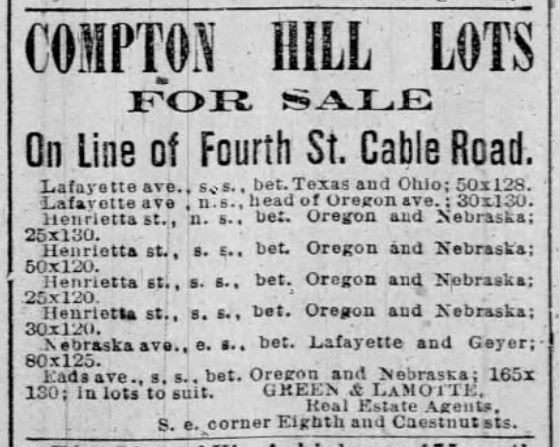
This real estate ad offers Compton Hill Lots, "On Line of Fourth St. Cable Road." (source: Saint Louis Post-Dispatch, 08-April-1888.) |

|
This real estate ad promotes an open house for an "Elegant Tyler Place Home." Prospective buyers could "Take Fourth street cable." (source: Saint Louis Post-Dispatch, 08-April-1888.) May, 2025 Picture of the Month. |
Go to top of page.
Saint Louis Railroad

|
A train of the Saint Louis Railroad's Broadway line, after the company was taken over by the National Railway Company. (Source: "The Street Railway System of Saint Louis", The Street Railway Journal, June, 1895.) June, 2015 Picture of the Month. |
line: Broadway
opened: 25-December-1890. Gano Avenue and North Broadway on North Broadway to Salisbury Street.
extended: 19-January-1891. Salisbury Street and North Broadway on North Broadway to South Broadway. South Broadway to Keokuk Street.
powerhouse: Salisbury Street and Broadway.
powerhouse: Lami Street and Broadway.
grip: Eppelsheimer bottom grip
gauge: 4' 10"
cars: open or closed grip and trailer trains, double-ended (?). Brownell and Wight.
Terminals: crossovers (?)
crossings:
| Intersection | Company | Status |
|---|---|---|
| Washington/Broadway | CRY | inferior |
| Morgan/Broadway | CRY | inferior |
| Olive/Broadway | MRR | inferior |
| Choteau/Broadway | STLRR | inferior |
| Potomac/Broadway | WCRY | inferior |
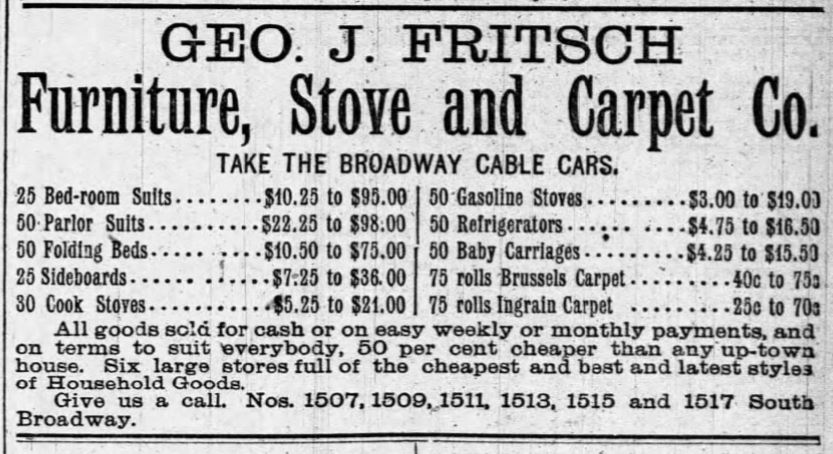
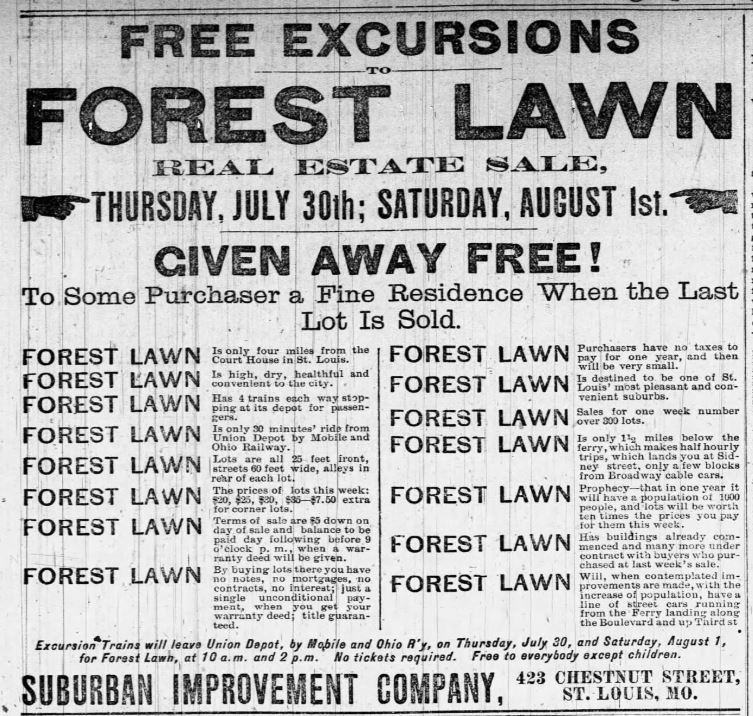
notes: The Saint Louis Railroad was the only north-south cable line in Saint Louis. It ran along Broadway, at the top of the bluffs along the river. The company tested Sidney Short's electric system, but could not get permission from the city to put up the double overhead wires used by the Short system.

|
Short Series System of Electric Railway. (Source: "The Short Series System of Electric Traction", The Street Railway Journal, May, 1888.) |
|
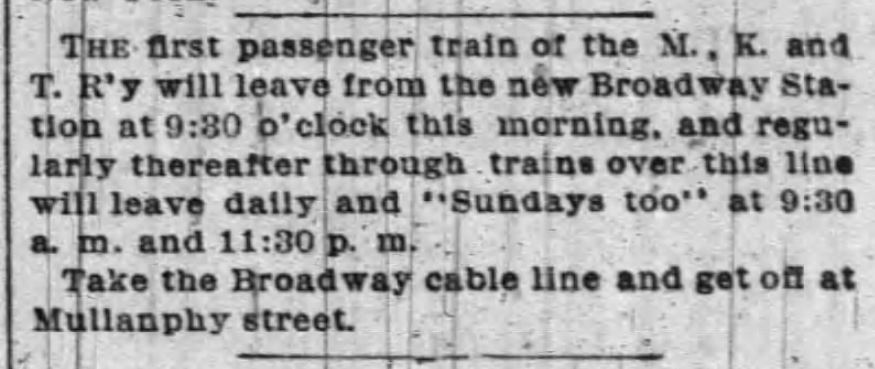
The line connected with the Missouri-Kansas-Texas (Katy) Railroad's Broadway station.
Because the line ran counter to all the other companies, the builders, Wright, Meyersburg, chose to use the Eppelsheimer bottom grip, the one that is still used on today's cable cars in San Francisco. It is easier to drop and pick up the cable at crossing with a bottom grip than with a side grip.
One unusual crossing involved a freight-hauling cable-operated line, the Western Cable Railway.
"The style of grip used is of the bottom pattern and was manufactured by the McMurray-Judge Architectural Iron Co. of St. Louis. There are at present on hand 100 grips, two for each grip car. This type is used because it is necessary to drop the rope so many times. The gripman has to drop the rope fourteen times on one round trip, twice at five cable road crossings, including Lemp's brewery-cable road crossing, and twice at each of the two power houses." (Source: "The St. Louis Railroad Co.'s Cable Plant", The Street Railway Journal, June, 1891.)
In 1888, C B Holmes, promoter of the Chicago City Railway, took over the Saint Louis Railroad and incorporated it and the Citizens Railway into the National Railway company.
|
On 08-October-1900, the Broadway line was converted to electric traction.

|
A train of the Saint Louis Railroad on Broadway in 1888. (source: Saint Louis Globe-Democrat, 08-January-1956.) |

|
A powerplant of the Saint Louis Railroad's Broadway line. (Source: "The St. Louis Railroad Co.'s Cable Plant", The Street Railway Journal, June, 1891.) |
|
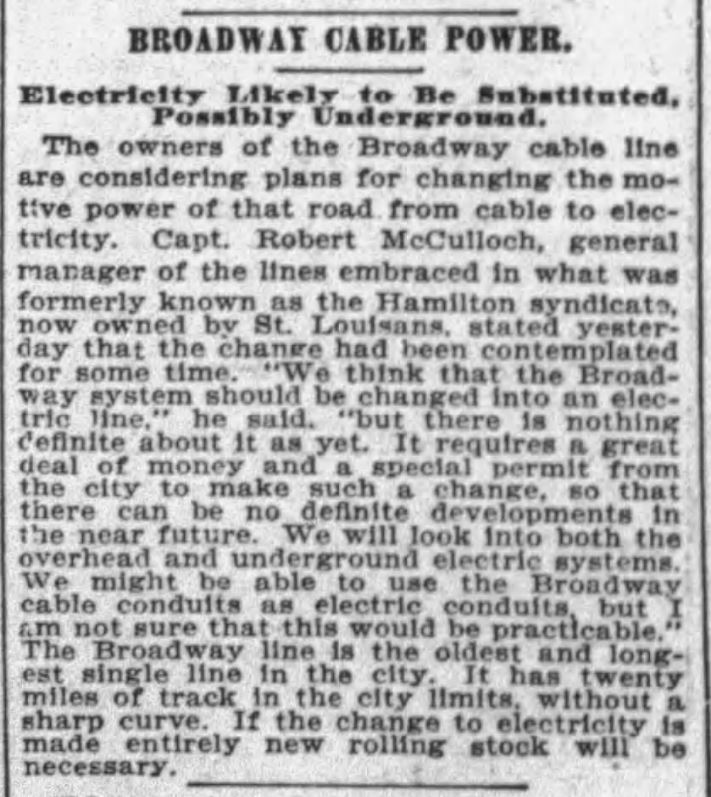
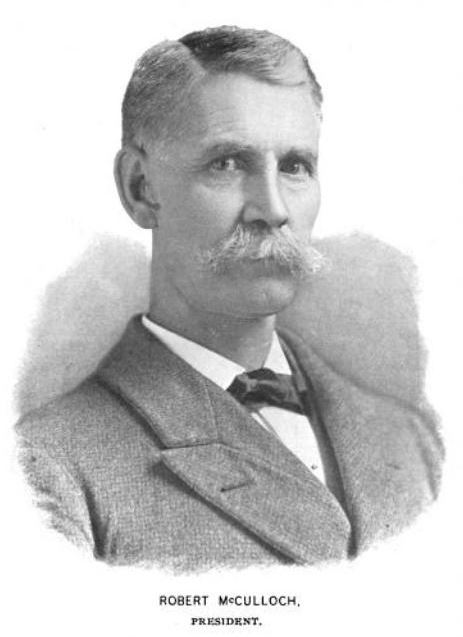
Captain Robert McCulloch was general manager of the Citizens' Railway and the Saint Louis Railroad. From the October, 1897 Street Railway Journal |
|
From St. Louis, the Fourth City, 1764-1909,
by Walter Barlow Stevens, 1911.
The cabling of the St. Louis railroad or Broadway line made a record. At that time the Broadway cable was the longest which had been constructed. It occupied what was then the busiest street in the city. It was seven and one half miles of double track. Extraordinary difiiculties were overcome. From one end of the line to the other it was necessary to move gas pipe and water pipe. At Washington avenue the crown of the railroad tunnel was so near the surface that the cable conduit could not be given the full depth it really required for normal operation. The Broadway cable crossed every other cable but one. This meant frequent "let gos." In spite of the unusual difficulties the Broadway cable, with two power houses and the longest cable road in the country, went into operation in 1891. |
|
From The Great Cyclone at St. Louis and East St. Louis, May 27, 1896,
compiled and edited by Juiian Curzon, 1896.
The Broadway cable ran successfully through the storm for about five or ten minutes when the destruction of buildings on South Broadway effectually barred the street. The cable continued to run along all right, but the cars were stopped by the vast amount of debris and timbers thrown along the tracks. (Page 117-118) At Broadway and Carr street the roof of a three-story brick buildding containing stores and flats blew off, a large section of the roof striking grip car No. 4 of the Broadway cable. The car was wrecked, the passengers escaping with slight injuries. (page 182) From both ends of the city the Broadway cable hauled people by the 200 and 300 to the train, with three-car trains running in either direction every minute in the day from early morning till long after dark. (page 268) |
|
|
Go to top of page.
Western Cable Railway

|
Read more about the Western Cable Railway: An Inclined Cable Railway for Transferring Freight Cars Between the Upper and Lower Yards of the Western Cable Railway Co., St. Louis, MO. By Edw. Flad, Member, Engineers' Club Of St. Louis. . (Image Source: Rippey's Index Map and Business Guide of St. Louis, Mo., Joseph Rippey, 1888) |
The Lemp Brewery was founded in 1840 by Johann Adam Lemp. His son William Lemp took over in 1862 and built the brewery complex which still stands today on what is now Lemp Avenue. The brewery is on top of the bluff along the river, and underneath it is a series of tunnels, which provided natural cooling to the beer. At the bottom of the bluff, along the river, ran the tracks of the Saint Louis, Iron Mountain and Southern Railway, which was later taken over by the Missouri Pacific.

|
The grip car of the Western Cable Railway (source An Inclined Cable Railway for Transferring Freight Cars Between the Upper and Lower Yards of the Western Cable Railway Co., St. Louis, MO. By Edw. Flag, Member, Engineers' Club Of St. Louis.). July, 2025 Picture of the Month. |
The brewery wanted to ship its product in refrigerated cars on the railroad, but it was difficult to carry it 95 feet down to the tracks in wagons. "Formerly all freight, whether supplies for the brewery or beer shipped therefrom, was loaded and unloaded in the lower yard established next to the Iron Mountain tracks, being transferred by means of wagons between the yard and the brewery. The expense, delay, and annoyance incident to the hauling, up and down so steep a grade, of the large amount of freight, which required from thirty-five to forty two-horse wagons, rendered it desirable to adopt some other method, and finally led to the construction of a cable road by means of which the regular freight cars are transferred between the lower yard and an upper yard which was established on a level with the brewery buildings." ("An Inclined Cable Railway for Transferring Freight Cars Between the Upper and Lower Yards of the Western Cable Railway Co...")
In 1891, the Western Cable Railway began hauling freight cars up and down the hill. A stationary steam engine in the brewery complex paid out and pulled in a finite cable. One end of the cable was attached to what is referred to as a grip car, even though it did not have a grip. At the bottom, switching locomotives would spot empty freight cars on the uphill end of the grip car. When the little train was ready, the conductor on the grip car would send a signal to the steam engine operator, who would reel in the cable, pulling the grip car and its companions up the hill. When the cars were loaded, the operator would pay out the cable and the grip car and the freight cars would run down the hill by gravity.
An elaborate slot brake would stop the train if the cable broke.
The Western Cable Railway crossed the Broadway line of the Saint Louis Railroad. The Broadway cars had to drop their cable and coast across.
When Prohibition and the Volstead Act took effect on 01-January-1920, the brewery and the railroad went out of business.
|
From Report of the Proceedings of the Annual Convention of the Master-Car Builders' Association, Volume 40, 1906.
Louisville & Nashville Railroad Company versus The Missouri Pacific Railway Company. Car Destroyed On Private Track. Louisville & Nashville Railroad Company's box car 11830 was totally destroyed by fire in the yard of the Medart Patent Pulley Company, St. Louis, Mo., May 4, 1902. The Missouri Pacific Railway Company notified the L. & N. R. R. Co. of the destruction of the car, but advised that the car was delivered to the Medart Patent Pulley Company by the Western Cable Railway Company, and that if bill was presented to the Western Cable Railway Company the same would be accepted. The L. & N. R. R. Co. replied that it did not consider such procedure in accordance with Master Car Builders' Rules, but, at the request of the Missouri Pacific Railway Company, bill was rendered against the Western Cable Railway Company, which made no response either in the way of payment or declining the bill. The L. & N. R. R. Co. then rendered bill to the M. P. Ry. Co., which is declined, and the M. P. Ry. Co. made statement with regard to the same as follows: "In receiving this car from the Wiggins Ferry Company and switching it to a connection with the Western Cable Railway Company, the Missouri Pacific Railway made merely a switching movement, and to that extent acted as the agent of Louisville & Nashville Railroad in moving the car on M. P. Ry. rails as far as they extended in the direction of making the delivery to the final destination contracted for by L. & N. R. R. Co. with the consignees. "The M. P. Ry. Co. had no voice in the origin of this freight, in the rate paid for its transportation from point of origin to destination or power to influence its movement beyond the service that the M. P. Ry. Co. performed of switching it from the Wiggins Ferry Co. to the Western Cable Railway Co.'s connection. "If the L & N. R. R. Co. contracted to deliver the freight to a concern located beyond the rails of a common carrier of freight, the L. & N. R. R. Co. assumes the responsibility beyond the line traveled by the common carrier, and the M. P. Ry. Co. is no more concerned in the transportation than the Wiggins Ferry Co., which forms a part of the switching line of communication, after the car had reached its terminus at St. Louis, and its further progress became entirely a switching movement, and the M. P. Ry. Co. were therefore only one of the agencies in the chain, namely, the Wiggins Ferry Co., M. P. Ry. Co. and the Western Cable Ry. Co. "Switching cars for another railway is a matter for their convenience. The situation of this industry at St. Louis was as well known to the L. & N. R. R. Co. as it was to the M. P. Ry. Co.. as the L. & N. R. R. Co. is practically a St. Louis road and its organization is supposed to be familiar with all of the locations and conditions to be met in handling business within the city and its adjacent manufacturing districts. "The M. P. Ry. Co. did not deliver this car to a private track. On the contrary, the M. P.. Ry. Co. delivered the car to the Western Cable Ry. Co., an independent connecting railroad, which, in turn, delivered it to the Medart Patent Pulley Co.'s tracks. "Owing to these conditions, and as stated in first paragraph, the M. P. Ry. Co. can not consistently entertain the account in question." The L & N. R. R. Co. make statement regarding the same as follows: "The Western Cable Railway Co. is nothing more than a private track operated by the Lemp Brewing Company for the purpose of handling cars between their brewery and the M. P. Ry., a distance of four blocks and up a very steep incline. This railway is operated by a cable on a drum located in the Lemp Brewing Co.'s plant. The cars are hauled up this incline by the cable and allowed to drop back by gravity, and in doing so pull the cable to the foot of the hill where the tracks connect with the M. P. Ry. The plant of the Medart Patent Pulley Co. is about one-half way between the Lemp Brewing Co. and the M. P. Ry. Co.'s tracks, and located adjacent to the Western Cable Railway Co. The Medart Patent Pulley Co. have arrangements with the M. P. Ry. and the Western Cable Railway Co. to handle cars between the M. P. tracks and its tracks, which are operated by this cable. The Western Cable Railway Co. is a private concern operated for the benefit of the Lemp Brewing Co., and is not a railroad in the common acceptance of the term, and from what we can learn was so styled in order to secure franchise to lay the tracks of this switch in the streets. It is the opinion of the L. & N. R. R. Co. that this case clearly comes under Master Car Builders' Rule 6, Section 4, revised September, 1001, and decision of the Arbitration Committee of the Master Car Builders' Association No. 323, which is parallel to the one in question. The claim of the M. P. Ry. is not based upon Master Car Builders, Rules, but upon the legality of the transaction of which we are not advised, and which would have no bearing on the case in so far as Master Car Builders' Rules apply. The L. & N. R. R. Co. claim that M. C. B. Rule, Section 4, was incorporated for the express purpose of avoiding such complications and to avoid railway companies dealing with private concerns, of whom they have no knowledge, and while it works out to the loss of railroad companies in some instances it is to their benefit in others and is therefore reciprocal." The same is respectfully submitted by the L. & N. R. R. Co. to the Arbitration Committee of the Master Car Builders' Association for decision as to whether or not the M. P. Ry. Co. is responsible to the L. & N. R. R. Co. under Master Car Builders' Rules for the loss of above car, the M. P. Ry. Co. stating that the matter is in the hands of its legal department, and it is not in position to act one way or the other in the submission of abstract. The information furnished shows pretty clearly that the Western Cable Railroad Company, on which L. & N. car 11830 was destroyed, is not a railroad in the common acceptance of the term. It has no engines nor cars and was not a subscriber of the M. C. B. Rules at the time the car was destroyed, it is also evident that the Missouri Pacific Railway is not a switching road, as claimed. Section 28 of Rule 5, of the Rules of 1905, defines a switching road as a corporation doing the major part of its business on a switching charge, or one that does not pay mileage for handling cars. This is a parallel case with Arbitration Case No. 323, and is clearly covered by Section 4 of Rule 6 of the M. C. B. Rules of 1901, which provides that settlement for a car owned or controlled by a railway company, damaged or destroyed on a private track, shall be assumed by the railway delivering the car on such track. The M. P. Ry. Co., having in this case delivered the car to private tracks, is responsible under the M. C. B. Rules for the destruction of the car.
|
Go to top of page.
The Volk Cable Grip and Carriage and Other Appliances
The Street Railway Journal. December, 1889
When, not many years ago, the success of cable traction as a substitute for horses on street railways was established beyond question in San Francisco, an almost limitless field for invention was thrown open, and the attention of the practical man of our street railways and inventors generall was directed towards the opportunities thus afforded. All sorts of devices have resulted, many of them of little value, as is the case in all fields of invention, but one improvement after another has been made until it would seem as though all the component parts of a cable road have been brought as near to perfection as may be practicable. Among the practical men who have devoted attention to these subjects is Mr. Jacob Volk, for eighteen years connected with the Citizens’ Railroad Co., of St. Louis, and new master mechanic of the road, which was acquired not long ago by the syndicate of which Mr. C. B. Holmes, of Chicago, is the head. The results of Mr. Volk‘s labors are a number of cable devices which are said to possess great merit, and are in part illustrated and described in the following article. The inventions, including the patent of Mr. C. J. Chapman, master mechanic of the Kansas City Cable Railway, which covers a grip-operating device and quadrant (illustrated and described in the April number of this year, page 82), are controlled by the Volk Cable Crossing, Grip & Car Brake Co., of St. Louis, of which Dr. K. Morgner, of 2800 Chouteau Avenue in that city is president, and they inform us that under a recent contract with the Citizens‘ Railroad Co. above mentioned,which have been employing the Volk grip since last June, and now have 120 in use, that company are to use all of their six patents during their entire term.
|
|
This is a type of bottom grip, and the features peculiar to it may be seen by an examination of Figs. I to VIII in the accompanying engravings, of which Fig. I is a side elevation. Fig. II, an enlarged detail elevation showing the lower end of the grip. Fig. III, an end view of the lower end of the grip, showing the guard plate in section. Fig. IV an outside view or elevation of one of the jaws with the die removed. Fig. V, a horizontal section showing also one of the jaw plates. Fig. Vi a top view of one of the dies with part of the jaw carrying the die in section. Figs. VII and VIII, vertical sections; Fig. VII showing the jaws closed, and Fig. VIII showing them open.

|
The application of the invention to a larger grip than the foregoing shown in the second set of cuts, of which Fig. IX is a similar view to Fig. II. Fig. X is an inside view of one of the jaws shown in Fig. IX, and Figs. XI and XII are vertical sections. The jaws are shown closed in Fig. XI and open in Fig. XII.
The main points aimed at have been to provide a grip occupying the least possible space in the conduit and which without injuring the cable, will firmly grasp it; yet in case of stranding, or when for any other cause it becomes necessary to let go of the cable, will instantly drop it altogether; and these points seem to be well provided for. The jaws of the grip are fitted with dies in such a manner that as they become worn they can be set out to compensate for the wear, and thus economize renewals. Each jaw, at the outer ends, is fitted with antifriction pulleys or rollers, set at such an angle and with bearing surfaces so formed that as the cable rides through the grip, when the jaws are slightly open to allow its passage, the rollers carry it, instead of its being carried by the dies; but not entirely so; the result to be achieved being that the friction is divided between dies and rollers and a saving in wear effected. Another feature is that the jaws at the top have interlocking projections, which as shown in Fig. XII are designed to prevent any possibility of the cable passing up above the jaws, and thus getting out of their grasp.

|
A perspective view and an end elevation of this device appear in the cuts herewith, an examination of which will show the distinctive features of the invention. The supporting frame for the grip is so arranged that it has both a lateral and a longitudinal movement, which enable it to work easily on curves and in starting, a spring being provided to take up the strain.

|
This invention is designed to supply a means of automatically raising the cable after it has been dropped from the grip for the purpose of crossing another cable. Its location is in the conduit at a point beyond the crossing; and the car being carried past the other cable by its momentum, its grip strikes the lever and, sliding along its surface, depresses it, thus raising the cable, which is also simultaneously raised further on by a similar lever set in an opposite position; until the cable is sufficiently raised to enter the jaws of the grip; the levers falling back to their original position as soon as the car has passed on. The operation is very clearly shown in the cuts which will be found herewith.
Go to top of page.
The City of St. Louis
The New England magazine. Volume 11, Issue 5, January 1892
The street railway system of St. Louis is well appointed and complete. The city is not compactly built, hence the roads are not only numerous but they are long. Four cable lines have 47 miles of single track where traffic is heavy; three unimportant roads have 12 miles where they still use animals; while ten lines have 161 miles of electric road. The total is 220 miles of single surface tracks, with 1000 cars in constant use. The fare is uniformly five cents. Cables run from 10 to 12 miles per hour; the electric cars with overhead wires reach at times a speed of 20 miles per hour. In contrast with these, the few remaining bob-tail cars dragged by mules seem intolerably slow. There is no record in St. Louis of an accident from an overhead railway wire.
Go to top of page.
New St. Louis
The New England magazine. Volume 15, Issue 1, September 1893
Up to the year 1885 the street-car service of St. Louis was operated by horses and mules. The usual western terminus was at Grand Avenue, three miles from the river front, and from twenty-five to thirty minutes were consumed in the trip. Now the roads have been extended several miles farther west, and the speed of the cars has been more than doubled. Electricity is the favorite motive-power, and one electric road carries passengers seventeen miles out into the country. Others reach the city limits north, south, and west, and where there is no electric road a cable road supplies its place.
Go to top of page.
from Rippey's Index Map and Business Guide of St. Louis, Mo., Joseph Rippey, 1888

|
Baden and St. Louis Railroad—From Grand avenue and Broadway to Baden. Office and stables, 8236 North Broadway.
Benton-Bellefontaine Railway—From Third and Washington avenue, via. Washtngtan avenue, Tenth and Eleventh streets, to Water Tower, thence west on Grand avenue to Florissant avenue, thence north on Florissant avenue to John avenue. Office and stables, 4238 North Twentieth.
Cass Avenue and Fair Ground Railway —Route: Broadway and Walnut, north on Seventh to Cass avenue, thence to Glasgow avenue, north to St. Louis avenue, west to Grand avenue and Fair Grounds; return by same to Eighth, south to Walnut, thence to Broadway. Office, 2900 Cass avenue ; stables, corner Cass and Glasgow avenues.
Citizens' Railroad Company—(Cable), from Fourth and Morgan to Grand avenue via. Franklin avenue. Extensions to Six-mile House, Easton avenue; on Grand avenue to Fair Grounds; also, Marcus avenue to Four-mile House, Natural Bridge road. Office and stables, Easton avenue. Three-mile House.
Forest Park, Laclede and Fourth Street Railway Company—1828 Market.
Jefferson Avenue Railway Company— Office and stables, Montgomery near Jefferson avenue.
Lindell Railway Company — (Yellow Cars),from Third and Washington avenue to Garrison avenue , north to Lucas avenue: west to Grand avenue; north on Grand avenue to Delmar avenue ; west on Delmar avenue to Vandeventer ave.; thence north on Vandeventer avenue to Finney avenue; thence east on Finney avenue to Grand avenue ; thence south on Grand avenue to Morgan; thence east on Morgan, connecting with regular tracks. (Blue Cars), 19 Compton avenue via. Fourteenth and Chouteau avenue. Office, 2207 Washington avenue.
Missouri Railroad Company — From Fourth and Market to Grand avenue; extension to Tower Grove station, Manchester road. Cable division from Fourth to Grand avenue on Olive. Office and power house, Olive near Channing ave.
Mound City Railway Company—From Pine cor. Fourth to Ntnth ; thence north to St. Louis avenue; thence west to Lindell avenue and Fair Grounds; return, from Fair Grounds, south to Lindell and and St. Louis avenue; east to Fourteenth, Lucas avenue, Twelfth, Pine to Fourth. General office and stables, 2500A St. Louis avenue.
Northern Central Railway Company— From Fourth and Locust to Fair Grounds. Office and stables, 2401 Spring avenue.
People's Line—From Fourth and Morgan to Grand avenue, by Chouteau Park, Mississippi and Lafayette avenues. Office, 1810 Park avenue.
Southern Railroad Company—Line of route, north from stables along Main, Broadway, Jefferson avenue; east on Pestalozzi, north along Ninth, east on Lafayette avenue to Eighth, north to Hickory, east to Sixth, north to Market; returning, same to Pestalozzi, south on Eighth to Arsenal; thence west to Jefferson avenue and south to stables. Office and stables, 4041 South Broadway.
St. Louis Cable and Western Railway Company—From Sixth and Locust west to Thirteenth, north to Wash, west on Wash to Easton avenue, west on Franklin avenue to Grand avenue, south to Morgan, west connecting with Narrow Gauge Railroad and running to Florissant. Office, Franklin avenue northeast cornet Charming avenue.
St. Louis Railroad Company—From Grand avenue on north to Kcokuk on south, via Broadway and Seventh, seven and a half miles. Office, 3710 N. Broadway.
Tower Grove and Lafayette Railway— From Fourth and Morgan to Anna, via Second and Third. Office, 1810 Park avenue; stables, Second and Victor.
Union Depot Railroad Company—Gravois branch (yellow cars), from Fourth corner Pine, on Ninth, Clark avenue, Twelfth; south on Park avenue to Ninth. Gravois avenue to Jefferson avenue, with extension to Tower Grove Park. Lafayette branch, same to Park avenue, thence north to Twelfth, Carroll, Linn and Lafayette avenue to I>afayette Park. General office and stables, Gravois avenue southwest corner Jefferson avenue.
Union Railway Company—From Locust and Fourth to Hyde Park and Fair Ground. Office and stables, 3629 Kossuth avenue.
Go to top of page.
The Delmar Loop Trolley

|
No thumbnail. |
Saint Louis cancelled its last electric streetcar lines on 21-May-1966. MetroLink. a light rail system, began service on 31-July-1993.
The Loop Trolley connects the Delmar Loop entertainment and shopping district to Forest Park. The line uses two modern replicas of Portland Council Crest cars and one Melbourne W-class car that used to run on Seattle's George Benson Waterfront Streetcar Line (not that George Benson). Two more W-class cars are in storage and should be put into service later.
The line was being tested in late 2017. It may require further funding to begin operations.
The Loop Trolley website: www.looptrolley.com
In December, 2019, John Meyer, president of the Loop Trolley Company, announced that the line would suspend operations on 29-December-2019. Service resumed in 2022, operated by Bi-State Development.
The line currently operates from April or May through October, on Thursday through Sunday.

|
Go to top of page.